

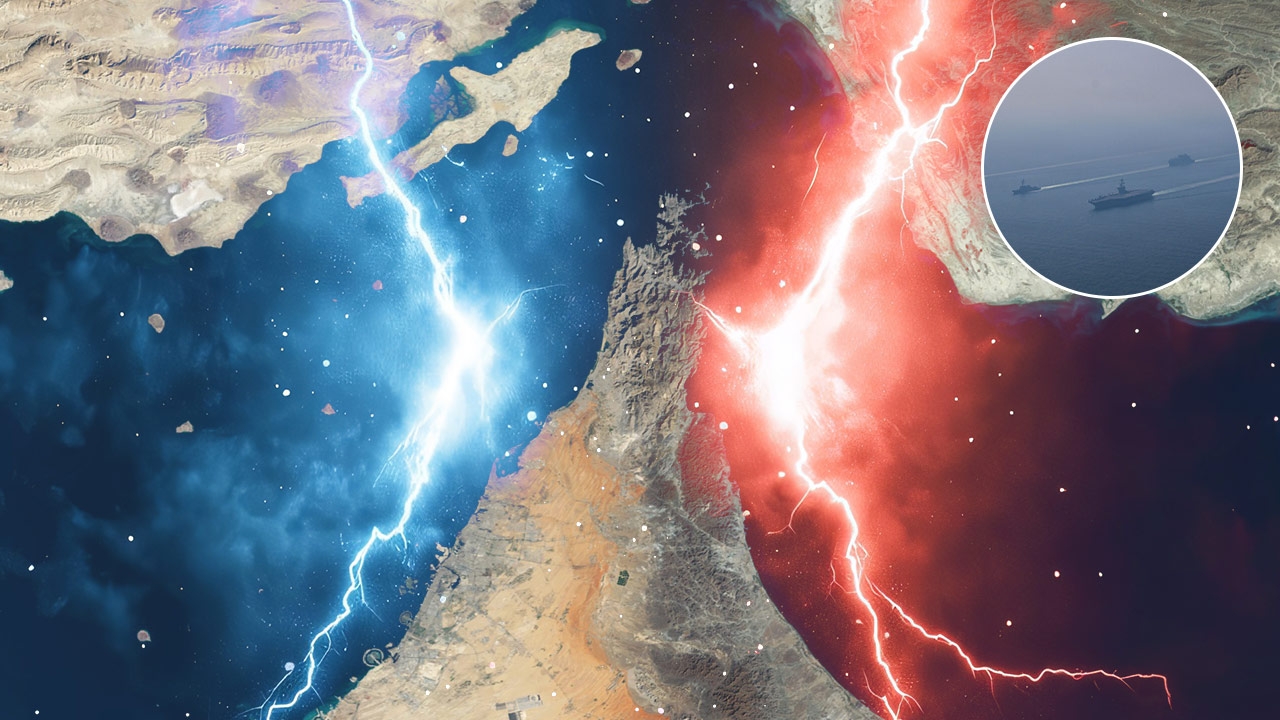
Get to know the "naval blockade" operation that the U.S. began yesterday (13 Apr), sealing off the Strait of Hormuz to pressure Iran. This is expected to impact the energy crisis again, but recent reports show some ships still passing through.
It has now begun, the naval blockade (Naval Blockade). The U.S. military has announced it will use warships to block the Strait of Hormuz, preventing Iranian vessels and ships that dock or pay transit fees to Iran from passing through. The goal is to escalate economic pressure after a conflict lasting over six weeks without resolution. The blockade started at 10:00 a.m. U.S. local time on Monday, 13 Apr (9:00 p.m. Thai time).

According to the U.S. Navy's 2022 manual on maritime operational law, a “blockade” is defined as “an operation by belligerents to prevent any vessel or aircraft of all nations, whether enemy or neutral, from entering or leaving specified ports, airports, or coastal areas controlled by the enemy state.”
A report from BBC News revealed that according to a notice from the U.S. Central Command (Centcom) sent to mariners, the blockade would “cover the entire Iranian coastline.” It is not limited to ports and oil depots and applies to all vessels regardless of nationality. It warns that unauthorized ships entering or exiting the blockaded area will be “intercepted, diverted, and seized.” Exceptions are made for humanitarian shipments such as food and medical supplies, which must be inspected and approved beforehand.
Additionally, it states that vessels of neutral countries will be granted “a grace period” to depart Iranian ports. This period ends once the blockade begins, after which any unauthorized vessel will be immediately intercepted, diverted, and seized.
Earlier, on 12 Apr, Centcom disclosed that two guided-missile destroyers, USS Frank E. Peterson and USS Michael Murphy, passed through the Strait of Hormuz as part of a mission to ensure “the strait remains free of naval mines laid by the Iranian military.”

The U.S. military has several ships stationed in and near the Middle East that could participate in this operation. USNI News reports there are at least 14 U.S. warships operating in the Persian Gulf and Arabian Sea, including the aircraft carrier USS Abraham Lincoln, and an amphibious assault group comprising over 2,500 Marines and crew.
There is also the possibility of deploying “submarines,” though such details have not been publicly disclosed, similar to “fighter aircraft” that might be involved, with their types typically kept confidential.
Other warships are either stationed nearby or reportedly being sent to the region, possibly called in to support the blockade.
USNI News reports that the aircraft carrier USS George H. W. Bush along with three destroyers is currently near Namibia, sailing around South Africa toward the Middle East.
Meanwhile, the aircraft carrier USS Gerald R. Ford and four destroyers are stationed in the eastern Mediterranean. This ship reportedly played a key role early in the U.S.-Israel-Iran conflict and recently underwent maintenance in Greece.

On 14 Apr, U.S. Vice President J.D. Vance condemned Iran’s earlier blockade of navigation in the Strait of Hormuz as economic terrorism and said that if Iran continues this tactic, the U.S. will respond in kind.
He emphasized that “the ball is very much in their court,” meaning it is now Iran’s decision to make after weekend talks in Pakistan failed to resolve the conflict.
Vance revealed that the U.S. has set clear, non-negotiable “red lines” on two main issues:
He noted that Iran’s mere declaration not to build nuclear weapons is insufficient without reliable verification measures.
The U.S. expects that under a temporary two-week ceasefire agreement, Iran would fully reopen the Strait of Hormuz.
If the U.S. operation fully blocks maritime traffic, it would severely impact Iran’s economy and could cause global oil prices to rise further, as the volume of oil transported has already been greatly reduced by the ongoing conflict.
In March, Iran benefited from oil shipments during the conflict, reportedly exporting over 57.9 million barrels—its highest volume in the past 18 months.
Mugesh Sadef, chief oil analyst at XAnalysts, told NBC News that if the blockade succeeds long-term, the U.S. might better absorb the energy crisis due to domestic production, while Iran would suffer greatly from lost export revenue.
Dr. Sumanta Maitra, a historian in the UK academic community, told CBS News that the operation would worsen the energy crisis and drive oil prices higher. She warned that if other powers like China and Russia, which trade oil with Iran, send warships to protect their shipments, it could create a dangerous situation. If U.S. naval forces intercept or seize those vessels, it risks international conflict; if they allow passage, the U.S. loses face.

on 14 Apr, Gao Jiaquan, spokesperson for China’s Ministry of Foreign Affairs, said at a press briefing that the naval blockade will escalate tensions and undermine the already fragile ceasefire agreement.
“This is dangerous and irresponsible behavior,” Gao said.
The spokesperson also denied reports that China plans to send new air defense systems to Iran, which had led U.S. President to threaten a 50% increase in import tariffs on Chinese goods if China provided military aid to Tehran.
“If the U.S. insists on using this as a pretext for additional tariffs against China, China will definitely take resolute countermeasures,” he added.

However, as of 14 Apr, nearly a day after the U.S. began the blockade, BBC Verify’s analysis of ship tracking data found that four vessels linked to Iran have passed through the Strait of Hormuz.
MarineTraffic data shows that two of these four ships had previously docked at Iranian ports. The "Christianna" is a bulk cargo ship that passed through the strait on Monday after the blockade began; it had earlier called at Iran’s Bandar Imam Khomeini port.
Another vessel, "Rich Starry," which is under U.S. sanctions for Iranian-related trade, sailed eastward after departing Sharjah port in the UAE, passing through the strait overnight.
The oil tanker "Murlikishan," also sanctioned by the U.S., came from Lanshan, China, heading west through the strait last night. Its last reported position was east of Iran’s Qeshm Island.
Additionally, another oil tanker named "Elpis" passed eastbound through the strait overnight after leaving Iran’s Bushehr port. This ship is also under U.S. sanctions, and its exact destination is unknown.
There is a possibility these ships are sending false position signals, known as "spoofing," to conceal their true locations.