

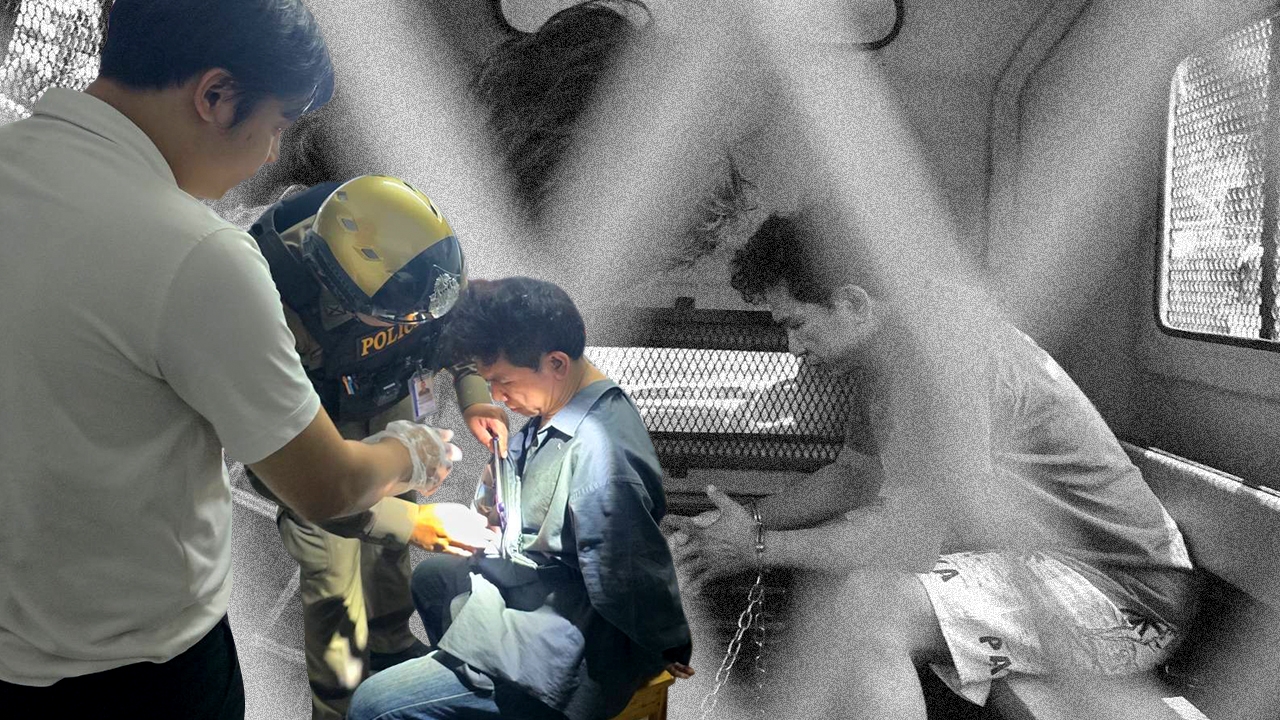
Suspicious staged setup in the bludgeoning death of a young man at a barbershop: "Wounds and audio clip." Forensic expert Dr. Moo points out that the assailant's wounds are uniformly deep, while the knife involved in the incident found in the victim's hand appears unnatural in appearance and position.
Yesterday (17 Apr 2026), Pak Kret Police Station in Nonthaburi Province received a report of a fatal altercation inside a barbershop in Pak Kret District. The scene is a four-story commercial building with the barbershop on the ground floor. Inside, the body of Mr. Thiti, 26, was found lying face down in a pool of blood in the inner room. He had five severe wounds to the back of his head. His right hand was gripping a pointed knife, and a bloodstained pestle was found beside him.
The suspect was identified as Mr. Jeerawat, 59, the owner of the barbershop. Police detained him at the scene. Meanwhile, hundreds of the victim's relatives and friends who learned of the death gathered angrily outside the shop, waiting to confront the suspect.

The investigation team from Pak Kret Police and Nonthaburi Provincial Police collaborated throughout the night, uncovering that the suspect, Jeerawat, has three wives—one Thai and two Laotian women—all working as female hairdressers at the shop where the incident occurred.
Police interrogation revealed evidence suggesting that Jeerawat and his two wives were involved in the assault leading to the victim's death, following Jeerawat's jealousy and rage. Prior to the incident, Jeerawat had called the victim, luring him to the shop by claiming he had a mobile phone to give him. When Mr. Thiti arrived, Jeerawat assaulted him with a pestle, resulting in the tragic event at the shop.
Initially, Jeerawat confessed to the crime, while the two women denied involvement, claiming they tried to intervene and stop the fight. All three face charges of "intentional homicide with premeditation" and "concealing and covering up the true cause of death."
Later at 10:30 a.m. on 18 Apr 2026, police transferred Jeerawat and his two wives from the detention room to file charges at Nonthaburi Provincial Court, opposing bail due to the severity of the case. While being escorted into the vehicle, Jeerawat told reporters, "I did not plan to kill; it was self-defense. I will provide further details in court." When asked about the audio clip capturing the victim pleading for his life inside the shop, Jeerawat lowered his head and refused to comment.

Clues in this case arise from the assailant's claim that the victim first attacked him with a knife, leading to a fight. The Thairath Online special news team consulted Associate Professor Dr. Weerasak Charatchaisri, a forensic medicine expert at Srinakharinwirot University (SWU), who analyzed two suspicious points. The first concerns the wounds: the assailant claimed he was injured by the victim's knife during the struggle and then used a pestle to fatally strike the victim. Normally, in a fight involving a knife, the victim instinctively raises their arm to block, resulting in wounds of varying depths across the body.
However, examining the assailant's wounds on the nose bridge, chest, and abdomen reveals shallow scratches of similar depth and size. This pattern does not match typical defensive wounds from a knife fight, suggesting the injuries are inconsistent with a struggle to defend against a knife attack.

The second point concerns the knife lodged in the victim's hand. Forensically, a knife held tightly in a victim's hand usually occurs when death is instantaneous, such as a fatal brain injury causing immediate death and muscle stiffening, preventing the weapon from dropping. For example, in suicide cases involving a gunshot to the brain, the finger remains on the trigger due to immediate death and muscle contraction. The question here is whether the victim sustained a severe brain injury causing immediate death, which would explain the knife remaining in hand.
If the victim did not die immediately, there would be a period before death during which muscle relaxation would cause the weapon to fall from the hand. Therefore, if death was not instant, it is unlikely the knife would remain lodged in the victim's hand as observed.