

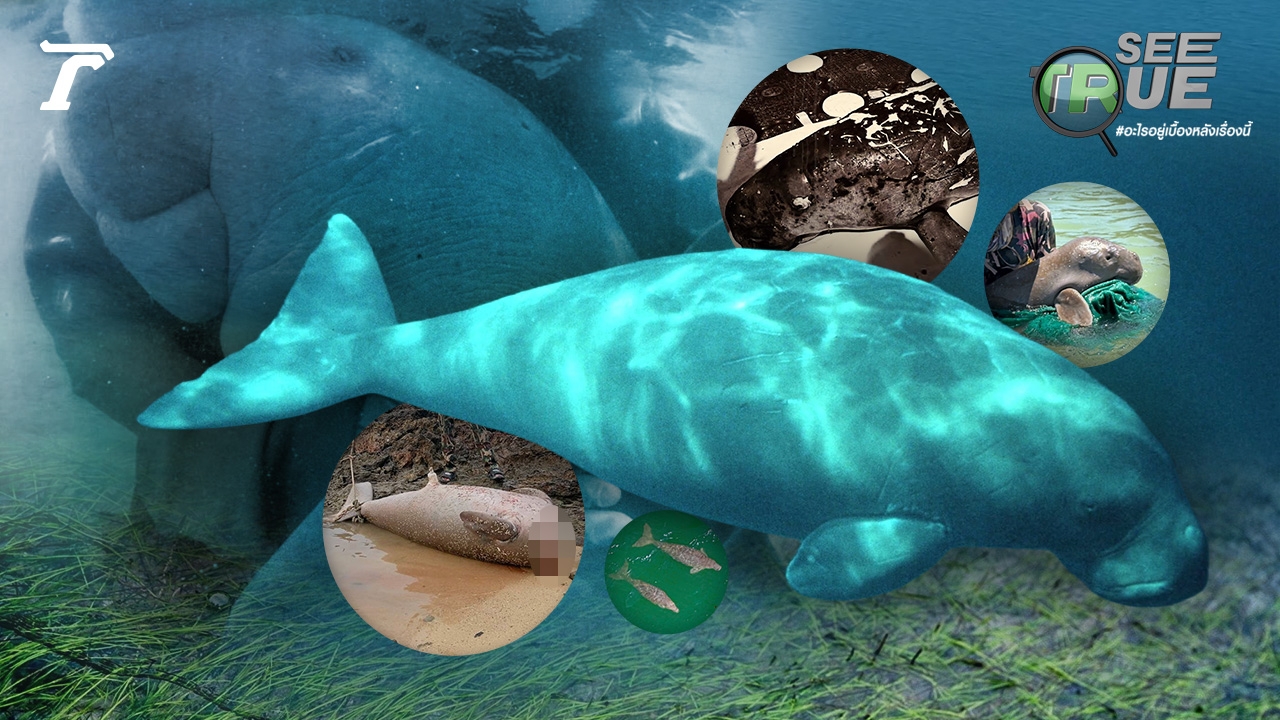
Following the crisis of the last dugong herd as global warming causes the loss of seagrass, their main food source, and human activities threaten them. Additionally, persistent superstitious beliefs continue to cause ongoing dugong deaths, raising fears that soon only the name "Andaman pair" will remain.
April 22 of every year is recognized as "Earth Day". But this year, less than two weeks before, Thailand found the carcass of a "dugong" with its head cut off and chained underwater in Phang Nga Province on April 9. This underscores that threats to dugongs, a protected species, remain at a critical level.
The SEE TRUE news team has followed this story for over a year, monitoring behavior and collecting statistics to observe changes in the last dugong herd of the Andaman Sea, seeking answers on the severity of Thailand’s dugong crisis.

The "dugong" also called the "sea pig" or "sea cow," is a marine mammal and an indicator of the health of Thailand’s marine ecosystems. Currently, the dugong population in the Andaman Sea likely numbers fewer than a hundred. Breeding or captive propagation for release has never been achieved anywhere in the world.
In 2024, a major dugong crisis occurred with over 48 deaths, the highest in recorded history. In 2025, another 25 deaths followed. On April 9 this year, another beheaded dugong carcass was found at Koh Yao Noi, Phang Nga Province. Though autopsy results later confirmed death by illness, these are ominous signs for Thailand’s marine environment.
Historically, dugong deaths averaged one per month, but during 2023-2024, deaths averaged 3.75 per month—2 to 3 times higher than usual. Approximately 60% died from illness caused by starvation, leading to secondary infections. The remaining 40% resulted from human activities such as propeller injuries, boat collisions, accidental entanglement in fishing gear, and hunting for tusks and tears used in superstitions.
The SEE TRUE team conducted field investigations tracing the migration of the last Andaman dugong herd starting December 2024, tracking their relocation from Koh Libong in Kantang District, Trang Province, known as the "dugong capital." In the past, hundreds lived there, but when seagrass in Trang Province disappeared over thousands of rai due to dredging at the Trang River mouth that caused sediment to smother the seagrass, only 3% remained—insufficient for the starving dugongs.
The team used drones to survey waterways from Koh Libong to Koh Muk over several kilometers hoping to spot dugongs, but found only empty seas.

following their life cycle. Adult dugongs require 13-16 rai of seagrass covering at least 60% of their habitat to sustain themselves. By 2024, such healthy seagrass was nearly absent in Trang, Krabi, and Satun, forcing dugongs to roam widely in search of food, leading to migration to new feeding grounds. Many arrived in Phuket and Phang Nga Bay, but these areas also face seagrass degradation in some parts. It can be said that "seagrass coverage of 60% is nearly impossible to find now." Most dugongs migrated north to gather on Phuket’s east coast and Phang Nga Bay, with Srisun being the last zone before open coastlines requiring a 45 km swim to reach the seagrass beds at Tab Lamu. While dugongs can travel 20-30 km if needed, they prefer calm bay waters with abundant seagrass, making reaching Tab Lamu unlikely.
The dugongs’ new home in Phuket Province is
"Ao Tang Ken," a small bay hidden within Mueang Phuket District with abundant seagrass. The team observed here for several days, capturing photos and flying drones, working alongside local officials and conservationists to avoid disturbance. “Miracle, Khao Yai, Khao Lek, Sleepy, Gecko, Peek, Casanova”
are names given by officials and conservationists to several dugongs for easy identification, excluding transient dugongs that regularly feed on seagrass in Ao Tang Ken. The rich food source attracted over 20 dugongs by late 2024.
Efforts included planting salt-tolerant seagrass species to feed dugongs, monitoring to prevent harmful algae covering the seagrass, and controlling air temperature during hot seasons that cause seagrass die-off. With food sources restored, dugongs can survive.
“Beheading and Dugong Tears Used in Witchcraft”

Recently, a tragic incident occurred on April 9, 2026, when a beheaded dugong carcass was found floating offshore at Koh Yao Noi, Phang Nga Province, its tail tied with rope and weighted with stones. Although autopsy confirmed natural death by illness, the mutilation to harvest tusks for superstitious purposes highlights ongoing threats from such beliefs.
As referenced in the popular song
“Bunga Tan Yong,” one lyric mentions “dugong tears.” These beliefs, especially in southern Thailand, hold that dugong tears are potent charms. Historically, sorcerers would remove dugong calves from their mothers, striking the water’s surface to deceive the mothers into shedding tears. These tears were then mixed with herbal oils and enchanted to create talismans. Villagers traditionally transformed dugong tusks and bones into amulets believed to ward off evil. Today, as dugongs are protected species, hunting live dugongs has ceased, but beheading carcasses to collect tusks for witchcraft persists.

All these represent the
"threats" currently chasing the last "dugong" herd in the Andaman Sea. Academics and government agencies are urgently seeking ways to restore seagrass to increase food supplies, employing drones for surveys and designating dugong habitats as safe zones. Engaging fishermen and citizen scientists is crucial to monitoring dugong locations and threats. Today, all sectors must unite to prevent the dugong’s permanent disappearance from Thailand’s waters. Follow the SEE TRUE mission to reveal the truth with continuous coverage from 22 to 23 April 2026 on Thairath News Show after 9:00 p.m.