

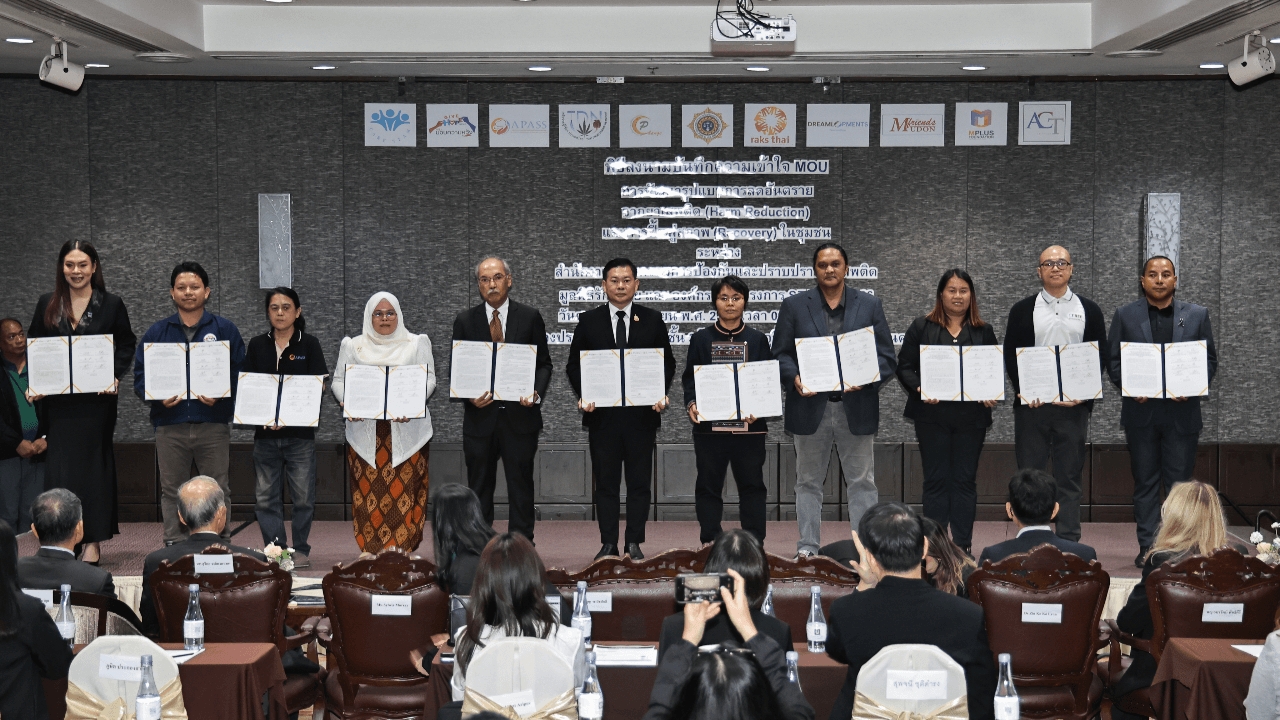
The Office of the Narcotics Control Board (ONCB) has joined forces with the Rakthai Foundation and nine partner networks to sign a Memorandum of Understanding (MOU) to jointly develop harm reduction models and sustainable community recovery initiatives, emphasizing a balanced approach integrating health, social, and safety dimensions.
Today (24 Apr 2026), Police Lieutenant Colonel Suriya Singhakamol, Secretary-General of the ONCB, and Promboon Panichpakdi, Secretary-General of the Rakthai Foundation, together with civil society partners from nine organizations — including the Songkhla Drug User Care Group, Hope Giving Group, Health and Social Support Access Promotion Group, Thailand Drug Users Network, K Khon Foundation for Change, Dream Development Foundation, M Friend Udon Ratchathani Foundation, M Plus Nakhon Ratchasima Foundation, and ACTeam Khon Kaen Foundation — gathered for the event.
They jointly signed a Memorandum of Understanding (MOU) concerning cooperation in developing models for harm reduction from drug use (Harm Reduction) and community recovery (Recovery). The aim is to collaboratively drive forward a new drug policy focused on balancing health, social, and safety aspects.

This collaboration aligns with Thailand’s updated drug policy under the 2021 Narcotics Act, which emphasizes the importance of human resources and integrated multi-dimensional work. It draws on principles from the 2016 United Nations General Assembly Special Session (UNGASS) to enhance treatment and rehabilitation efficiency for people with drug problems, addressing both health and social aspects. This supports the national strategy focused on building a stable and sustainable society in health and social terms.
This effort involves collaboration with civil society across 23 provinces. Under this cooperation framework, the Rakthai Foundation and nine network partners will support government agencies in creating learning processes to prevent new drug users and promote behavioral change among current users. The goal is to enable drug users to care for themselves and live harmoniously in society through joint mechanisms involving government, private sector, and civil society.

During a panel discussion on Thailand’s drug policy reform shifting from suppression to balanced health-focused understanding, Papasee Kainan Director of the Office of Drug Prevention and Solution Development at the ONCB, commented on the transition from suppression to health focus. He explained that originally, drug problem-solving centered on suppression, but it has since shifted to focus on treating drug users with public health leading. This includes developing harm reduction approaches, requiring cooperation from all sectors—government, private, and civil society—to ensure sustainable implementation.
Meanwhile, Dr. Sarayut Boonchaipanichwatana Director of the Boromarajonani National Institute for Drug Treatment and Rehabilitation (BNIDTR), stated that one key challenge in harm reduction is its sensitivity, as some question why drug users should receive harm reduction support. However, as BNIDTR is a specialized agency treating drug addiction, it regards drug users as patients. Considering economic, health, family, and social dimensions are interconnected, the involvement of civil society agencies helps government agencies become more agile. He affirmed that civil society operations comply with the 2021 Narcotics Act and meet BNIDTR’s harm reduction service standards based on Hospital Accreditation quality standards.

Dr. Nonglak Yodmongkol Assistant Secretary-General of the National Health Security Office, representing Dr. Jadet Thammathatari, Secretary-General of the National Health Security Office, noted that the key principle is not only policy but also enhancing local and civil society participation in caring for drug users. This occurs through policy mechanisms and local-level budgets such as local/provincial health security funds, supporting preventive and recovery services while developing community service provider networks.
Promboon Panichpakdi Secretary-General of the Rakthai Foundation concluded that, based on over 20 years of experience in this field, the challenge for civil society is to serve as a bridge to harm reduction services. Collaboration with the government has advanced policy progress and increased acceptance despite legal and social attitude limitations. Future progress requires cooperation from all sectors to create a comprehensive service system based on the principle that "Everyone should have the opportunity."
