

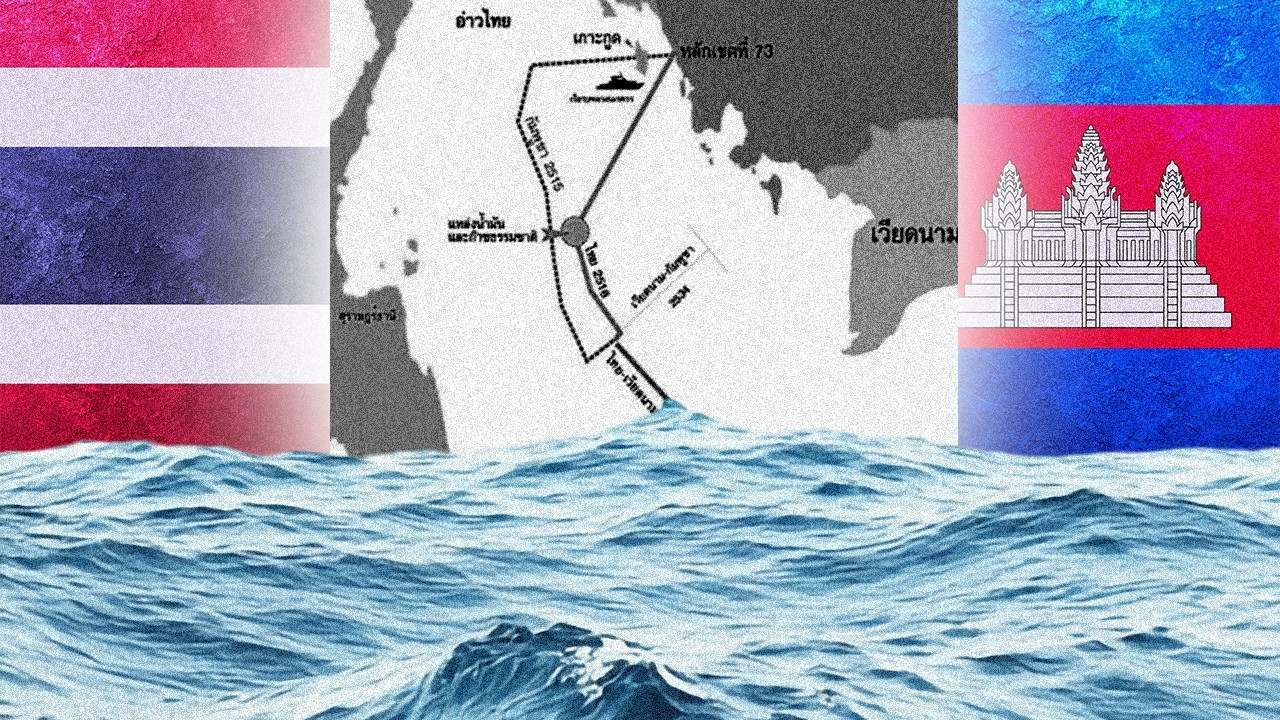
Can Thailand unilaterally cancel MOU44? An examination of Cambodia's conditions for rebutting the border dispute on the global stage.
In the case of Thailand preparing to cancel MOU44, an agreement made with Cambodia regarding the unresolved border area, can Thailand unilaterally terminate it in the international arena, and how might Cambodia respond?
Dr. Phattharaphong Saengkrai, a law professor at Thammasat University, posted his opinion that the key issue—whether Thailand can unilaterally cancel MOU44—is likely to be resolved through mediation processes under UNCLOS.

1. The first issue: Can Thailand unilaterally cancel MOU44, given that the MOU does not provide for unilateral termination rights?
He suggested Thailand might invoke Article 56 of the Vienna Convention on the Law of Treaties (VCLT), which is probably the strongest basis for such a claim.
Article 56 states that if a treaty does not explicitly allow unilateral termination, parties cannot terminate it unilaterally; they are bound until all parties agree to end the treaty.
Except in cases where
(a) it can be proven that all parties intended to allow unilateral termination, or
(b) by the nature of the treaty, unilateral termination can be inferred.
Thailand might claim the exception (a), which would require evidence, such as whether Cambodia objected when former Prime Minister Abhisit attempted to cancel MOU44 or how the agreement was drafted.
Thailand might also argue exception (b), which applies if the treaty's nature suggests it can be terminated unilaterally. This exception is based on the rationale that some treaties, by their nature, cannot bind parties indefinitely. A frequently cited example is a temporary arrangement called modus vivendi, often used to manage territorial and boundary disputes.
While MOU44 between Thailand and Cambodia is not precisely a temporary arrangement, it is an agreement to negotiate boundary delimitation and joint development. Thus, if Thailand argues that MOU44 is temporary in nature—not a permanent boundary demarcation binding indefinitely—and that both parties have tried but failed to reach agreement, either side may have the right to terminate unilaterally.

Procedurally, Thailand would need to notify Cambodia of its unilateral intent to terminate MOU44 and specify when the termination takes effect. The VCLT requires a 12-month notice period; however, under customary international law, a reasonable period is sufficient. Therefore, even if Thailand notifies Cambodia, termination does not take immediate effect.
The next issue is:
(2.1) If Cambodia agrees that unilateral termination is allowed, it might remain silent, which in this context implies acceptance.
The dispute resolution process could then restart under UNCLOS.
(2.2) If Cambodia disagrees (likely scenario), it would contest Thailand’s claim with factual and legal arguments before the termination takes effect.
(2.2.1) In this case, the government might consider proposing amendments to MOU44,
such as correcting any problematic maps to comply with UNCLOS,
or modifying the agreement to establish boundary delimitation first, followed by benefit-sharing arrangements.
If Cambodia agrees to these amendments, the process would proceed under the revised MOU.
(2.2.2) If Cambodia refuses to amend, the dispute over MOU44’s status remains unresolved, and negotiations would likely stall.
(2.2.2.1) Cambodia could then propose that Thailand use other UNCLOS mechanisms, such as the International Court of Justice, the International Tribunal for the Law of the Sea, or arbitration, because bilateral negotiations have failed. This aligns with Article 283 of UNCLOS concerning exchange of views on dispute resolution methods. Thailand would need to evaluate politically feasible options and, if agreed, proceed with that mechanism.
(2.2.2.2) If Thailand rejects Cambodia’s proposal, Cambodia can immediately initiate mediation under Annex V of UNCLOS.
Under Annex V, a five-member Conciliation Commission is formed: each disputing state selects two members from a pre-existing list, not necessarily nationals of their own country, and both agree on a chairman. If they cannot agree, the UN Secretary-General appoints one.
The Commission hears legal arguments and evidence, similar to court proceedings, as seen in the Timor-Leste and Australia case. However, the Commission cannot issue binding rulings; it produces a report to help the parties resolve the dispute further.
Importantly, the Commission must complete its report within 12 months of establishment.
A drawback, as I have emphasized, is that involving a third party like a Conciliation Commission brings unpredictable outcomes. The advantage is it propels the process forward, a lesson learned from the Timor-Leste and Australia dispute—which was as severe, or more, than the Thailand-Cambodia case, considering Australian officials even seized Timor-Leste lawyers’ property (a story for another time).
Questions about whether Thailand can unilaterally cancel MOU44 and whether the MOU remains binding on both countries may resurface during mediation.
I support Thailand and Cambodia resolving their maritime dispute swiftly with a fair outcome acceptable to both. If negotiations fail, mediation is the second-best option.
Regardless of pros and cons, if scenario (2.2.2.2) unfolds and Cambodia proceeds under UNCLOS, the Commission’s findings will likely emerge during the Anutin government’s term, possibly in Anutin’s fourth year as Prime Minister—potentially before the next election.
