

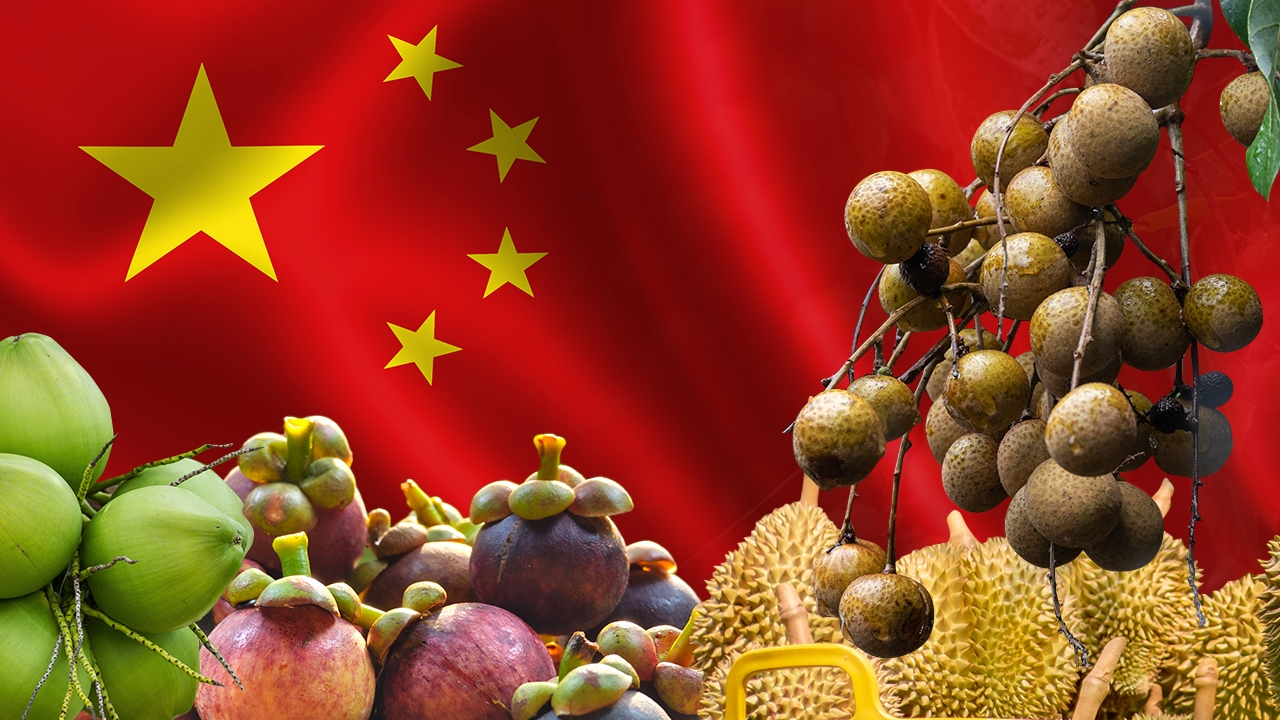
The situation of Thai fruit exports to China shows market growth but fierce competition from neighboring countries. Notably, "longan" export volumes are declining. The president of the Thai Fruit Exporters Association revealed that stricter safety standards are being enforced.
During Thailand's summer season, it is the prime season for the king and queen of fruits such as durian, mangosteen, and rambutan. Besides domestic consumption, these fruits are among Thailand's top export products, especially to major markets like "China."
According to data on Thai fruit imports by China for the year 2025, referencing China's National Customs, the top five Thai fruits imported are 1. Fresh durian, with a volume of 920,749 tons (accounting for 40.82%), 2. Coconut, with a volume of 432,812 tons (19.19%), popular both fresh and for processing in the food and beverage industry, 3. Fresh longan, with a volume of 375,123 tons (16.63%), 4. Mangosteen, with a volume of 225,483 tons (10%), and 5. Dried longan, with a volume of 178,942 tons (7.93%).
Meanwhile, this year it has been observed that "durian" production is abundant, raising concerns about possible price declines. Most recently, on 5 May 2026, Mr. Suriya Juangroongruangkit, Minister of Agriculture and Cooperatives, stated that he has received information from the Nakhon Phanom MP that scheduling durian inspections at minor border posts has prolonged export times. He emphasized that inspection processes must ensure no contamination to avoid issues upon export to China, requiring extended durian quality checks at border posts.
Durian remains Thailand's number one export fruit, but other important fruits are also significant. On 6 May, the minister plans to meet with global fruit exhibition experts from Germany to discuss hosting a fruit expo in Thailand to promote Thai fruits. Regarding El Niño issues, water levels in dams are sufficient, but non-irrigated areas face problems. The Royal Irrigation Department has been instructed to prepare equipment and machinery to handle these challenges.

Thairath Online's special news team discussed export fruit issues with Sanchai Puranachayakiri, president of the Thai Fruit Traders and Exporters Association. He revealed that aside from durian, Thailand's top fruit export to China,
other top five fruits face various challenges. Regarding "longan," which begins production after June and continues until year-end, problems have occurred with food safety standards. China conducts strict random inspections, especially regarding the process of fumigating fresh fruit with sulfur dioxide gas, which may leave residues exceeding limits and cause shipment rejections.
China's random inspections are not limited to border points but also occur in stores and supermarkets, causing many retailers to hesitate to import longan for fear of subsequent issues, potentially reducing imports gradually in the future.
Regarding "mangosteen," Thailand dominates the Chinese market but faces competition from Indonesia. However, Thailand still holds advantages in transport distance and strict grading with high quality. For "durian," despite this year's abundant production causing price drops, Sanchai believes that if export markets remain strong, sales will continue.

Meanwhile, data fromthe Agricultural Counselor's Office in Beijingreported the latest agricultural product situation for March 2026, showing increased fruit imports by China. Thailand ranks second among countries exporting fruit to China. Imports of durian and coconut have increased compared to the previous year, while longan imports have decreased.
In March 2026, Thai agricultural exports to China continued expanding, especially fresh fruits like durian, coconut, and mangosteen, which remain popular in the Chinese market. However, tensions and conflicts in the Middle East have impacted global logistics, increasing shipping costs and route uncertainties.
At the same time, China continues to enforce strict food safety measures and product quality inspections, requiring Thai exporters to adapt to increasingly stringent requirements.

Additionally, competition in the Chinese market is intensifying, particularly from regional competitors such as Vietnam, which has expanded its market share in certain fruit products like durian. Vietnam benefits from geographical proximity, sharing a direct border with China. In 2025, Vietnam exported durian to China worth about 3.6 billion USD, closely trailing Thailand's 4 billion USD. It is possible that in 2026, Vietnam could become the largest durian exporter to China.
In summary, China remains a major high-potential market for Thai agricultural products, but it is necessary to enhance product quality and production standards, improve logistics efficiency, and manage risks from global situations concurrently.