

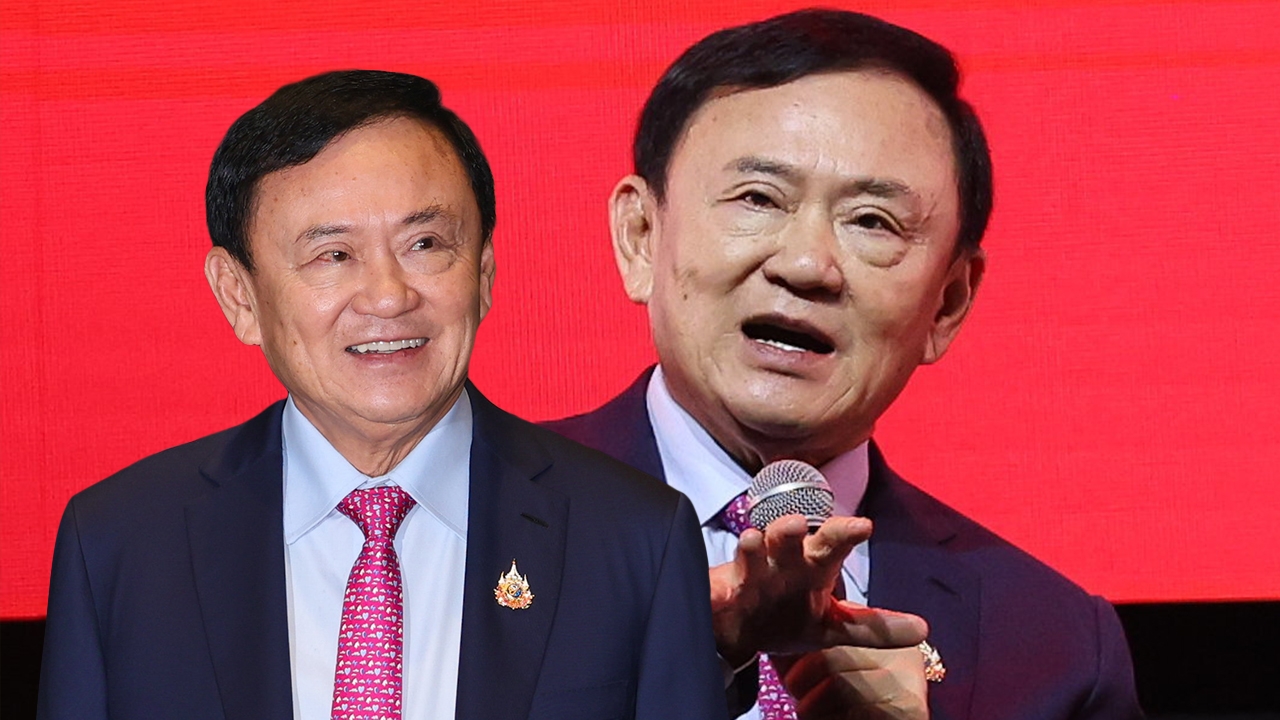
Thaksin Shinawatra will be released from prison on the morning of 11 May after being granted parole. Experts view this as a development that will shake up the political backstage, with Pheu Thai organizing its team to await the right moment, emphasizing important lessons from the past.
Former Prime Minister Thaksin Shinawatra is set to be released on parole from Klong Prem Central Prison on the morning of 11 May 2026. However, he will be fitted with an electronic monitoring bracelet and prohibited from traveling abroad after having been incarcerated for 7 months and 28 days.

Nearly every phase of Thaksin Shinawatra’s life since reaching the peak as prime minister, through the subsequent coup and exile abroad, has been closely watched. Even his recent returns to Thailand have seen him act as a political backstage figure. It is therefore notable to see what role Thaksin will play after this parole release, and whether he will influence Pheu Thai’s political maneuvering to reclaim its status as the leading party.
Dr. Satithorn Thananitichote, a political science lecturer at Chulalongkorn University, analyzes that Thaksin will need to exercise considerable restraint after his parole release, even though legally there may be no explicit prohibitions.
From a political strategy perspective, "he should keep a low profile for now." The key reason is that Pheu Thai currently has no urgency since it is part of the coalition government and already controls important ministries.
Interestingly, when the government faces criticism, most public scrutiny targets the Bhumjaithai Party. Thus, Pheu Thai should take this opportunity to quietly "accumulate goodwill" without making overt moves that might attract unwanted attention, allowing "Professor Chen" to handle frontline duties effectively. This also serves as preparation for the next phase.
If Thaksin were to act immediately upon release, it could destabilize the currently smooth situation since the timing is not yet appropriate for him.

Will Thaksin’s return cause upheaval within the party? Dr. Satithorn notes that internal power shifts have been ongoing even during Thaksin’s imprisonment. Key decisions such as ministerial seat allocations or political appointments often coincided with visits by his relatives.
This indicates that the central decision-making power remains at "Baan Chan," with Thaksin as the key figure balancing between the Shinawatra family network and various power groups within the party.
Going forward, Thaksin’s role will be "behind the scenes," supporting "Professor Chen" (Yotchanan Wongsawat) as deputy prime minister and minister to work confidently without worries. The focus will be on showcasing policy achievements that outshine other coalition parties. Meanwhile, backstage political work—such as maintaining power balance, managing dissent within the party, and preventing defections—will be Thaksin’s responsibility, leveraging his personal influence.

Regarding concerns that Pheu Thai may become a "pawn" of Bhumjaithai or the Buriram political faction, Dr. Satithorn explains that in reality, there is a division of labor. This has been clear since the cabinet formation, with ministries divided into clusters smoothly. Although Pheu Thai seemed disadvantaged initially, the party has since gained control of key clusters, allowing it freedom to pursue its agenda independently.
For Pheu Thai members worried about not being Thaksin’s "favorites," the lecturer says this is normal. But with only 70 seats and control of important ministries, the party still depends on proven members. Removing someone is difficult unless they hold no key positions or are not top choices for political appointments.
Dr. Satithorn believes that Pheu Thai has a chance to become the top party again but must maintain good timing. Currently, politics is divided into three camps—blue, red, and orange. Though red (Pheu Thai) appears smallest now, its central position allows it to attract votes from both blue and orange if rivals falter.
Pheu Thai must change its mindset—not as the biggest party as before, but as a challenger working to climb the ranks. If Bhumjaithai fails in governance or the orange camp lacks concrete policies beyond rhetoric, Pheu Thai should quickly showcase policy-driven politics to regain momentum and supporters. Crucially, Thaksin must avoid rushing onto the stage aggressively to prevent disadvantages experienced in the past. The lesson is that this time Pheu Thai is not number one yet and must gradually accumulate support until the next election.