

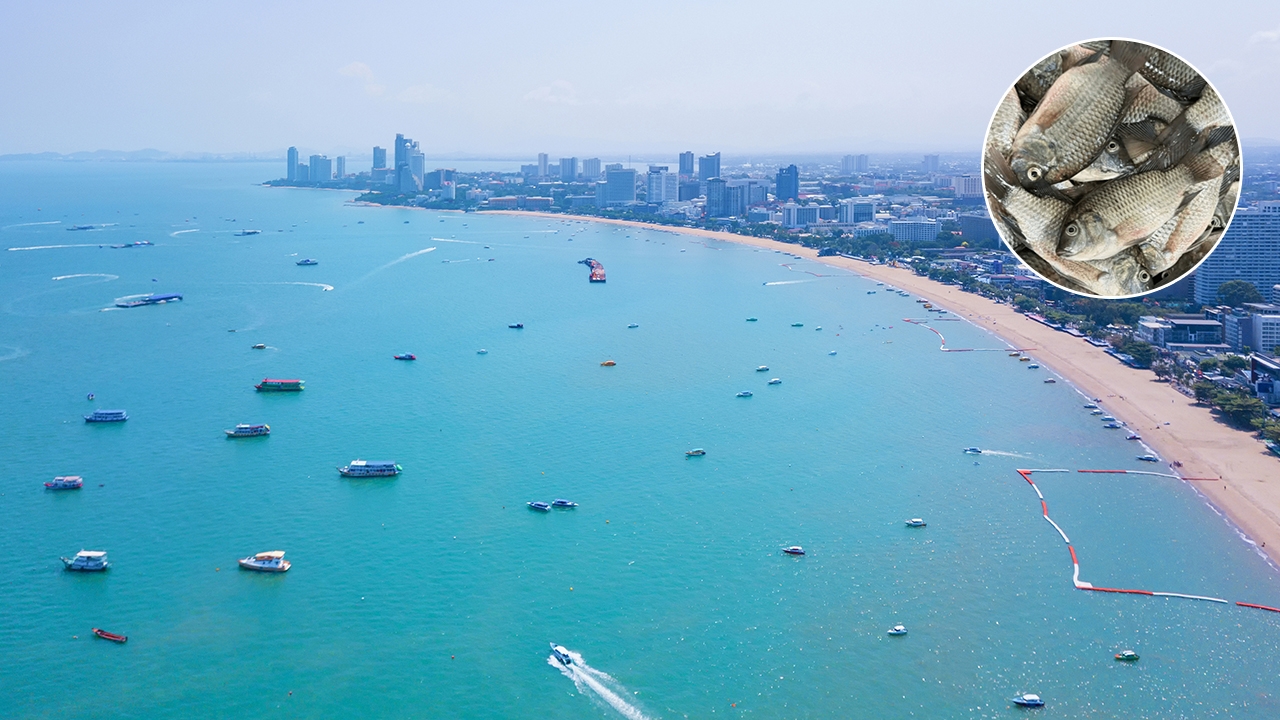
Three steps of blackchin tilapia invading Pattaya Beach: Dr. Thorn points out the need to eliminate them in the source canals before coastal fisheries are devastated. If left unchecked, the ecosystem and economically important fish may disappear from the market.
On 14 May 2026, a Facebook user named “Tart Channel” posted a message and video clip after discovering a large number of blackchin tilapia along the beach in Pattaya City, Nong Prue Subdistrict, Bang Lamung District, Chonburi Province. This caused alarm among fishermen, squid fishers, and many tourists who gathered to watch the scene.
Thairath Online's special news team consulted Assoc. Prof. Dr. Thorn Thamrongnawasawat, a marine scientist and faculty member of the Department of Marine Science, Faculty of Fisheries, Kasetsart University. He explained that the spread of blackchin tilapia in natural water bodies occurs in three steps:

1. Blackchin tilapia reproduce and spread in brackish water canals. Being a three-water fish, they prefer brackish water the most. Thus, canals are the initial outbreak points where they breed and multiply.
2. They spread to coastal areas, such as closed bays adjacent to brackish water sources and mangrove forests like Khung Kraben Bay. This is most apparent in Khung Kraben, a seagrass habitat severely affected because it is a home to aquatic animals.
3. They then spread along the coastline. In fact, Pattaya is not the first place; previously, blackchin tilapia were caught near Nai Beach in Phetchaburi Province and Cha-am Beach.
Blackchin tilapia spreading along the sea coast are fully grown adults. Their life cycle involves spawning and rearing larvae in the brackish canal waters first. Once mature, they swim out to the salty coastal waters.
In the case of the spread at Pattaya Beach reported in the news, most are mature-sized fish. It is believed they originated from canals connected to the coastal area. After breeding extensively in canals, the mature fish swim out to the coastal zones.

Blackchin tilapia are an alien species. They consume abundant natural food until depleted. When food runs out and population density increases, they spread from canals and expand to new feeding areas, occupying one area after another. Now, their spread has even crossed national borders.
The presence of blackchin tilapia in Pattaya's marine area disrupts the ecosystem balance. The impact depends on their population density and the specific area; if in canals, total devastation can occur.
The method to control blackchin tilapia spreading at Pattaya Beach must target the source and breeding grounds in the canals connected to the sea. Catching them directly in Pattaya's marine waters is ineffective due to the larger area compared to canals. Additionally, using cast nets could harm other fish species.

Captured blackchin tilapia should be promoted for processing into food products, such as sun-dried fish, for consumption. If Pattaya does not quickly control the tilapia entering the beach area, it will negatively affect coastal fishermen, as economically important aquatic animals like grey mullet and rock bream will decline.
Therefore, the spread of blackchin tilapia along Pattaya's coastline reflects challenges faced by local communities, especially coastal fishermen, as high-value fish species decrease due to ecosystem damage caused by the invasive tilapia.