

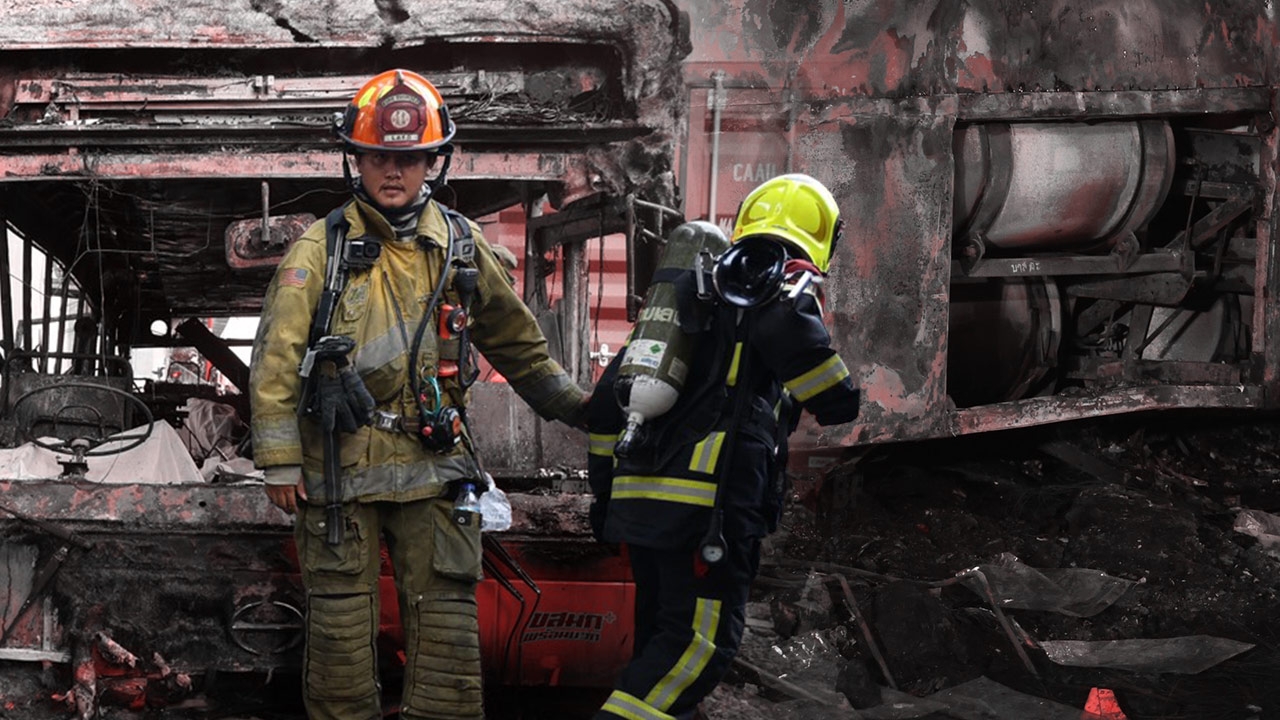
A train collided due to four negligence factors; the bus modification is suspected as the fire's cause. The “Thai Bus Page” analyzed that the gas tanks installed under the bus, beneath the passenger seats, ignited quickly upon impact in the middle of the vehicle.
Abhisit Mantri, administrator of the Thai Bus Page, analyzed the incident of a train crashing into a bus stalled on the tracks with the Thairath Online special news team, stating the main problem is “Thai people's discipline” regarding traffic. This is not the first such case. Basic traffic rules dictate that if traffic is congested, vehicles should keep a distance at the marked line, but Thai drivers often queue up, causing vehicles to stall on railway tracks. Observations are as follows.
1. Initially, from inquiries with staff onboard, according to the Thai Bus Page and Bus Zone 3, neither the driver nor the conductor died. At the time of impact, the conductor was seated in the front monk’s seat and was thrown out of the bus along with the front route sign. Some reports mistakenly showed route 23 signs, but it was actually route 206. The driver is receiving treatment in hospital. 2. The bus stalled on the tracks due to traffic congestion. When the bus stopped, other vehicles cut in, prompting buses to drive forward, ultimately stalling on the railway tracks.
3. Regarding signal and barrier malfunctions, at the time of the accident, the railway crossing barrier did not lower, and there were no flashing lights or usual warning signals.
4. Risk points in Bangkok include, aside from the accident site, other locations such as Ratchaprarop intersection near Indra Hotel towards Sri Ayutthaya, Phaya Thai intersection, and along the Yommarat area.

The bus hit by the train had an engine modification; originally diesel-powered, it was converted to NGV gas to comply with environmental policies. A total of 323 buses have undergone such modifications.
Notably, the dangerous gas tank placement may have caused the rapid fire. This bus model places gas tanks "under the chassis" beneath the passenger seats, from the midsection to the rear wheels. When struck mid-body, this caused an explosion and quick fire, unlike newer buses which place gas tanks on the "roof."
These gases tend to leak downward; when mixed with sparks from collisions of metal against metal, or between buses and motorcycles, they cause intense fires resembling a "sea of flames."
Currently, the Department of Land Transport has a policy that by 2028 it will no longer renew registrations for buses equipped with NGV gas systems. The Bangkok Mass Transit Authority (BMTA) plans to lease new buses as replacements.
This modification is considered highly risky for safety in accidents because the gas tanks are located where impact forces concentrate and close to the passenger compartment.

BMTA’s bus management is often constrained by government policies, preventing selection of the highest-quality vehicles and requiring changes according to political shifts.
Regarding railway safety, better coordination is needed between BMTA and the State Railway of Thailand, and sliding grille-type barriers should be used to prevent motorcycles from slipping through.
The accident raises significant concerns, especially for public transport passengers. Beyond ensuring drivers comply with traffic laws, the vehicles themselves should have enhanced safety. It is also presumed that the train driver might be unfamiliar with this route, as trains here usually slow down to monitor slower crossing vehicles.