

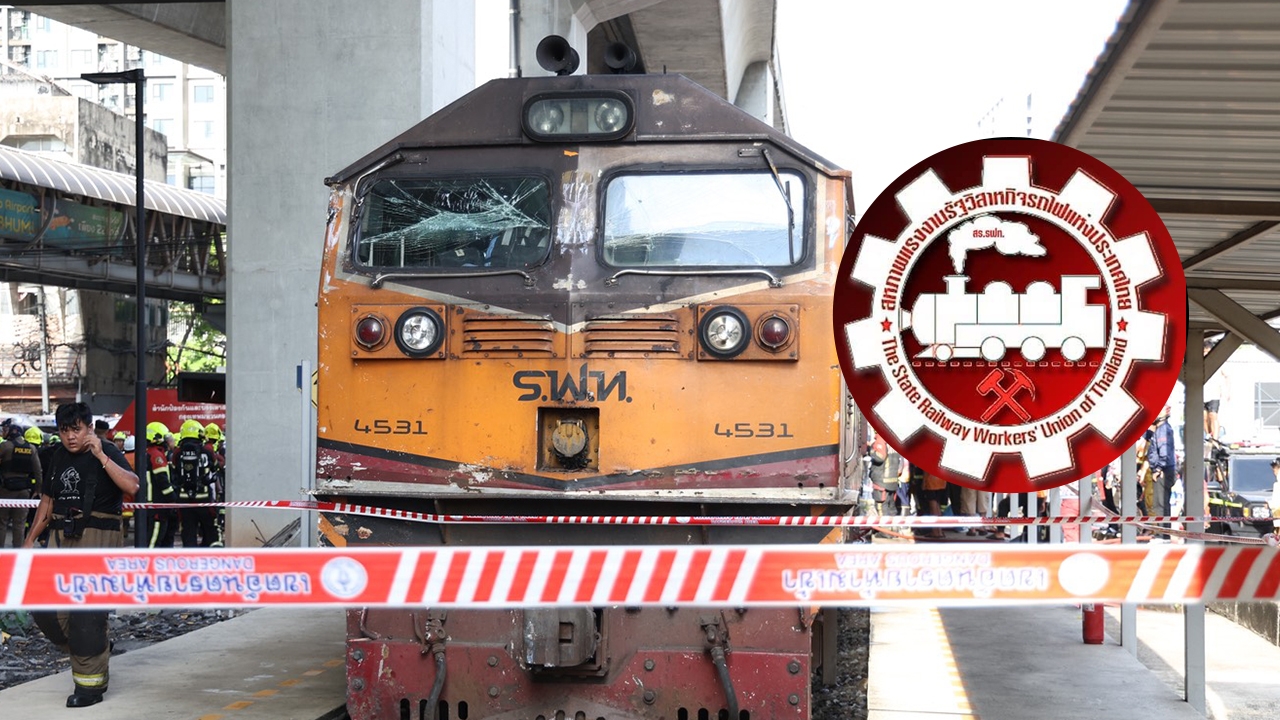
The "Railway Union" challenges the "Department of Rail Transport," affirming that train employees clearly hold licenses, highlighting manpower shortages and lack of rest. Transport scholars view that Thailand's public transport system requires addressing root causes.
The State Railway Labor Union (SRLU) issued a statement to clarify facts for accurate public understanding regarding train operators and their operating licenses.
Statement by the State Railway Labor Union of Thailand (SRLU).
Subject: Clarification of facts regarding operating licenses of train operators and protections under the transitional provisions of the Rail Transport Act B.E. 2568 (2025).

Following the tragic accident where freight train No. 2126 collided with bus route 206 at the Asoke-Din Daeng railway crossing on 16 May 2026, causing multiple fatalities and injuries, the SRLU expresses deepest condolences to the families of the deceased and all injured. The true facts and causes are under thorough investigation by relevant committees and agencies. However, some media reports have distorted facts, and the union wishes to clarify for public awareness as follows.
On 17 May 2026, the Director-General of the Department of Rail Transport informed the media that the train operator involved in the incident had not yet received an operating license from the department and had been suspended. This information, lacking full context and facts, caused confusion about the train operators’ roles and led to widespread public misunderstanding that State Railway of Thailand (SRT) employees operate trains illegally without licenses or qualifications.
As representatives of railway workers, SRLU finds it necessary to clarify the facts based on law and practice to protect the dignity of employees and ensure correct public understanding, as follows:

1. The Director-General’s claim that the train must apply brakes 2 kilometers before the stopping point is inaccurate. Effective stopping depends on locomotive condition, train load units (which were 578 units that day), and speed limited to 40 km/h. The normal stopping distance is about 200 meters, not 2 kilometers.
2. Before the Rail Transport Act B.E. 2568 came into force, all SRT train operators had been properly screened, trained, tested, and appointed in accordance with SRT regulations.
Specifically, under regulation 3.1 authorized by section 25(3) of the State Railway of Thailand Act B.E. 2494 (1951), all personnel underwent a standardized screening process backed by law, establishing their employment status and qualifications before the Department of Rail Transport was established.
3. Although the Rail Transport Act B.E. 2568 was published in the Royal Gazette on 27 December 2025 and effective from 27 March 2026, its transitional provision, section 156, clearly protects the rights of existing train operators to continue duties during the licensing transition period to avoid service gaps.
4. Currently, SRT has complied with section 156 by submitting license applications for 951 operators to the Department of Rail Transport. Of these, 208 have been issued licenses. According to the Director-General’s view, the remaining 743 operators must cease duties, which would halt 743 trains. However, these operators have served long before the department’s establishment and are in the legal transition period, thus are lawful operators—not “unlicensed” as the department’s statement might mislead the public.
5. There is a total required workforce of 1,258 train operators, but currently only 951 work continuously with almost no weekly rest. SRLU and SRT have consistently urged the Minister of Transport to increase staffing for public service quality and to prevent operator fatigue, which is critical for safely operating longstanding locomotives. The union has always emphasized safety improvements as a top priority.

Thairath’s special team interviewed Dr. Sumeth Ongkittikul, Director of Transport Policy and Logistics Research at the Thailand Development Research Institute (TDRI), who analyzed the accident as a systemic failure involving multiple factors. Physically, the site is a high-risk intersection with heavy traffic congestion, causing vehicle queues to extend onto the railway tracks—a common occurrence for those familiar with the location.
The accident’s causes stem from several factors: the physical layout at a busy intersection, poor road traffic management, and unchanging driver behaviors. Notably, just one day after the accident, vehicles still blocked the railway tracks. Thus, the problem requires systemic solutions rather than blaming any single party.

Studying foreign accident cases reveals that independent special committees typically investigate incidents. These committees do not assign blame but analyze problems and recommend measures to prevent future occurrences.
"Therefore, if we review accidents and causes thoroughly and design comprehensive prevention measures, such incidents should not recur. We want to avoid superficial responses—campaigns that fade quickly. Thus, conducting deep accident investigations and implementing short-, medium-, and long-term measures remain essential."