

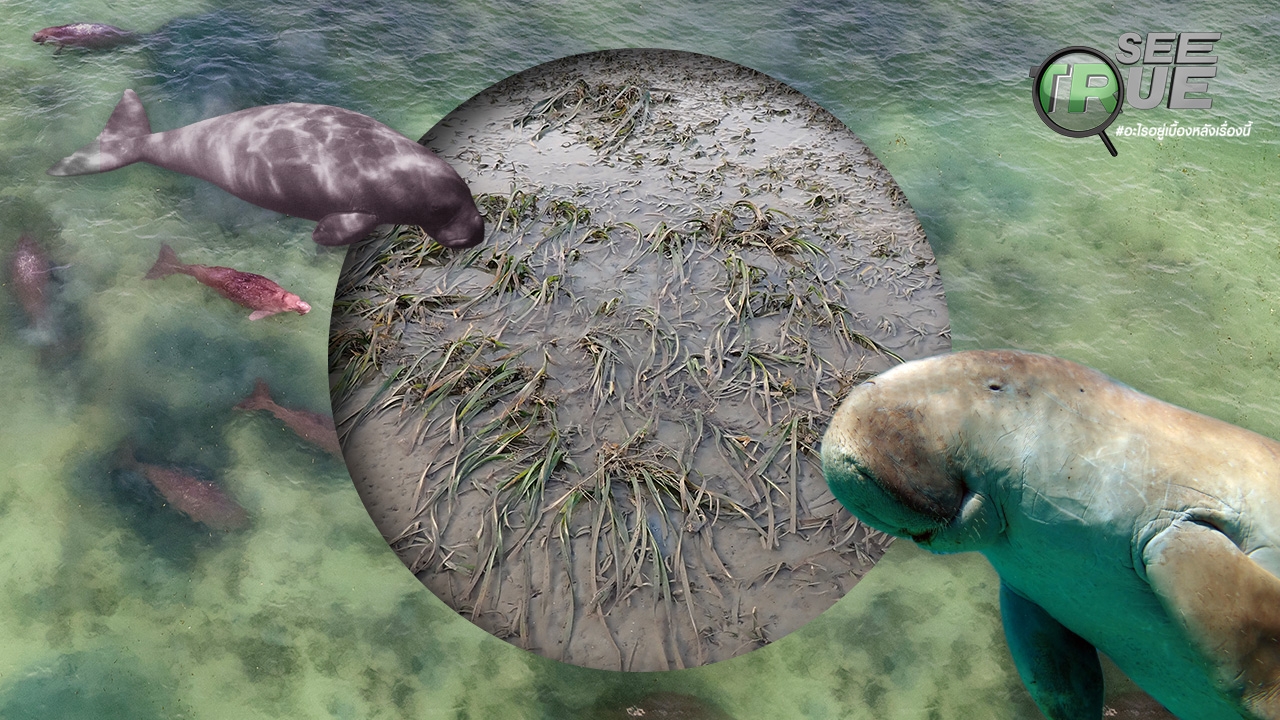
The situation of 'seagrass,' the primary food source for dugongs, is severely deteriorating with reduced density and a continuing crisis in long-leaf seagrass. However, recent positive signs show 'small-leaf seagrass' beginning to recover, which is easier to eat and regenerates quickly, offering hope for the conservation of Thai dugongs.
Following the distressing news on 9 Apr 2025, a dugong carcass with its head cut off was found stranded on a beach in Phang Nga Province. The autopsy revealed the dugong died from illness before its head was severed to remove the tusks due to local beliefs. There are suspicions this may be linked to ingestion of 'toxic algae'. These have replaced 'seagrass'. Seagrass, the dugongs' main food source, is increasingly degraded and disappearing due to pollution and global warming.
The SEE TRUE news team has closely followed the story of 'Andaman dugongs'. For over a year, they have tracked behavior, collected statistics, observed changes, including the critical threat of seagrass disappearance. 'Seagrass'.

Regarding recent developments in the 'seagrass' situation, latest, Ms. Natthawadee Bantivivatkul, a senior fisheries scientist, director of the Central Gulf of Thailand Marine and Coastal Resources Research Center, and coordinator for seagrass ecosystem management at the Department of Marine and Coastal Resources, revealed that in 2025 there was widespread concern over seagrass degradation.
This issue is closely linked to food sources and the extinction threat facing dugongs. Thailand's seagrass exists on both the Andaman and Gulf of Thailand coasts, with the Gulf of Thailand showing a 'relatively stable' trend, but the serious crisis occurs on the Andaman coast, which is showing a 'declining' trend, especially around Libong Island in Trang Province and Krabi Province, key feeding grounds for dugongs.
Comparing changes in seagrass areas in 2025 to the previous year, most areas showed a 'decline' (34%), followed by 'stable' (25%), 'natural decrease' (21%), and 'improvement' (15%). This reflects that over recent years, seagrass degradation in Thailand is a critical marine resource issue demanding urgent action.
"Looking back, Thailand's seagrass began degrading in 2020. Spatially, the area loss may not be clearly measurable, but quality declined, with seagrass density falling drastically in some areas to less than 10% coverage. Overall data for 2025 show most areas have low density, and this low-density percentage has steadily increased over the past five years."

Data from the Central Gulf of Thailand Marine and Coastal Resources Research Center show that in 2025, Thailand's total seagrass area was 98,578 rai, up 1% from 97,784 rai in 2024. However, on the Andaman coast, seagrass areas have continued to decline—from 74,737 rai in 2020 to only 56,055 rai in 2025.
In terms of quality, coverage has clearly decreased—from an average 33% coverage during 2020–2023, down to 28.77% in 2024, and further to 21.60% in 2025—indicating significant ecological degradation.
Over the past decade, seagrass coverage during the first period (2016–2020) was mostly 'moderate coverage' at 38–54%, followed by 'high to very high coverage' at 27–39%, and 'low coverage' areas at 19–23%.
In the later period (2021–2025), most seagrass areas fell into the 'low coverage' category at 20–65%, with 'moderate coverage' at 21–52%, and only 14–29% of areas maintaining good coverage or 'high to very high' levels.
The areas with the most severe seagrass degradation are Trang Province, including Libong Island and nearby locations such as Muk Island, Yong Lam Cape, Kham Bay, and Laem Sai village. Here, Enhalus acoroides (long-leaf seagrass) which is a dominant species crucial to the ecosystem, has suffered the most severe damage, showing clear signs of degradation such as leaf tip breakage, root rot, and decay, impacting overall seagrass ecosystem health.

Ms. Natthawadee explained that when seagrass areas degrade, dugongs lose food sources and migrate elsewhere. If they find no food after migrating, they begin to starve and suffer from malnutrition-related diseases.
Data indicate that dugong numbers in Trang Province have steadily declined from 188 individuals in 2022 to only 59 in 2025—an average loss of 35 dugongs per year. During seagrass degradation, dugong mortality increased due not only to illness but also accidents during migration to unfamiliar routes, where they encounter fishing gear set by locals. Dugongs traditionally did not migrate frequently.
However, in 2026, there are emerging positive signs, with some 'small-leaf seagrass' species, such as Makrut-leaf seagrass, turtle grass, and oval-leaf seagrass appearing in areas like Khlong Saphan Chang and Ban Pak Khlong in Trang Province, as well as Ao Nam Mao in Krabi Province. This reflects ecological adaptation in some areas, although the 'long-leaf seagrass' (Enhalus acoroides) which has been severely damaged, remains degraded with no signs of recovery.
"As seagrass in original areas begins to recover more, dugong herds have started returning to their traditional feeding grounds, especially on Libong Island in Trang. This year, seagrass is beginning to recover, particularly the small-leaf species, which regrow faster than the long-leaf seagrass that is still struggling to restore."

Studies of stomach contents from deceased dugongs show roughly equal proportions of both seagrass types, but dugongs prefer small-leaf seagrass because its young leaves are easier to eat. In contrast, mature long-leaf seagrass leaves are tough, like land grasses. The advantage of small-leaf seagrass is that after grazing, it regenerates rapidly—within about two weeks—whereas long-leaf seagrass takes months to regrow leaves.
To restore seagrass areas, agencies are pursuing four approaches:
1. Restoration, by planting seagrass in existing or new areas.
2. Rehabilitation, which involves environmental improvements such as reducing sedimentation, though this is challenging due to the large affected areas.
3. Natural propagation, through fenced-off zones where seagrass is sparse, to protect from grazing animals and fishing gear until the seagrass matures before moving fences elsewhere.
4. Restoring balance, an experimental approach releasing organisms like sea cucumbers into seagrass beds to reduce sediment and improve water quality, thereby promoting faster seagrass growth.
Ms. Natthawadee concluded by urging reduction of activities harmful to seagrass recovery, such as industrial wastewater discharge, dredging that increases sediment blocking photosynthesis, and coastal development projects.