

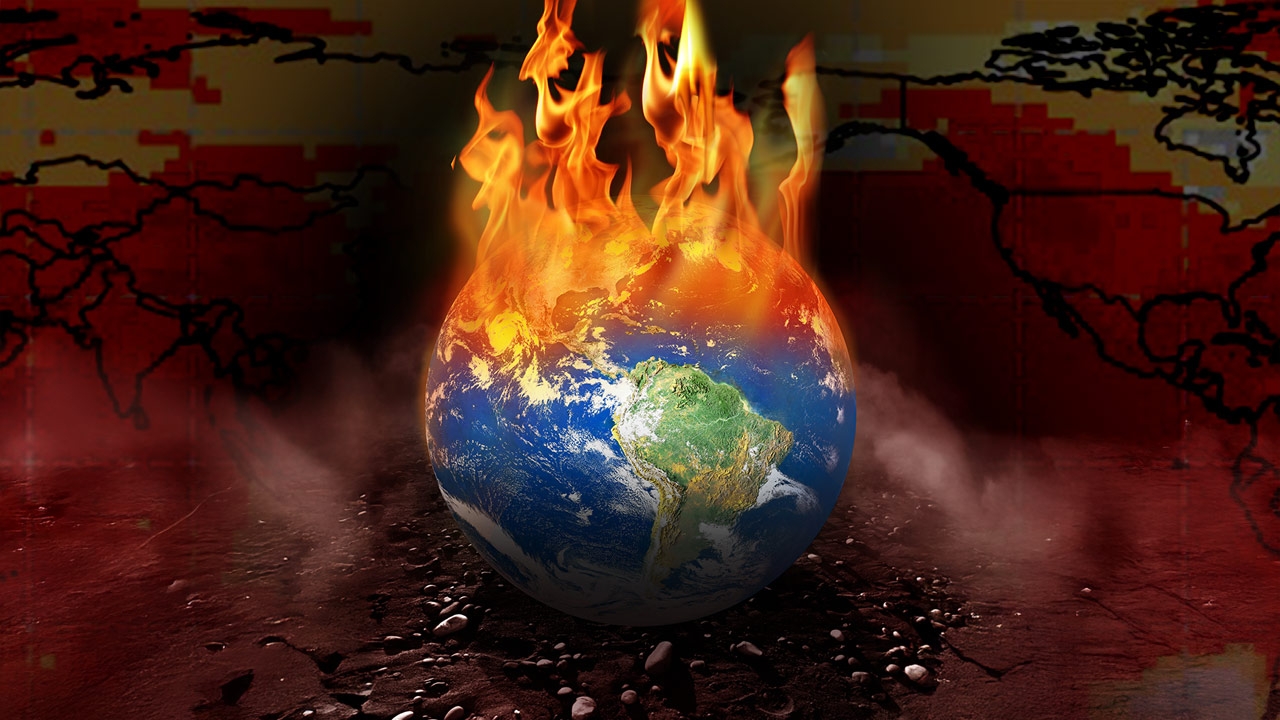
Prepare for rising global temperatures as the World Meteorological Organization (WMO) expects records to be broken between 2026 and 2030, with signs of an El Niño event late this year pushing 2027 to become the hottest year on record.
Many countries around the world are experiencing consecutive record high temperatures, with Europe currently enduring a severe heat wave causing the phenomenon known as a "Heat Dome". This occurs when a high-pressure air mass remains stationary over the European continent, trapping heat beneath it.
. In the United Kingdom, temperatures exceeded 35 degrees Celsius on 26 May, surpassing the previous May record by more than 2 degrees. The UK Met Office (MET) stated that such heat is highly unusual even during mid-summer, and it is still only spring.

France is also experiencing an unprecedented early-season heat wave, according to reports from Météo-France, the French national meteorological service. Hundreds of heat records have already been broken across the country.
. In Portugal, temperatures in Mora, a town in the central region, surpassed 40 degrees Celsius on 27 May, breaking the previous May record set in 2001.
Meanwhile, Ireland has broken its May temperature records, with readings 2 degrees Celsius higher than before, while Germany, Italy, Spain, and Switzerland are all experiencing unusually hot weather for the spring season.
Not only Europe, but other countries such as India are also facing intense heat. The India Meteorological Department reports that many areas in Uttar Pradesh and Jharkhand states have temperatures 3–5 degrees Celsius above average, while parts of northwestern and central India have temperatures reaching 43–47 degrees Celsius.

On 28 May 2026, the World Meteorological Organization (WMO) released a new report compiled by the UK Met Office (MET), which gathered and analyzed forecast data from 13 institutions, including four global centers: the Barcelona Supercomputing Center, the Canadian Centre for Climate Modelling and Analysis, the German Meteorological Service, and MET.
The report states that average global temperatures are likely to reach or approach record highs over the next five years, with Arctic temperature anomalies continuing to exceed the global average.
Forecasts predict that the average global surface temperature from 2026 to 2030 will be 1.3 to 1.9 degrees Celsius above pre-industrial levels (1850-1900). There is a 75% chance that the five-year average during 2026–2030 will exceed 1.5 degrees Celsius above the 1850-1900 average, though the probability of exceeding 2 degrees Celsius is less than 1%.
Additionally, there is over an 86% chance that at least one year between 2026 and 2030 will become the hottest on record, surpassing 2024's previous record of 1.55 degrees Celsius above pre-industrial levels.
Dr. Leon Hermanson, lead author of the report, stated that an El Niño event is predicted to occur in late 2026, increasing the likelihood that 2027 will be an exceptionally hot, record-breaking year.
Furthermore, five-year average temperature forecasts in the central equatorial Pacific Ocean (Niño 3.4 region) indicate a trend toward El Niño, particularly in 2027 and 2028.

The same report notes that Arctic winter temperatures (November–March) in the Northern Hemisphere are expected to be 2.8°C above the 1991-2020 average over the next five years. This anomaly is 3.5 times greater than the global average temperature anomaly during the same period.
Sea ice in the Arctic during March between 2026 and 2035 is projected to decline further in density in the Barents Sea, Bering Sea, and Sea of Okhotsk.
Regarding precipitation forecasts, wetter-than-normal conditions are expected at high northern latitudes during the winter months (November–March) over the next five years.

Rainfall is predicted to increase in tropical and high-latitude regions compared to the 1991-2020 average, but decrease in subtropical zones, especially in the Southern Hemisphere, aligning with forecasts of rising temperatures.
From May to September during 2026–2030, unusually heavy rainfall is expected in the Sahel region (bordering the Sahara in Africa), Northern Europe, Alaska, and Siberia, while severe drought conditions are predicted in the Amazon basin.