

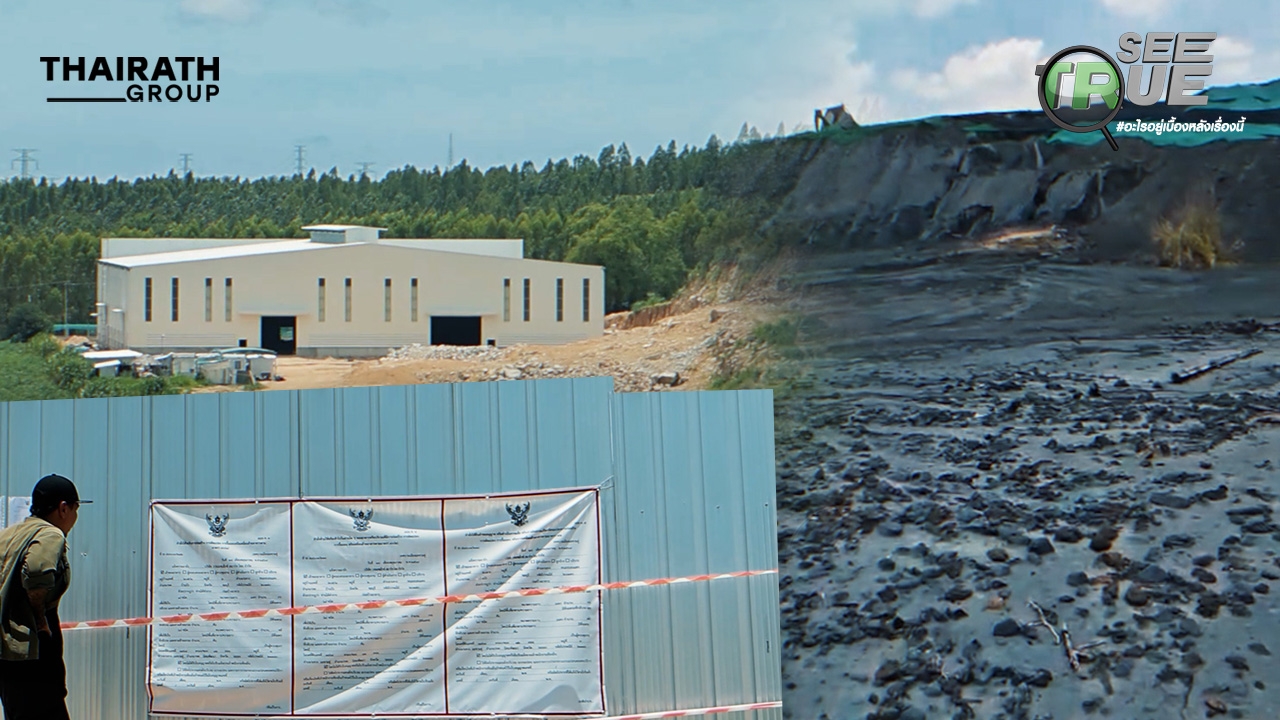
"Chinese-funded factories" aggressively build around communities, causing severe distress to residents who expected development but face pollution, foul odors, and rock blasting that cracks temples. They question whether regulatory agencies enforce strict inspections.
In Makham Khu subdistrict, Nikom Pattana district, Rayong province, attention has focused on several Chinese investors simultaneously constructing large industrial factories amid the community.
Although residents have protested and filed complaints about chemical odors, dust, noise, and large trucks coming and going all day, some factories previously ordered by authorities to suspend operations after community complaints have resumed construction.
This raises questions about whether these investors are truly boosting the local economy or degrading residents' quality of life. SEE TRUE news team conducted on-site investigation to uncover the facts behind this issue.

Interviews with locals revealed that the influx of Chinese investors began about seven years ago, following the announcement designating this area as part of the Eastern Economic Corridor (EEC). At that time, villagers believed prosperity was coming to their community.
Originally, the opposite side was zoned as industrial, but now these factories have encroached into the community center. The area was initially designated as green zone (rural and agricultural land) but was secretly changed to light purple zone (special industrial land) without informing residents; only government agencies were aware.
The arrival of Chinese-funded factories in the heart of the community, once hoped to bring economic growth, jobs, and income, has instead caused hardship, negatively affecting residents' daily lives.

“Pee Tua” One affected resident described the distress, saying these Chinese-funded factories often conduct construction at night, causing loud noise and releasing strong foul odors, especially from “resin.” This has severely impacted community health, particularly during the first four months when residents experienced coughing, sore throats, and irritation. Even the resident himself fell ill for seven days after entering the factory area due to the intense odor.
When asked about factory setup procedures, Pee Tua said representatives initially told villagers and brought Chinese investors who distributed gift baskets, claiming the factory would produce pillow covers without odors. However, it ultimately produced resin.
Villagers began filing complaints with relevant agencies, secretly documenting and monitoring the factory. The resin production factory, established in December 2024, was ordered to close and cease resin production on 22 March 2025 GMT+7.
Nonetheless, residents claim the factory continues to operate covertly, as some affected homes are only four meters away, where the smell is clearly detectable without surveillance cameras.
“No standards at all. You know resin smells and is hazardous, yet you just put up zinc and steel frames. What can that possibly block? I say this factory lacks any pollution control standards.”

During the investigation, it was found that on either side are villagers' homes, with the factory separated by just a fence. Although legal proceedings have halted construction, some clandestine building continues.
Residents reported that when immigration officers arrive, foreign workers panic and flee, hiding in villagers' homes, raising suspicion: if operations were legal, why would workers run from immigration inspections?
After obtaining this information, the team monitored the factory's perimeter, observing vehicles entering and exiting intermittently and a Chinese man—possibly the owner or construction supervisor—inspecting progress. The team approached the factory front and spoke with its caretaker.

The caretaker, a Thai speaker fluent in Chinese, explained the construction halt was due to deviations from approved plans. Construction must pause to correct issues before proceeding.
Regarding future production, he lacked detailed knowledge. This suggests that if the factory completes construction and reapplies for industrial permits, residents may again have to file complaints if operations harm the community. He expressed willingness to address issues.
“I am willing to fix everything. I ask for a chance to discuss; everyone makes mistakes.”
Villagers led the team to survey surrounding areas, finding several Chinese-funded factories under construction within five kilometers, where rock blasting disturbs residents and damages community structures such as “the crematorium of a temple.” Cracks have appeared.
“Because there was no space, they blasted rock right next to the temple to claim adjacent land. Could Thai people do that? They’d go to jail. But Chinese investors can do anything. This is excessive.”

Meanwhile, “a temple novice” reported being disturbed by the constant noise of backhoes and machinery, preventing monks from concentrating on religious duties. The blasting, done twice, was so intense it caused pigs to die from shock.
Additionally, inspection of the “temple’s crematorium” revealed significant new cracks extending to the chimney, clearly from blasting vibrations. Although the factory offered to pay for repairs and build a pavilion, residents feel the factory should exercise greater care and safety. Proper blasting involves drilling a central hole to reduce noise and shock, not single large blasts that cause such damage.
These impacts highlight threats from Chinese-funded factories to resources, environment, and community life. The question remains: how did these factories begin construction?

“Payoon Dam” an environmental advocate closely following this issue, revealed that factories suddenly began excavating and filling land without residents’ knowledge of what they intended to build, whether pollution would occur, or if permits were valid.
Upon investigation, “they found no permits whatsoever.” When residents complained, authorities inspected and ordered work to stop due to lack of permits, but construction soon resumed, repeating the cycle. This particular factory has been ordered to halt five times, suggesting government agencies are aware. Residents end up monitoring themselves, and although agencies visit upon complaint, this pattern persists.
“This cycle repeats endlessly. Our country should develop further, but with this approach, what benefit do residents get? Thai workers aren't hired, and illegal wastewater discharge and toxic waste dumping occur.”

Numerous Chinese-funded factories are emerging within Thai communities under the guise of “investment,” promising to boost the economy, create jobs, and develop the country, but the reality is foreign investors expanding businesses and profiting on Thai soil while locals bear the burdens and suffer hardships.
This raises questions about government enforcement: is oversight truly strict, or is someone allowing these factories to continue for certain benefits? Thailand risks becoming merely a business base for “zero-capital investors,” who reap profits while Thai people gain nothing.
Follow #SpecialScoopNews, the sharp investigative news variety show that probes and verifies facts on-site, exposing the truth every Saturday at 6 p.m. on Thairath TV, Channel 32.