

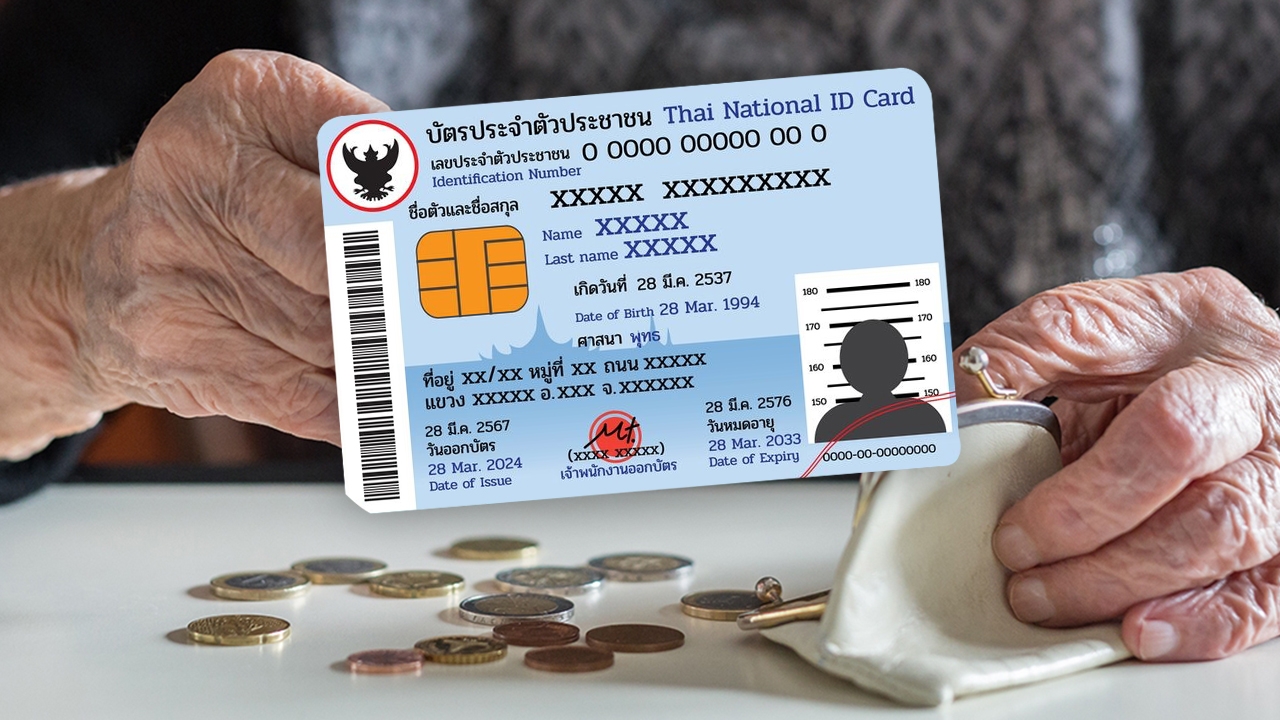
A heated online controversy quickly emerged after the government started registration and revised the screening criteria for the 'State Welfare Card,' or 'Poor People's Card,' in its new round. One heavily criticized criterion is the disqualification of elderly people whose children use them as tax deduction dependents.
This issue has caused considerable worry among salaried workers and their families, who feel pressured by the system and fear they might end up losing out in both directions.
Assoc. Prof. Dr. Yuttana Srisawat, founder of iTAX and deputy dean of the Faculty of Law at Siam University, told the Thairath Online special news team that the government's intention in linking tax criteria is from a fiscal discipline perspective. It is an attempt to screen recipients so that welfare budgets reach truly needy individuals, as studies have found many ineligible people have fraudulently claimed benefits.
Thus, the government assumes that if a parent’s child claims a tax deduction for supporting them, that parent already "has someone to care for them," so the state need not provide additional support, allowing funds to be redirected to those truly without caregivers.

Considering a rough calculation from the perspective of a lower- to middle-income salaried worker, suppose the child earns 30,000 baht per month (360,000 baht annually), placing them in the lowest 5% tax bracket.
On the tax deduction side, claiming one parent as a dependent (deduction of 30,000 baht) saves the child only 1,500 baht per year in taxes (about 125 baht per month).
By contrast, the State Welfare Card provides parents with monthly assistance for water, electricity, consumer goods, and travel expenses, totaling several thousand baht per month.
Even if the child is wealthy enough to pay the highest tax rate of 30-35%, the benefits from the 'Poor People's Card' still exceed the tax deduction savings. Many netizens lamented, "If I had known this, I would not have claimed the tax deduction to preserve the welfare card benefits for my parents."
Experts have expressed that this criterion may be "too strict and abrupt" because it does not consider the deeper realities of the economic structure.

Although the government's original intent was to plug fiscal leaks, the sudden announcement of criteria may cause more harm than good. Citizens now seek not only clear criteria but also "explanations and more flexible standards," such as including income ceilings for children, rather than outright disqualification just because a tax deduction was claimed.
Amid social media criticism, experts advise that "the public should voice their concerns loudly," as the government currently uses social listening to gather feedback. If citizens’ reasons are weighty and reflect real hardship, it is believed that after this registration round ends, the government will review and establish more detailed and fairer criteria for "dutiful children."