

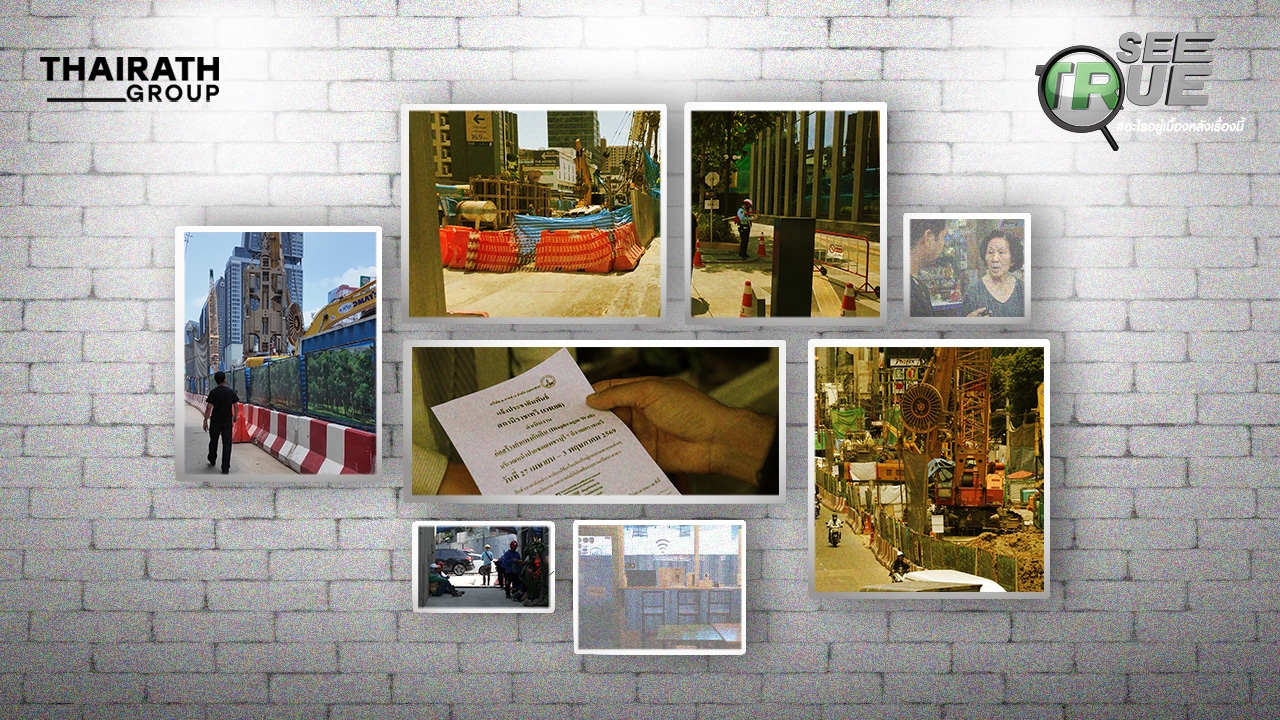
An investigation into the struggling "small businesses" along the Orange Line metro construction reveals severe impacts such as traffic congestion, dust pollution, and narrow pathways, which have caused all customers to vanish. Business owners express fear of "dying before thriving" and appeal to the new governor for solutions.
Large-scale government projects, especially various metro lines in Bangkok, currently lack regulations to support small businesses or vendors located along construction routes who suffer severe impacts. As a result, these businesses are gradually closing down before the construction projects are completed.
Small vendors on Phetchaburi Road near Ratchathewi intersection took the SEE TRUE news team to survey the shops that have gradually closed, a consequence of the Orange Line metro construction. Since early 2025,

"This area used to be busy. For example, Madinah restaurant had been here for over 10 years but has now closed. It only shut down when the Orange Line construction began because they said operating was no longer profitable," said Aneesah Lateh, the owner of a restaurant and hostel. On-site, she showed various shops that have shut down after the Orange Line construction reached Phetchaburi Road near Ratchathewi intersection.
She said that shops still trying to operate are in similar dire conditions, with almost no customers because the area has been cordoned off, leaving only narrow walkways where people must squeeze past each other. Additionally, dust from construction discourages customers from coming.
Her own restaurant and two-room hostel remain quiet all day, with only the noise of construction machinery and Myanmar workers nearby breaking the silence.
"There are no customers. Normally at this time (around noon), it’s very busy. I usually get foreign customers, but since before New Year 2025, it’s been dusty and empty. Last month, a staff member got sick from the dust. Every day there’s loud drilling and banging noises," she explained.

She emphasized that she does not oppose progress, but when such large projects cause harm to small businesses like hers, she wants authorities to care for and support these small businesses until the project is finished and prosperity arrives.
"So far, no agency has approached us to discuss whether we can still operate, what damages we have, or how much our income has dropped. The voices of the locals are barely heard, and there are no clear regulations about assistance," she added.
She also said she asked the construction company about the impacts on people and businesses along the route but was referred to discuss with the project owner. When calling the Mass Rapid Transit Authority, she was told there is no policy to assist affected businesses.
Aneesah then took the SEE TRUE news team to another restaurant, which was similarly deserted even during lunchtime.
"We rent this place, not own it, paying 25,000 baht monthly. We’ve rented for many years. Before, customers were so many we never sat down. Now, customers come infrequently. Some days I even lie down waiting for customers, which never happened before. It’s stressful. I had to borrow money, hustle to pay rent—headaches and stress everywhere,"
said Maroi Sa-lae, the Thai restaurant owner. Operating for many years at Ratchathewi intersection, she described the challenges small businesses like hers and others face since the Orange Line metro construction began in early 2025.

Most of her restaurant’s customers are foreign tourists from Malaysia, Indonesia, and Singapore, who used to come mainly on weekends. Now they no longer come because taxis refuse to enter the difficult-to-access construction area.
"I talked to some construction supervisors, and they told me to report to the Rama 9 office (the project owner’s office). I haven’t gone there yet, I don’t even know where it is. When I can’t manage anymore, I want to talk to them because I have no money to pay rent," Maroi said, urging project owners to help struggling small businesses.
The news team also spoke with the longtime eyeglasses shop at Ratchathewi intersection, which has been severely affected. Regular customers avoid coming due to difficult access, and new customers do not exist because the shop is located in an active construction zone that seems unwelcoming to any business.
"Most of our customers are regulars, but even they find it hard to come now. They say they want to come but their children refuse to bring them because travel is difficult, taxis don’t come here, and access is tough," said Chatporn Kasemprasatporn, the eyeglasses shop owner, describing the hardships while revenue has dropped by more than half.

"For example, we used to make several hundred thousand baht monthly, but sales have dropped by half, sometimes even 75 percent. That’s not enough to cover expenses. If this lasted a year or two, it would be bearable, but the project says it will take about 5 or 6 years, making this a long-term impact."
Moreover, dust and vibrations from the construction have affected the health and mental well-being of everyone in the household.
"We want assistance because the project duration is long. We want compensation for lost income. They must help because our expenses certainly don’t disappear," Chatporn pleaded, calling on project owners to care for those affected.
The Orange Line metro section from Bang Khun Non to the Cultural Center began construction at the end of 2024, with a 5-year timeline scheduled for completion in 2030. However, just one year in, small businesses near Ratchathewi intersection have been heavily affected, with some unable to bear costs and closing down.
Although Thailand currently lacks regulations to support small businesses affected by large-scale construction projects, examples exist abroad. In the United States, the Los Angeles Metro subway project established a fund to compensate affected small businesses. Similarly, the UK's high-speed rail project set up a fund to aid impacted residents.

Therefore, these small business owners want Bangkok Metropolitan Administration, as the local authority, especially the new governor, to intervene and coordinate with project owners to find ways to support and sustain these small businesses until construction completes, because their voices are so faint that project owners may not hear them.
Follow the SEE TRUE mission to reveal the truth in the special episode "A Better Bangkok," airing continuously from 9-22 June 2026 on Thairath News Show after 9:00 p.m., available on YouTube at Thairath News and on Facebook at Thairath.