

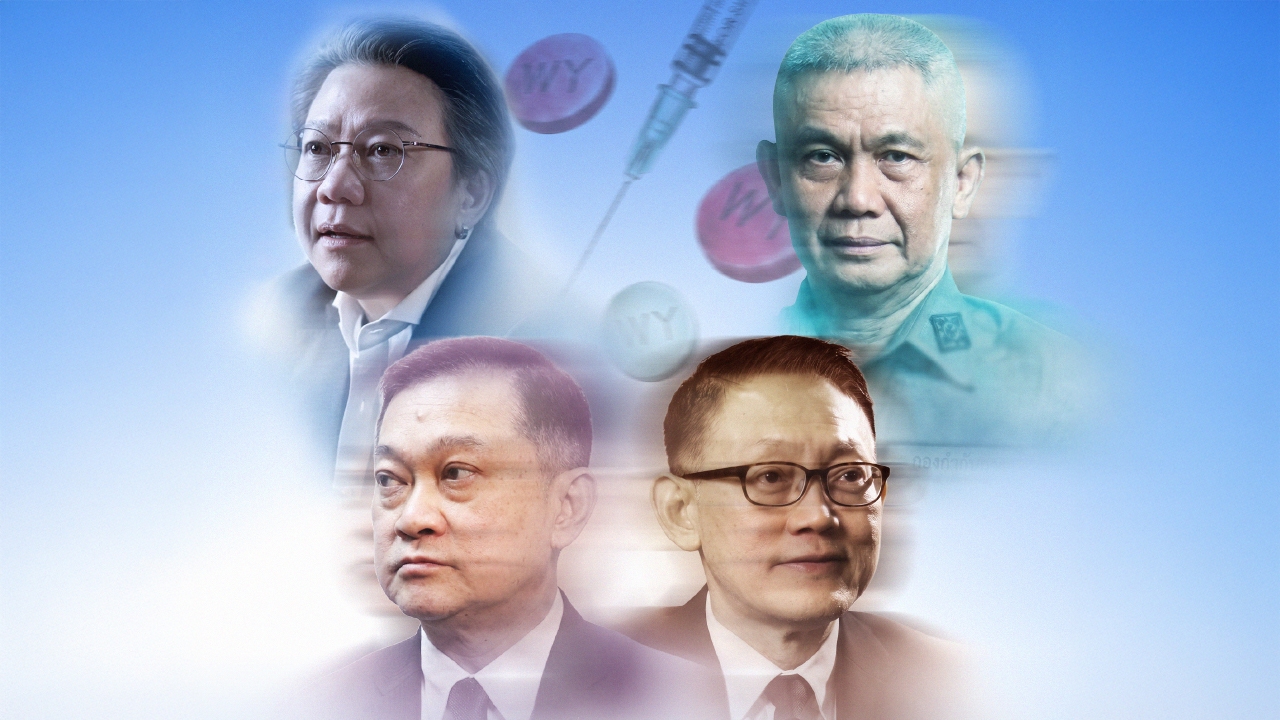
The policy path to solving drug problems in Thailand involves Harm Reduction strategies implemented by four government agencies—Public Health, the Office of the Narcotics Control Board (ONCB), local authorities, and the police—transforming drug users from criminals into patients and restoring human resources to society.,
Over several decades of Thailand's drug problem response, the country is currently undergoing a policy transition, seeking to move beyond the old stereotype that views "drug users" as "criminals" —offenders who must be removed from society. This mindset led to harsh suppression measures that have proven ineffective in resolving the issue.
The approach now shifts to new concepts and methods, viewing "drug users" as "patients" —similar to other chronic illnesses that can be treated successfully, enabling individuals to return as vital contributors to the country through therapy and Harm Reduction strategies.
In civil society, private agencies and non-profit organizations actively work on the ground to build understanding. At the government level, under the 2021 Narcotics Act, users who voluntarily enter treatment face no criminal penalties, while enforcement against traffickers has intensified.
Nevertheless, despite policies and laws, social understanding and frontline staff practices still face significant limitations and gaps requiring coordinated progress.

With the law defining drug users as "patients," the first crucial sector is Public Health, responsible for policy and treatment. The main agency in charge is the Boromarajonani National Institute for Drug Abuse Treatment (BNIDAT), under the Department of Medical Services, Ministry of Public Health.
Dr. Sarayuth Boonchaiyanitwattana, director of BNIDAT, explains that BNIDAT manages drug users across three main dimensions. The first is as a medical facility, caring for complex drug patients beyond other hospitals' capacities, stabilizing them before returning them to their communities for ongoing care.
The second dimension is as a standard setter, defining procedures for establishing drug treatment facilities, developing treatment curricula, providing training, and monitoring quality compliance.
The final dimension is to provide policy recommendations for patient care, which enabled Harm Reduction to be incorporated as a treatment method under Section 108 of the current Narcotics Act.
With over 36 years working on drug issues, Dr. Sarayuth summarizes that methamphetamine remains the most prevalent drug in Thailand, appearing in two forms: pills mixed with other substances known as "yaba" and the pure powdered form known as "ice." However, in some regions and periods, other substances like opium or heroin may dominate, such as in southern or certain northern areas.
Regarding users, the age of those entering treatment has steadily decreased from late twenties and thirties to predominantly teenagers aged 15 to early 20s. Additionally, while males still form the majority, the proportion of female users has increased.
"The drug problem is not easing; younger users and more females are appearing. Notably, hospital patients overall show more severe conditions, with longer inpatient stays needed. Causes may include some drugs being decriminalized, leading users to delay treatment until symptoms worsen," he said.

Regarding measuring success, Dr. Sarayuth emphasizes that drug addiction is a chronic illness like diabetes or hypertension, not easily cured, and relapse is common. The approach should avoid stigmatization and instead offer ongoing opportunities for treatment.
"Drug patients deserve compassion because unlike other patients, most users don’t realize they are ill. Families, relatives, or community leaders often must bring them for treatment," he stated.
Dr. Sarayuth acknowledges that although Harm Reduction is academically accepted, it still conflicts with many people's feelings, including some officials, because it is a flexible approach focusing on improving quality of life—from health to family and social relations—rather than solely on cessation of drug use.
"People often think stopping drug use entirely is the best outcome, which is understandable. For some, such as heroin patients with complex symptoms, we must accept they might use methadone as a substitute lifelong, as is medically accepted worldwide, so long as they avoid heroin use," he explained.
Thus, building understanding among families, acquaintances, government officials, and community leaders that drug users are patients, engaging in positive dialogue and avoiding stigma, is crucial for encouraging treatment entry. Such conversations require genuine belief in this approach.
"Imagine a community with a drug user. One community offers positive support and encourages treatment, allowing the person to return and contribute, while another excludes them. Rejection makes users feel worthless and less likely to seek help, as stigma persists," he noted.

Since hospital treatment alone is insufficient and unsustainable if patients return to unprepared or unaccepting environments,
BNIDAT and the National Health Security Office (NHSO) have promoted rights and harm reduction treatment programs emphasizing community understanding and participation through the "Community-Based Treatment and Rehabilitation (CBTx)" project. Users live at home with neighbors helping to support their care.
Dr. Sarayuth points out that the government aims to allocate budgets but also encourages communities to actively participate in planning and implementation, which is more effective than simply funding projects without local context. Some rehabilitation centers arise organically, such as temples where families bring users for monastic care, often successfully leading to cessation, and these can qualify for NHSO funding if meeting standards.
"We want patients to live within their communities, attending counseling and group activities at village halls or local leaders’ homes by day, returning home at night, demonstrating they no longer pose a threat, so the community accepts their presence," he explained.

Dr. Jadeth Thammathacharee, Secretary-General of NHSO, noted that although hospital treatment costs have been reimbursable, treatment pathways cannot be completed solely in hospitals.
Over the past decade, related agencies have discussed comprehensive drug problem solutions. NHSO already collaborates with local administrative organizations through local health funds and seeks to expand these funds' use for community drug problem activities.
"We promote community groups to organize projects for drug user care, from prevention to rehabilitation. When communities unite, we want local authorities to support budgets by approving projects, rather than NHSO centrally funding all efforts, considering there are over 7,000 local administrations nationwide with systems to receive such projects," he said.
Activities vary by local context. NHSO sets broad guidelines on possible activities, including prevention before drug use onset by strengthening community cohesion through exercise and awareness campaigns.
For users returning to communities after treatment, projects might include home visits to monitor recovery, medication adherence, or community surveillance to prevent relapse.
"Strong communities might use temples, village health volunteers, local leaders, or administrative bodies as mechanisms. We document lessons and exchange knowledge among communities, a distinctive Thai approach," he added.
Dr. Jadeth emphasized that drug problems are larger than perceived. Some may think they can avoid issues by moving elsewhere, but sometimes this isn’t possible. Even one’s own children may face drug risks. Without community involvement, anyone could become a victim.
By strengthening communities’ awareness and action, alongside partial NHSO funding support, the overarching drug problem can ultimately be solved by the communities themselves.

Dr. Jadeth explained that under the health security system, benefits and services are assessed for economic value considering outcomes for patients and society. Since many users are of working or adolescent age, activities enabling them to live productively or reduce drug use are valuable investments, supported by research.
"If these individuals receive care enabling them to live and work productively, the return on investment compared to treatment costs is worthwhile. Thus, benefits must cover not just treatment but also prevention and rehabilitation for a comprehensive approach," he said.
Currently, no definitive cure exists for drug addiction, which involves behavioral, environmental, resilience, family, and community factors. Past experience shows that enforcement alone is not 100% effective, so multiple approaches are needed. Harm Reduction, treating users as patients and integrating them into health systems, has proven effective for long-term solutions.
"Those with direct experience know that drug users need medication during a so-called rehabilitation phase. This transition is critical, and society must learn to accept it—not judging or promoting drug use but understanding that reduction or cessation takes time," he added.

Areepak Nernbamrung, Deputy Secretary-General of the Office of the Narcotics Control Board (ONCB), added from a law enforcement perspective that when drug use was criminalized and punishable by arrest and imprisonment, Thailand lost significant human resources, especially as it becomes an aging society.
People released from prisons often face social rejection, employment difficulties, and become public financial burdens, with family and community acceptance problems, leading to recidivism.
"The state invests heavily in human development from birth, compulsory education to grade 12. If we lose someone who could be helped, why not restore them as valuable national resources?" he asked.
Areepak said that with growing human rights awareness and laws classifying users as patients separate from dealers, ONCB’s work has evolved accordingly.
The approach shifted from imprisoning users to a health-centered view recognizing everyone’s equal dignity. Those who want to recover should have opportunities and support.
Conversely, enforcement against dealers has intensified. ONCB’s core functions expanded from four—prevention, suppression, treatment, and management—to seven, adding international cooperation, asset seizure from trafficking, and community participation enhancement.

"Drug dealers are effectively killers because overdoses can be fatal anytime. ONCB and other law enforcement agencies uniformly regard dealers as criminal organizations requiring coordinated action, since production, transport, and sales form a vicious cycle funding other crimes," he explained.
ONCB coordinates internationally as drug problems transcend borders, though solutions vary by societal context. All member countries of the International Narcotics Control Board agree on treating users as health issues. Harm Reduction, a Western concept, has been adapted in Thailand.
"We accept some Western approaches but tailor them to Thai culture, emphasizing community care as the smallest social unit after family. If communities care for their members and communicate needs to the government, policies can be adjusted for accessibility rather than relying solely on law enforcement," he said.
Currently, ONCB works with Public Health on Harm Reduction, focusing on educating law enforcement, many of whom misunderstand initiatives like clean needle programs and may perceive them as supporting users or traffickers.

Areepak hopes that in 5-10 years, government agencies will share a unified understanding of drug problem solutions aimed at reintegrating users into society, alongside public acceptance recognizing drug issues as common health concerns. Users seeking treatment would access public health systems like other patients, then return to society and work.
If government and society share this understanding and work stepwise together, peaceful coexistence with drug issues is possible, as no society globally can eradicate drugs entirely.
Therefore, societies must be safe and drug-aware, knowing how to minimize harm if cessation is not yet achieved, protecting themselves, families, and communities.
"We want society to be open to those who have erred in drug use, acknowledging everyone makes mistakes. When someone goes astray, we should reach out to offer a chance to return as valuable human resources, rather than deepening wounds that prevent their return. If these were our children, we would want them back—holding their hand and saying, ‘It’s okay, stop now, let’s work together.’ This is the highest aspiration of drug workers," he concluded.

The police are a key component in drug problem solutions, traditionally enforcing laws and making arrests. With changes in drug laws, their role now also includes being a "buffer,"
preventing violence related to drugs and facilitating rapid access to help for users, families, and communities. Lieutenant Anan Prasongjai, Community Relations Crime Suppression Inspector at Huai Khwang Metropolitan Police Station,
explained that under current drug laws, users are patients. Voluntary entry into treatment before arrest falls under Section 113; if discovered by authorities, Section 114 applies. If users consent to treatment and meet conditions without dangerous behavior, they face no criminal charges. Failure to meet these conditions results in prosecution.
"Each arrest must be evaluated individually. Early users with mild symptoms are directed to treatment; repeat offenders face legal action; those with psychiatric symptoms must be promptly referred. Avoiding generalizations improves management and targeting of different user groups," he said.
Regarding Harm Reduction, Lt. Anan admitted initial confusion about its utility and acknowledged police have been conditioned to view drug users as criminals due to associated offenses like theft or violence, leading to negative attitudes and sometimes disregard for users' dignity.
However, through working with volunteers who are users yet maintain health and employment, he began to learn and engage with various groups.

"Initially skeptical, I realized no definitive cure exists, but we can help users improve health and, over time, possibly seek serious treatment. Drug problems are health problems. Promoting health enables quitting, but initially, preventing harm to self and others is crucial," he explained.
Lt. Anan also noted that after 30 years working with users, not all are dangerous. Depressant users mainly harm themselves, so Harm Reduction focuses on health risks like infections and methadone use.
For stimulant users prone to violent outbursts, Harm Reduction aims to prevent harm to family and community. Police must gather intelligence to anticipate and block risky behaviors swiftly.
Early detection requires building intelligence networks and trust with users, families, and communities. Lt. Anan described daily work collecting drug-related intelligence, communicating with local schools to raise awareness and enable reporting, engaging villagers, and creating community Line groups for information sharing.

"For example, at Samsen Nok School with over 3,000 students, every Thursday I visit to discuss these issues and provide contact numbers, creating a network of thousands aware and connected. When parents see their children know me, it builds relationships," he said.
This approach has succeeded, with student networks reporting drug user gatherings leading to arrests and treatment, neighbors alerting authorities to risky behaviors, and users themselves seeking help before violent episodes.
"Recently, a methamphetamine user experiencing violent outbursts voluntarily contacted police before harming family. Police intervened to calm and transfer him, reducing harm," Lt. Anan recounted.
Though some users are dangerous, statistics show fewer than society assumes. Police classify cases into green (no symptoms), yellow (manageable symptoms), orange (increased symptoms, paranoia, manageable for 48 hours), and red (aggressive, high risk requiring action within 24 hours). Currently, Huai Khwang station has 12 red cases.
This aligns with ONCB data showing most dangerous users have psychiatric symptoms. With 66 million Thai population, about 250,000 enter treatment annually (0.38%), with fewer having mental symptoms.
Lt. Anan believes Harm Reduction reduces crime by fostering understanding and removing stigma. He believes users can quit or maintain quality of life, reducing criminal behavior.
"Past laws were made by non-users focusing on control, overlooking some contexts. Drugs are dangerous and must be controlled, but quitting is very difficult. Society now focuses on safe coexistence while preventing new users," he said.

Also, drug trafficking must be suppressed, especially small dealers. If dealers are reduced, drug access becomes harder, encouraging treatment entry.
"Local health centers report increased methadone use for heroin treatment, mostly by existing patients. Earlier this year, about 7 kilograms of heroin were seized in a Din Daeng area flat, affecting local users. Without heroin, users experience withdrawal and turn to methadone, bringing them into treatment," he explained.
Thailand's next step may be synchronizing all sectors to simultaneously suppress dealers decisively and treat users with understanding, supported by communities that offer opportunities without rejection.
Recognizing Harm Reduction is a shared responsibility among government, civil society, communities, families, and users themselves, working together not only resolves drug problems but restores humanity, returning children to family embraces and reintegrating human resources into society.