

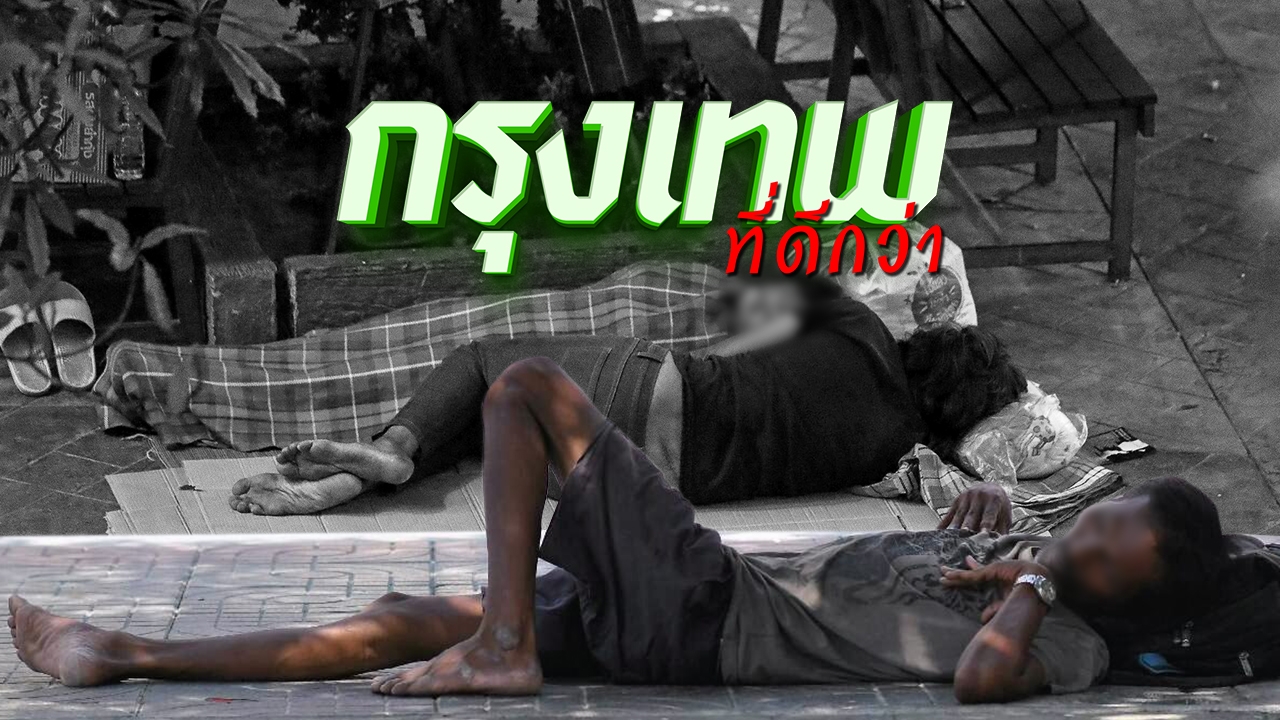
This article reveals the latest statistics and locations of homeless people in Bangkok, explores why assistance efforts often see them return to homelessness, and presents the Ministry of Social Development's new approach shifting from "arrest and detention" toward creating "homes, jobs, and rights" to address root causes and reintegrate them into society with dignity and respect.
Currently, Bangkok has a large homeless population. According to 2023 data, there are 1,271 homeless or street people in the city. The highest concentration is in Phra Nakhon district, with 585 individuals, accounting for 46.03% of the total. They typically reside in key public areas such as Sanam Luang, Ratchadamnoen Road, Khlong Lot, and around government offices or major community centers.

The districts with lower numbers are as follows:
Chatuchak district has 96 homeless individuals, representing 7.55%.
Yan Nawa district has 78 people, accounting for 6.14%.
Bangkok Noi district has 59 people, making up 4.64%.
Pom Prap Sattru Phai district has 47 people, or 3.70%, respectively.
These figures reflect that economic centers, transportation hubs, and large public spaces remain primary locations where homeless people sustain themselves and reside in Bangkok.
From recent data on users of the Bangkok Center for Protection and Quality of Life Enhancement for the homeless between October 2025 and now, there are currently 213 homeless individuals. The districts with the highest numbers are:
Pathum Wan district, with 59 people, accounting for 27.70%.
Phra Nakhon district, with 55 people, making up 25.82%.
Chatuchak district, with 35 people, representing 16.43%.
Laksi district, with 8 people, or 3.76%.
On Nut district, with 4 people, accounting for 1.88%, respectively.

Regarding homeless or street people, operations are conducted on a regular basis.
Currently, the Ministry of Social Development has shifted its approach from "arresting, forcing, and detaining" to peaceful engagement using professional methods to reach homeless individuals and understand their real problems.
If someone is identified as homeless or without support and shows no signs of mental illness, the Ministry ensures they undergo medical examinations and communicable disease screening by doctors first. This prevents the spread of diseases to other service users within the agency.
Protecting and rehabilitating the quality of life for homeless and unsupported individuals requires integrated teamwork among social workers, psychologists, medical personnel, and related agencies to provide comprehensive support covering physical, mental, social, and fundamental rights aspects.
According to the Protection of the Destitute Act of 2014, which governs protection, rights, and rehabilitation under social welfare, human rights, and consent principles, the goal is to safeguard welfare and improve the quality of life for destitute individuals, including street people. Relevant agencies must survey, assess issues and needs to plan appropriate assistance tailored to each case.
Destitute individuals in Bangkok are targets of the Department of Social Development and Welfare. However, the Act does not impose penalties on these individuals. Section 22 states that if someone is accused of offenses related to residing in public spaces under laws or local ordinances, officials must send that person to a protection center with the individual's consent.
Regarding local legal enforcement, the Cleanliness and Orderliness of the Municipality Act of 1992 applies. Section 37 prohibits sleeping in public places, with a fine of 500 baht for violations. Section 43 assigns the Governor of Bangkok responsibility over official staff's enforcement.
Therefore, those managing initial responses must include authorized officers under the Cleanliness and Orderliness of the Municipality Act, as the Ministry of Social Development has no role in arresting, fining, detaining, or any human rights-violating actions as defined by law.
All actions must respect human dignity and freedoms, and no one may be forced, moved, or restricted in public spaces without consent or lawful justification.
If the public encounters homeless people or street individuals, they can report to the Ministry of Social Development via hotline 1300, the "พม. Smart" application, or local district offices for coordinated assistance efforts.

The Department of Social Development and Welfare has established homeless service coordination points (Drop-in centers) in public areas twice weekly. Locations include Baan Im Jai at the former Maen Si Waterworks office in Pom Prap Sattru Phai district and under Somdet Phra Pinklao Bridge in Phra Nakhon district, key gathering spots for homeless people.
These centers provide protection of rights and basic services such as guidance on accessing rights/welfare, ID card issuance, quality of life promotion and self-reliance services including health care, return to hometown arrangements, temporary shelters, job placement, urgent assistance, and other services like distributing survival kits, food, bathing, haircuts, and laundry.
Table showing the number of users at the homeless coordination points (Drop-in) of the Bangkok Center for Protection and Quality of Life Enhancement from October 2025 to April 2026.
Services | Number of users (people) | |
Protection of rights and basic services | 1. Rights/welfare guidance | 704 |
2. ID card issuance | 220 | |
Quality of life promotion and self-reliance | 3. Health services | 408 |
4. Return to hometown | 0 | |
5. Temporary shelter | 0 | |
6. Job placement | 0 | |
Urgent assistance and other services | 7. Survival kit distribution | 0 |
8. Others (food, bathing, haircuts, and laundry services) | 396 |

"Homeless psychiatric patients" are individuals diagnosed with mental illness who live on the streets or public areas without permanent housing, lacking caregivers or adequate social support systems. This may affect their ability to live independently, care for themselves, and access continuous medical treatment.
They are a vulnerable group needing medical treatment, social rehabilitation, and welfare protection through integrated efforts by health, social work, and relevant agencies to enable appropriate social reintegration and improved quality of life.
The Department of Social Development and Welfare operates under the Mental Health Act of 2008, which allows individuals who are dangerous or need treatment to be taken for care. Witnesses can notify officials, administrative officers, or police to take such persons to government hospitals or treatment centers, even if the patient does not consent to hospitalization.
Section 23 states that anyone who finds a person exhibiting signs of mental illness or danger must promptly notify officials or police.
Section 24 directs officials or police who receive such reports to take the individual to a hospital for diagnosis. Physical restraints may only be used if necessary to prevent harm to the individual, others, or property.
The Ministry of Social Development's involvement begins after hospital treatment ends, relying on Section 40, which states that if a patient improves, relatives should be notified to take them home. If no caregiver exists, social welfare agencies must be informed. Patients cannot be discharged themselves.
In practice, even if the Ministry is notified about psychiatric patients, coordination with officials and police is necessary to admit patients for medical treatment before further action. The Ministry also collaborates with psychiatric hospitals for assessment and screening to ensure genuine recovery, as it lacks sufficient medical, nursing, public health, psychology, and physical therapy personnel.
Overall, public administration follows principles of rights protection and human dignity, focusing on rehabilitation and capacity building rather than coercive measures. However, systemic limitations remain in protection center capacity and the complex nature of target groups, especially those with mental health or substance abuse issues requiring long-term integrated care.

The recurrence of homelessness among some groups stems from several causes.
1. Unresolved conflicts: Over 52% of homeless individuals have experienced severe family problems. When sent back, if root issues like disputes or violence persist, they choose to return to the streets, feeling more comfortable there.
2. Not wanting to be a burden: Many refuse to impose on family members, especially when lacking income, preferring to live alone.
3. Some homeless people do not wish to receive government services because they remain capable of self-support and work. Additionally, shelters often house many psychiatric patients, deterring those mentally sound from staying.
4. Alcohol or substance addiction: Addiction makes adjustment to normal work or society difficult. Without continuous treatment, they often relapse into homelessness.
5. Negative societal perceptions limit fair employment opportunities, causing a lack of sustainable income.
Overall, past solutions have not fully addressed comprehensive needs, especially securing life stability post-rehabilitation, such as employment, housing, and social relationships. Current strategies focus on tackling root causes alongside sustainable support systems.
In particular, Bangkok and inner economic zones are strategic areas where some homeless people choose to stay due to job opportunities and daily wage work availability.

Previously, the government shifted roles from mere welfare to opportunity creation, implementing key measures such as supporting housing through cost-sharing, promoting employment, and engaging communities and partners to collaboratively care for target groups—emphasizing social partnerships over government-only actions.
1. Protection centers and shelters: The Department of Social Development and Welfare operates 11 protection centers nationwide, providing basic needs, medical care, and vocational training.
2. The "Baan Im Jai" project (Bangkok): In 2026, Bangkok and partners opened a temporary shelter at the former Maen Si Waterworks building, accommodating 200 people. It follows the "6 As" principle (Housing, Food, Hygiene, Clothing, Occupation, Savings) and does not require criminal background checks to reduce access barriers.
3. Emergency Shelter Model: Drop-in points are improved for homeless people to access showers, laundry, and counseling without overnight stays to allow flexibility aligned with their lifestyles.
Proactive policies and rights protection
1. Homeless coordination points provide mobile ID card services to enable access to state welfare, such as the 30-baht health card or elderly allowance.
2. Employment: The government supports hiring homeless people in agency activities like street sweeping or public space maintenance to generate income and reduce reliance on donations.
Currently, homelessness solutions are systematic and integrated, emphasizing prevention of homelessness onset, increasing affordable housing access, linking to employment systems, and developing comprehensive and accessible welfare systems. Two key mechanisms include:
1) Housing welfare — Establishing stable lives by directly subsidizing destitute individuals’ housing costs, including rent up to 1,500 baht/month, utilities up to 500 baht/month, clothing and bedding up to 2,000 baht per person, with partners jointly implementing the system.
2) Foster family welfare — Rehabilitation through family and community support, encouraging destitute individuals to live in family-like environments. The state provides 5,000 baht per month per family for close care to reduce isolation and foster social warmth.
Addressing homelessness is a key government priority as it reflects inequality and lack of access to basic rights. Stable housing is emphasized as the starting point for life foundation, job creation, and sustainable social reintegration.
The Ministry of Social Development has significantly shifted its role from "provider" to "opportunity creator," aiming to "build a prosperous, opportunity-rich society for all Thais." It focuses on systematic work, data and technology integration, and multi-sector participation to prevent recurring problems.
Ultimately, the goal is not just to reduce visible homelessness but to enable all citizens to live with dignity, security, and sustainable reintegration, a core element of sustainable social development.