

Cambodia's military is strengthening with Chinese weapons, while Thailand's slower response puts it at a disadvantage on the border. Associate Professor Dr. Dulyapak interprets China's strategy as something Thailand cannot counter, while keeping an eye on the U.S. as it maneuvers to balance power.
Has the Third Round of War already begun without our awareness? Attention focuses on the strategic game along the Thailand-Cambodia border as Cambodia adjusts its plans, quietly gathering intelligence while awaiting a major outbreak of conflict. Meanwhile, China and the U.S. are making diplomatic and military moves. Decoding the appearance of Chinese tanks in Cambodia raises the question: what exactly is Thailand facing?
Regarding the ongoing tensions and clashes between Thailand and Cambodia, recent Chinese deployment of tanks to Cambodia has raised questions about the relationship between the great power China and Southeast Asian countries. The Thairath Online special news team spoke with Associate Professor Dr. Dulyapak Preecharat, president of the Regional Studies Association and faculty member at Thammasat University, who analyzed that China and Cambodia have maintained a close relationship for over 10 years, since Hun Sen became the supreme leader.

Hun Sen's "Quadrilateral" strategy emphasized agricultural development and infrastructure, with China providing assistance. Recently, their relationship has evolved into a strategic partnership, especially in defense cooperation, including collaboration between the ministries of defense and foreign affairs, and military aid. Therefore, China's delivery of arms to Cambodia amid conflict with Thailand is a significant issue affecting regional peace and Thailand's trust in China.
When asked about opinions that China gave tanks to Cambodia to gain control of Cambodia's Ream Port, Associate Professor Dr. Dulyapak said China views several Southeast Asian countries as sources of investment and interests, grouping Thailand, Myanmar, and Cambodia together. If conflict arises between Thailand and Cambodia, China will seek to help end it, since any fighting would jeopardize its overall investments like the Belt and Road Initiative and mega port projects.
“Currently, China is not taking sides—it neither supports Cambodia to attack Thailand nor supports Thailand to pressure Cambodia. China maintains relations with these countries to coordinate broader shared interests.”
Thailand's strategic response is to maintain a balance of great powers, not choosing to side with either China or the United States. It keeps equilibrium between the two powers to avoid tilting too much toward one and becoming adversarial with the other.
When asked about Chinese representatives meeting Thailand’s defense minister despite knowing he was absent, followed by U.S. representatives meeting the next day, the question was whether these actions carry any particular significance.
Associate Professor Dr. Dulyapak commented that this reflects power balancing and clarifies concerns to reassure Thailand. When news emerged about Chinese tanks docking in Cambodia, potentially enabling Cambodia's military to engage Thailand, China had to clarify the situation. It is part of the Chinese military diplomatic system’s duty to report and explain clearly to Thailand’s Ministry of Defense.
Regarding the U.S. stance, seeing a suitable opportunity, it approached Thailand's defense ministry. The U.S. likely has intentions beyond seizing a moment or opportunity; it aims to combat transnational crime, including cyber threats and human trafficking, issues prevalent in Cambodia. Thus, the U.S. move is expected to benefit Thailand.

Associate Professor Dr. Dulyapak believes, “They have been fighting for several months already, though news reports question whether a third round will occur. The conflict has been ongoing for some time; Cambodia has been gathering details and waiting for the right moment to ignite a major battle.”
Cambodia has repeatedly violated the Chantaburi agreement by planting explosives, increasing personnel, and infiltrating provocations at multiple border points. It is clear Thai forces remain insufficient to monitor the border effectively, while Cambodia is preparing for a major conflict, driven by resentment over lost territory from previous battles.

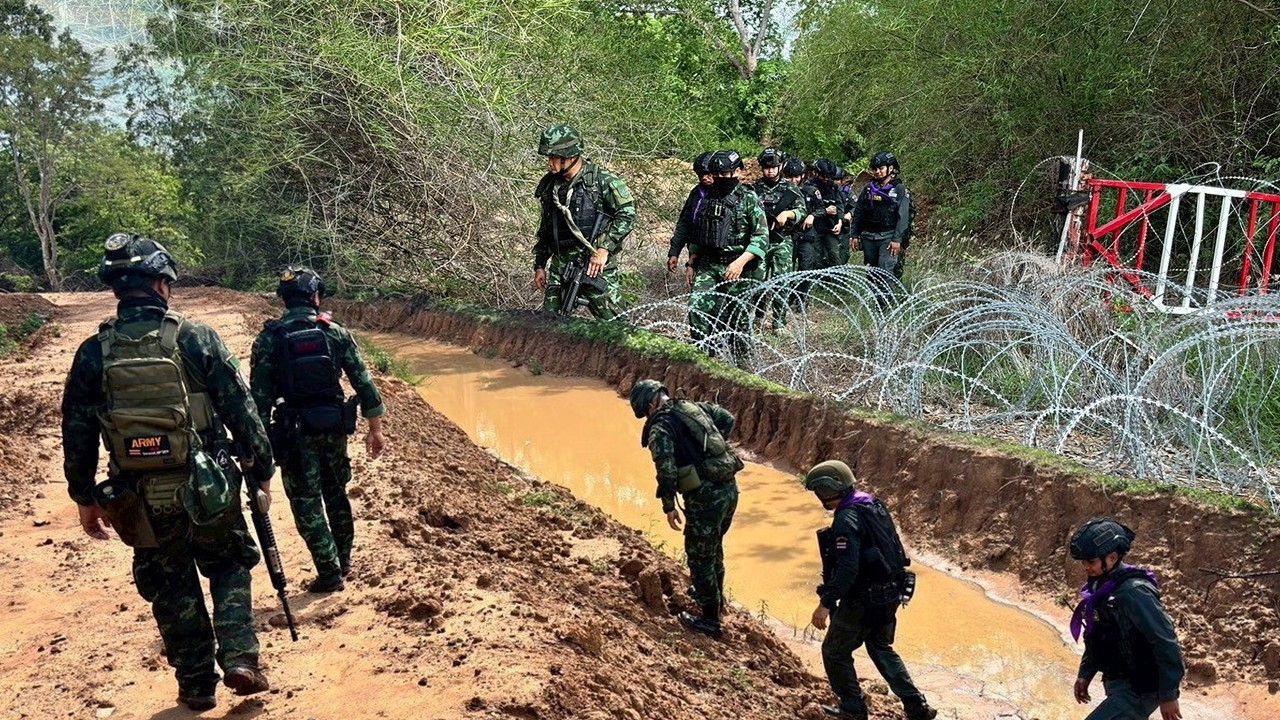
Currently, the Thai military has shifted from being the "offensive reclaiming territory" force to a "defensive" posture. This raises strategic concerns about whether the current troop levels, reduced from previous years, suffice to close gaps at bases and supply routes. Meanwhile, Cambodia’s 4th Military Region continues to reinforce, advancing at multiple points.
Therefore, although Thailand's military capability surpasses Cambodia's, complacency is unwise. Thailand must organize a more precise and systematic defense to prepare for the major conflict that may arise in the future.