

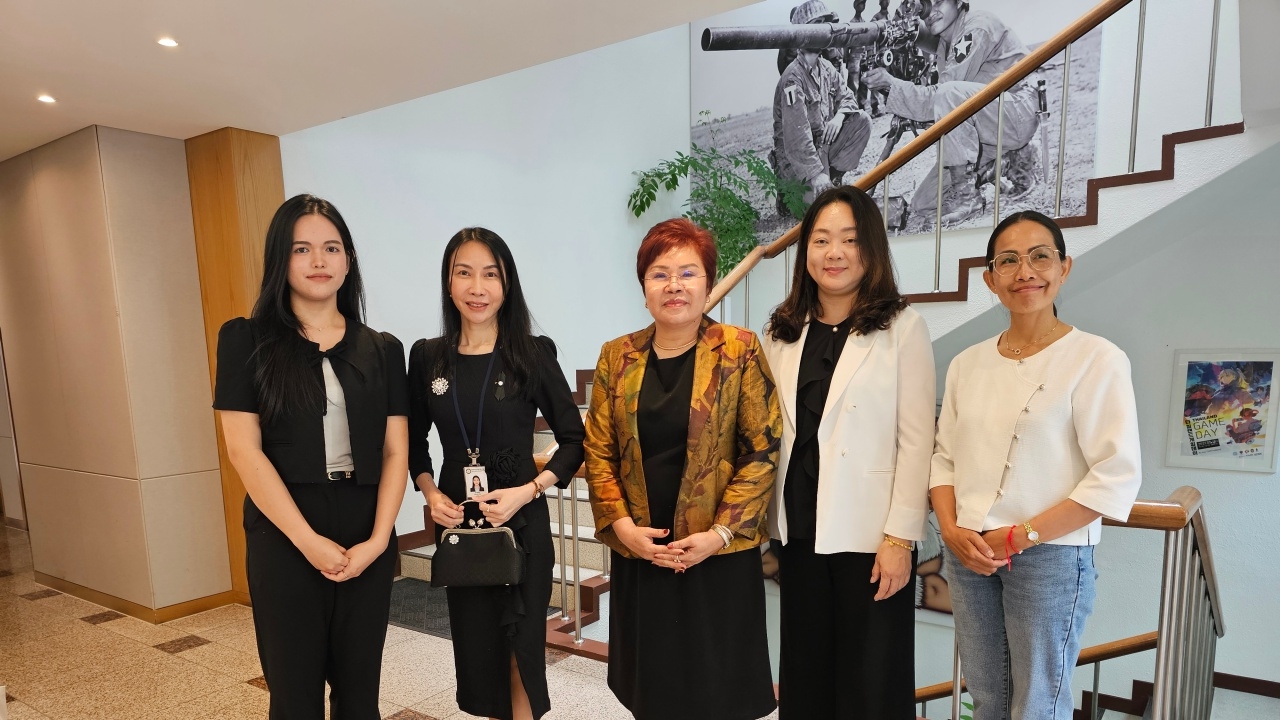
An interview with five Thai women from different generations living in South Korea reflects models of life abroad, ways of coming together to form clubs, associations, and business groups, as well as efforts to promote contemporary Thai culture and Thai Soft Power.
Today, the Ministry of Foreign Affairs (MFA), under the leadership of Prime Minister and Minister of Interior Anutin Charnvirakul, with Deputy Prime Minister and Minister of Foreign Affairs Sihasak Phuangketkaew, continues to produce proactive policies and actions. Notably, Thai embassies worldwide collaborate to organize Thai festivals showcasing Thailand's charm, identity, and potential through creativity, contemporary culture, and Thai Soft Power to the international community. This goes beyond their core missions of representing the government in diplomatic relations, promoting good ties, protecting national interests, and caring for Thais abroad.
Special Representative Thirakul Niyom, on behalf of Deputy Prime Minister Sihasak, emphasized the MFA’s proactive approach while chairing the opening of the “Sawasdee Seoul Thai Festival 2026,” a major annual Thai festival held June 20-21 in Seoul, South Korea. He noted that Thai festivals organized continuously by Thai embassies worldwide, including the embassy in Seoul led by Ambassador Thani Sangrat, aim not only to showcase Thailand’s charm, identity, and potential through creativity, contemporary culture, and Soft Power internationally but also serve as key platforms for Thai people and communities.and the Thai communityin South Korea to demonstrate their potential, drive activities, and build relationships among Thais themselves, with international communities, and with the embassy.
Mr. Thirakul added that an important mission of Thai embassies worldwide is to strengthen various forms of Thai communities abroad. The embassy’s role is to empower these communities in each country by promoting the establishment of Thai community groups, clubs, and associations—for example, supporting traditional Thai attire, sending personnel and advisors to provide knowledge and guidance, as well as assisting with official registration or certification by the host country’s authorities.
This approach by the MFA has produced tangible results, as seen in South Korea, where Thai groups have formed strongly with support from the Royal Thai Embassy in Seoul. For instance, Ms. Pawinee Daokaew, a Thai businesswoman married to a Korean, founded and owns Isan Food Company, which operates a factory and owns the Thai food brand S. Pawinee. She began her life in South Korea as a determined laborer.She perseveredand worked diligently until she became a business owner, supporting many Thais working in her company, in addition to employing numerous Koreans.

Ms. Pawinee recalled that over 30 years ago, she started as a Thai laborer, gradually gaining experience and capital to open a Thai restaurant serving Thai workers locally. Over time, her business grew through trial and error, developing product recipes and sourcing ingredients both locally in Korea and partly through imports.She eventually established a factory and her own brand, producing processed Thai food products.These include items like pork sausage, fermented pork, Thai-style sausages, meatballs, and ready-to-eat meals distributed throughout Korea. Customers include Thais, Koreans, and various other nationalities.
The Thai businesswoman, well known among Thais in South Korea and embassy officials, proudly stated that the S. Pawinee brand now serves not only Thai customers but also Koreans, Vietnamese, Myanmar nationals, and others. She is also preparing to launch new products aimed at younger consumers.
Ms. Pawinee advised Thais coming to work in South Korea to do so legally and avoid being undocumented workers. Legal entry ensures protection and care. She stressed the importance of being prepared mentally and physically to work hard, as the rewards are good. She encouraged saving money and serious dedication to work. Regarding government support, Ambassador Thani and embassy staff provide good assistance and care. She urged continuous effort from the embassy but emphasized that Thais must also take care of themselves, work seriously, be attentive, and enter legally. Despite only completing primary education, she has successfully become a business owner.
Ms. Patcharin Chuensee, President of the Volunteer Thai Massage Association of the Republic of Korea, explained that she originally used traditional Thai massage, a native Thai wisdom, as a tool to build positive relationships and image of Thailand among Koreans through volunteerism, but it was not easy.She perseveredand proved herself until gaining acceptance. The group organized volunteer massage services for elderly Koreans in various communities continuously and free of charge. This not only relieved pain but also impressed and fostered understanding of Thai culture among Koreans, especiallythe elderly.Although Thai massage has been registered as an intangible cultural heritage by UNESCO, legal restrictions remain in Korea. The association is pushing for professional recognition and policy-level acceptance.

“How to get Thai culture, Thai massage, and Thai people accepted? We worked on this until meeting Ambassador Thani, sharing experiences with him, which enabled us to make it a profession. The ambassador gave opportunities and supported activities with the embassy up to 2026. We gathered members and signed MOUs with local Korean agencies to register officially, which was difficult because Korean law does not yet fully recognize it. However, acceptance has grown widely, and we have received opportunities from the embassy for outreach, Thai festivals, and other occasions.”
Another example of Thai community organization in South Korea is from Ms. Yada Songsaroj, Chairwoman of the Thai Women's Council of the Republic of Korea. The council was officially established in 2025 aiming to be a center to assist, coordinate, and advise Thais—especially women, children, and families—facing challenges with language, law, and social adaptation. The council also acts as a liaison with Korean local authorities and the Thai embassy to ensure efficient and prompt assistance, reflecting the development of a Thai community network capable of self-support abroad, with strong backing from Ambassador Thani and the Royal Thai Embassy in Seoul.

Ms. Cherilin Eun, Chairwoman of the Thai Cultural Council in the Republic of Korea based in Seoul, shared that the council recently received registration and certification from the Department of Cultural Promotion, Ministry of Culture, with support from the Ministry of Foreign Affairs and the embassy.The embassyThe council plays a key role in promoting Thai Soft Power more broadly in Korea, encompassing arts, performances, food, and lifestyle.
Working in Korean law with her husband, she provides advice on Korean immigration, bringing concepts from Australia where she had lived before. Initially an online product influencer, she later metAmbassador Thani.She had the chance to exchangeexperiences,and settled on leveraging her influencer status to promote Thai Soft Power. A major plan is to develop key areas such as Suwon city into a Thai cultural district or Thai Town, which has not existed in Korea before. This will be a hub for Thai restaurants, shops, cultural activities, and festivals, aiming to create a new destination for Korean and international tourists and a comprehensive space to showcase Thai identity. This will boost economic opportunities for Thai entrepreneurs and enhance Thailand’s long-term image.
“The planinitiallywas to develop Myeongdong (central Seoul) as Thai Soft Power, creating a Thai Town where people could wear traditional Thai shawls with jeans. There were plans for MOUs and establishing Thai Town, but government restrictions prevented this, so alternatives were sought. Recently, Suwon city has been selected as a suitable location to pioneer Thai Town. Suwon, a UNESCO World Heritage city with many tourists, offers convenient, clean transport, making it ideal to attract tourists and promote Thai identity.”

Finally, Ms. Purichaya Pisawong, Vice President of the Thai Students Association in the Republic of Korea, noted that while Thai students in Korea previously kept in touch informally, embassy support led to official registration, organized activities, and systematic networking among dispersed students. They hold training, experience exchanges, and orientation for newcomers. The association also coordinates with the Thai embassy and various agencies to support academic and cultural activities, including participation in Thai festivals, enabling Thai students to showcase their potential and build international networks.
Regarding why they choose to study in Korea, it is considered one of the countries with highly ranked universities, supported by government scholarships and open admission policies. Additionally, there are private scholarships and strong links to employment opportunities. The presence of Thai friends and embassy support also contribute.
These stories represent only a portion of the real experiences shared by five Thais in South Korea who took different paths from Thailand but received strong support from the Ministry of Foreign Affairs and Thai embassies abroad. This underscores a key mission of Thai embassies worldwide: to strengthen Thai communities abroad so that Thais anywhere in the world can live well.
Importantly, Thai communities and collective Thai groups may be seen as a new core—a people's ambassador—in conveying the charm, identity, potential, contemporary culture, and Thai Soft Power to Korean society in an effective, non-imposing manner.