

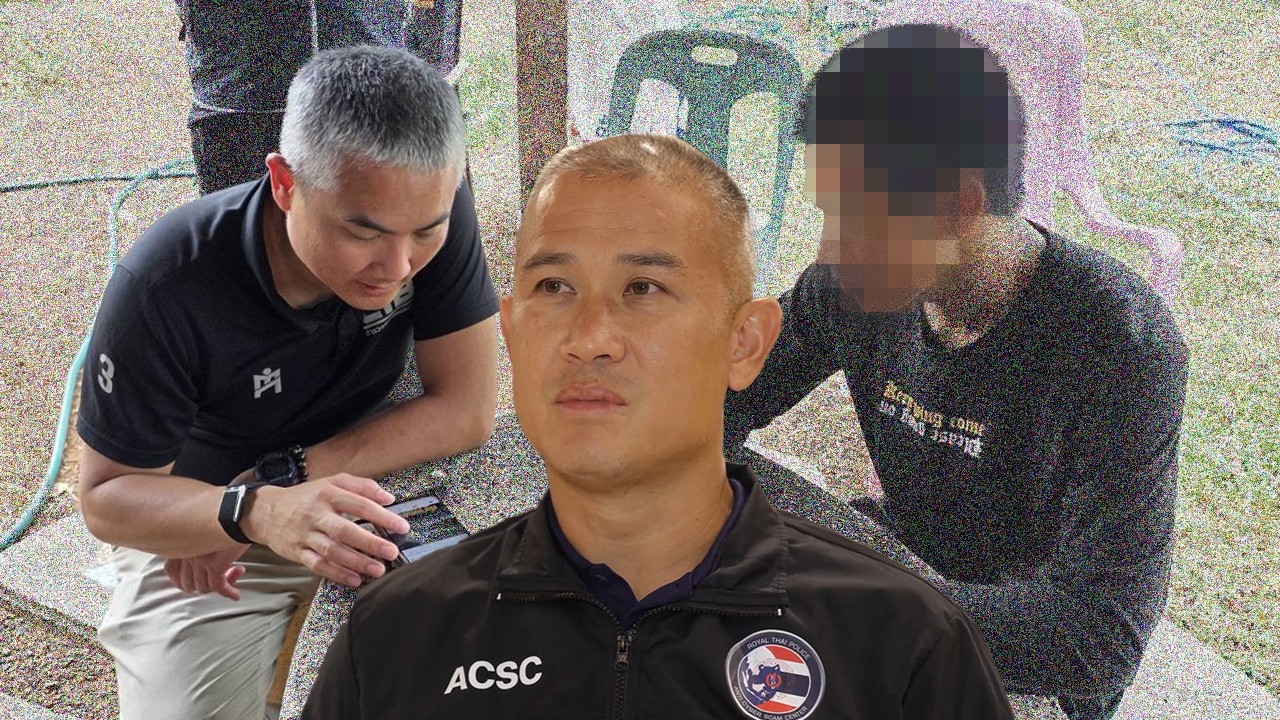
Infiltrating for years, SEE TRUE news team from Thairath TV discovered that the sold lists include teachers, doctors, nurses, and even police and military personnel.
One major reason online scam gangs, especially call center threats, can deceive victims into transferring money is because these criminals hold detailed lists and in-depth information about Thai people.
Recently, central investigation police went undercover to make a purchase and arrested this gang. Computers examined contained data on up to 9.6 million Thai individuals, and alarmingly, the sold data included not just names and phone numbers but very comprehensive information.

This operation began late last year (2025) when police from the Crime Suppression Division searched targets in eight provinces, arresting eight people involved in selling personal data. They seized computers and found the network collected data on six million Thais to sell to scam gangs.
Later, officers from Division 4 of the ACMSD expanded the investigation using data from the suspects, uncovering multiple gangs still actively trading Thai data with scammers continuously.
Police Colonel Phaskorn Napachote, Division 4 commander, revealed that he infiltrated Telegram groups buying and selling Thai data to scammers for over a year, learning about their trading activities before making a purchase of over 50,000 Thai names from the gang.

After obtaining the lists, Police Lieutenant Colonel Thamsak Pholdech, Deputy Commander of Division 4 ACMSD, verified that these names had been leaked since early 2022 and are still repeatedly traded. Most data belonged to government teachers and retirees, and importantly, among the acquired names, 1,050 people had been scammed, with fraudsters stealing 354 million baht.
This evidence was sufficient for Division 4 ACMSD police to obtain arrest warrants for those involved, including 31-year-old Mr. Poonsap. Police arrested him at his home in Aranyaprathet district, Sa Kaeo province, and seized computers for examination.
Examinations revealed up to 9.6 million Thai names prepared for sale, divided into over 10,000 files. Even names of several well-known former civil servants—familiar to many Thais—were included in the gang’s trading files.

Each record contained not only full names and phone numbers but very complete information, including ID card numbers, addresses, workplaces, age, positions, responsibilities, emails, and bank account numbers.
Some files even detailed whether the individual was retired and from which department. This level of detail allows criminals to craft scam scripts that victims trust completely.
Besides naming files by profession, folders were organized by the financial status of the data owners, such as folders labeled "Rich Group," "Investors Group," and "Bidders Group," showing criminals grade and segment Thai names by purchasing power to sell to scam gangs.
Regarding pricing, names of wealthy individuals were sold at 10 baht each, while general government officials’ names sold for 3 baht each.
Colonel Phaskorn said during interrogation, suspect Mr. Poonsap claimed he obtained the lists while working on a gambling website in Poipet with a Chinese group, but police remain skeptical. Investigations led to the arrest of his brother, Mr. Kanoksak, who was detained with a firearm. Authorities are expanding their probe to apprehend other accomplices, with suspects implicating others.
Another gang arrested by Division 4 ACMSD involved four suspects operating in Chiang Mai province. Authorities are now gathering evidence to request arrest warrants for the gang leader, who remains at large.

Lieutenant General Jiraphop Phuridech, Deputy National Police Chief and head of the Online Fraud Suppression Center, explained that previously, scam gangs used random phone calls with similar scripts to trick unaware victims. With detailed data, they can tailor scams, increasing success rates. The center is developing a system for citizens to check if their data has leaked.
"We are working with the Personal Data Protection Committee (PDPC) on solutions. Initially, we will create an app or web-based system allowing citizens to log in and verify if their names are in leaked datasets. This is our first step. Secondly, we plan to send SMS alerts to those whose data was leaked, warning them to be cautious if contacted by scammers," he said.
Lieutenant General Jiraphop outlined protective measures for citizens whose data was leaked to scammers, noting that since assuming his role in October 2025, anti-scam efforts have cut daily victim counts and financial losses by over half. Previously, about 1,200 victims lost roughly 100 million baht daily.
"Currently, cases have dropped to about 600 per day, with losses around 20 million baht daily. On some low days, losses reached a new low of 9 million baht per day. We strive to do our best, cutting off every possible avenue," he added.
Lieutenant General Jiraphop also stated that despite efforts, complete eradication is difficult because scam gangs are based in neighboring countries, limiting direct enforcement. Nonetheless, international cooperation has designated Thailand as a regional hub for combating scam gangs.