

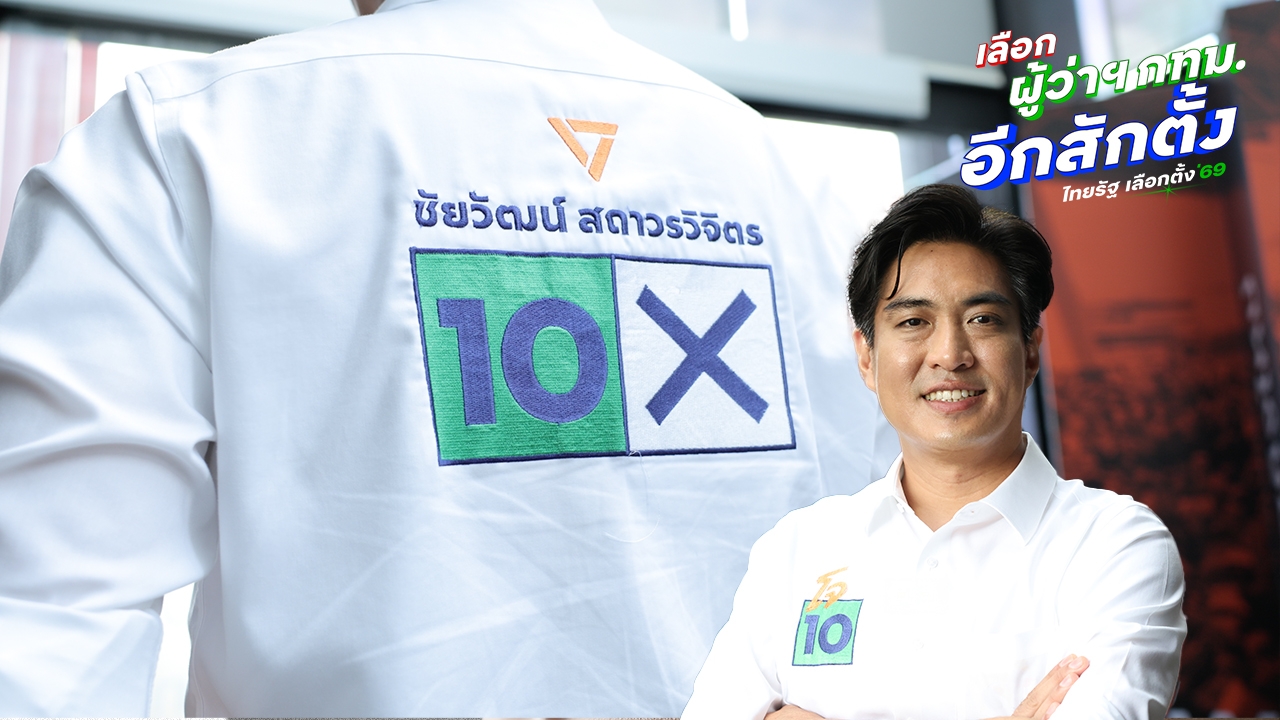
Dr. Joe, a candidate for Bangkok governor, explores his political beginnings and outlines people-centered urban policies that address powers Bangkok’s administration currently cannot resolve.
The Thairath Online team had the opportunity to speak with Chaiwat Sathawornwijit, or Dr. Joe, candidate for Bangkok governor, to ask about his reasons and inspiration for resigning as a party-list MP with the People’s Party to contest the upcoming election for governor at Sao Ching Cha, as well as his life goals.
Chaiwat shared that after earning his doctorate and working as a researcher at Japan Advanced Institute of Science and Technology (JAIST) and NEC in Japan for a period, he decided to return to Thailand with the intention of driving change for the country, eventually working at the Bank of Thailand.
“I never considered working in the private sector because working in government agencies allows me to drive change and create impact for society,” Chaiwat said.

During about 10 years at the Bank of Thailand, Dr. Joe’s roles involved financial technology, monetary policy, payment systems, and the central bank’s organizational strategy. His last position before resigning was Deputy Director of the Organizational Strategy Group, responsible for developing strategies concerning Central Bank Digital Currency (CBDC) or digital baht, focusing on how the central bank should issue digital currency safely and support future financial systems.
While working at the central bank, Dr. Joe noticed that many laws, such as the currency law, were outdated relative to technology, prompting his decision to resign and enter politics to push for legal reforms, marking the start of his collaboration with the former Move Forward Party.
“I spoke with Move Forward Party members at that time about an agenda to help Thailand escape the middle-income trap by leveraging the digital economy to add value, generate employment, and develop new IT service jobs extensively.”
With this agenda to lift Thailand beyond middle-income status, Dr. Joe became part of the Move Forward Party’s economic team and has continued this work into the People’s Party.

Q: If the People’s Party won the most MPs in the 8 February election and formed the government, what role would Dr. Joe play in that government?
A: I would be part of the management team.
Q: Would you be a minister?
A: I would be on the economic management team.
Q: Minister?
A: We don’t cling to positions...
Q: Minister?
A: I’m not the one deciding that (laughs).
When asked why he resigned from his party-list MP position with the People’s Party after only three months to run for Bangkok governor, Dr. Joe told Thairath Online,
“After the general election, the People’s Party did not get the opportunity to govern. I’m not attached to the MP position and believe the governor has a better chance to effect change.”
Asked about the biggest challenges during campaigning, Dr. Joe said there were two: first, approaching and speaking with people he had never met, and second, helping people understand that managing Bangkok requires more than just the governor’s individual skills.

“Bangkok’s powers are quite limited; it cannot even set bus routes independently. Many tasks require cooperation with organizations outside its authority. Therefore, the governor must rely on the governor’s team, the Bangkok Metropolitan Council (BMC), and MPs to work together and amend laws.”
Chaiwat stated that the People’s Party MPs intend to push a decentralization bill to grant local administrative organizations like Bangkok the authority to manage public transport and set bus routes independently, better meeting local needs. Currently, these powers rest with the Ministry of Transport.
When asked whether the long-standing Rama II Road issue could be resolved if he became governor, Dr. Joe affirmed it must be resolved and expressed confidence in his ability to do so.
“Don’t focus on whether Bangkok has the authority or not; it’s an issue that must be addressed. Even if it’s beyond Bangkok’s powers, the governor must take responsibility and advocate for the people, never remaining passive. At minimum, the governor must act as a host, coordinating and following up to get the matter resolved,” Dr. Joe said.

The Thairath Online team asked why the People’s Party’s initial campaign concept “Simple Bangkok” was later changed.
Chaiwat clarified that the concept was not changed; the focus remains on reducing complexity in daily life, with an added emphasis on making Bangkok a more caring city.
“Being a city that cares means supporting people in Bangkok from birth to old age, enabling them to work without quitting their jobs to care for young children or bedridden parents, and removing worries. We have a vision to create opportunities and jobs for Bangkok residents.”
Dr. Joe added there are 40 other policies covering issues like transportation, livelihoods, health, flooding, AI and digital anti-corruption systems, and animal welfare.
“With a budget of over 100 billion baht, Bangkok can be better. I volunteer because I believe I can make the city care for its people better, provide opportunities, and create jobs,” Dr. Joe said.
Finally, when asked what he would do if he loses the 28 June governor election, Dr. Joe affirmed he would continue working with the People’s Party but initially plans to spend more time with his family, especially his son.