

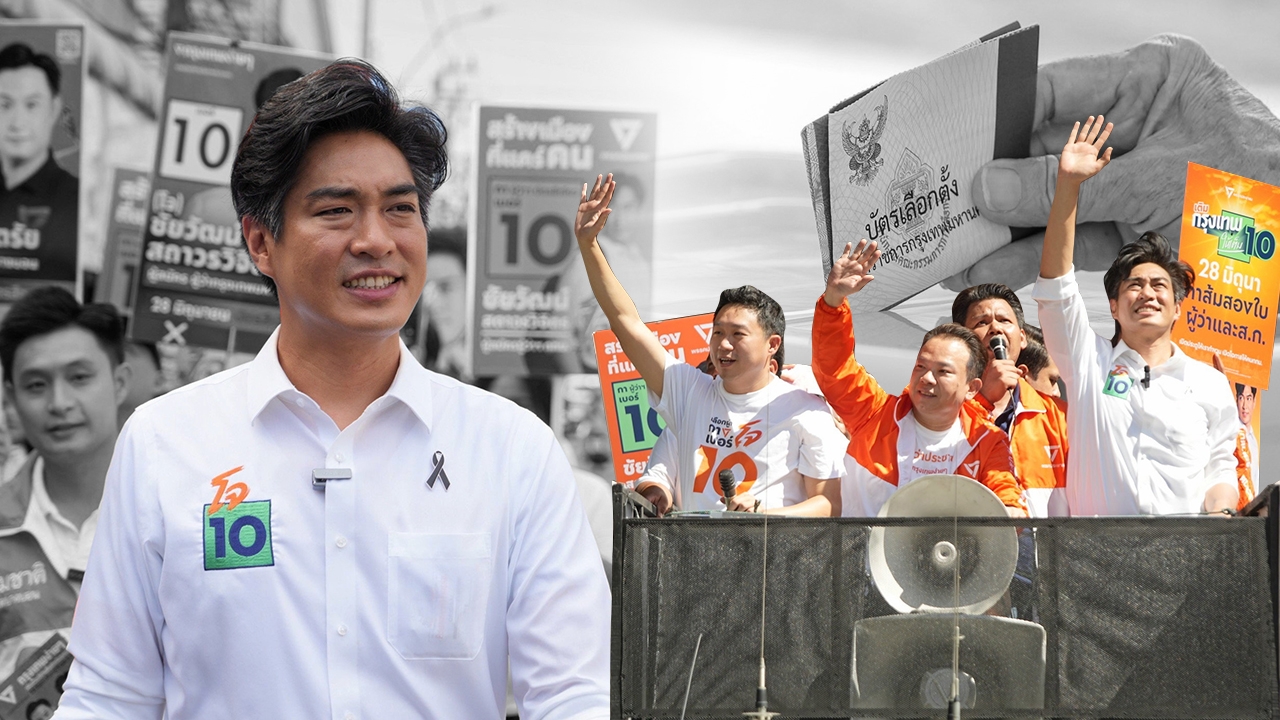
Decoding the 2026 Bangkok election reveals that while voters favored Orange Party councilors, the Bangkok governor race saw Dr. Joe suffer a heavy defeat, finishing third behind Mallika.
On 28 June 2026, during the simultaneous Bangkok governor and Metropolitan Council elections, the same group of Bangkok voters went to the polls and made their choices. They chose the “Orange Party.” The Orange Party won first place for council seats with about 660,000 votes, representing 36%, securing 22 out of 50 seats.
Compared to the last Metropolitan Council election in 2022, when Orange Party councilors won 14 seats, this election maintained all previous seats and gained an additional 8.
In contrast, for the Bangkok governor race, the same group gave Dr. Joe Chaiwat Sathaworawijit, the Orange Party candidate, about 180,000 votes, or 8% of votes cast, placing third behind Mallika Boonmeetrakul Mahasuk who secured approximately 290,000 votes.
This means nearly 500,000 Bangkok voters supported Orange Party councilors but did not vote for the Orange Party’s governor candidate.

In 2022, Chatchart won the governor election with about 1.39 million votes (~52%) by a large margin. At that time, the Orange Party candidate, Wiroj Lakkhanaadisorn, received around 250,000 votes (~9%), placing third behind Dr. Suchatvee Suwansawat of the Democrat Party, who narrowly lost by less than 1,000 votes. Voter turnout was 61%.
In 2026, although the count is not yet complete, Chatchart leads with about 1.44 million votes (~66%), winning by an even larger margin. The Orange Party’s Dr. Joe received about 180,000 votes (~8%), again placing third, this time well behind Mallika by roughly 100,000 votes. Voter turnout dropped to 49%, signaling a significant drop in public confidence in Chatchart’s past term. The phrase “Chatchart is cruising” sums up the situation. This is inferred from the 12% decline in voter turnout.
Over four years, the Orange Party’s support for governor dropped slightly from about 9% to 8%, while Chatchart’s support increased. Clearly, after one full term, the Orange Party still cannot penetrate the capital’s executive leadership.
However, for the Metropolitan Council, the Orange Party increased from 14 to 22 seats, about 36%, becoming the council’s top party, surpassing Pheu Thai, which dropped from 20 seats in 2022 to only 4 seats under the Pheu Thai Life group this time.
This echoes the national pattern seen in the February 2026 general election, where the Orange Party won all 33 Bangkok constituencies and 118 seats nationally, finishing second behind Bhumjaithai and failing to form the government.

Dr. Joe has an impressive profile: a first-class honors degree in computer engineering from Chulalongkorn University, a doctorate from Japan, and 10 years as a strategic executive at the Bank of Thailand focusing on digital economics. However, as the King Prajadhipok Institute’s KPI poll noted, “An A-grade profile does not guarantee A-grade appeal.” He is not well known to the public and lacks a proven record in local administration.
Moreover, Dr. Joe has a “low tolerance for harsh conditions” image when compared to the “resilient” image of Chatchart or even Mallika, who, despite appearing quirky and humorous—especially on AI topics to those who did not vote for her—seems “weatherproof” when contrasted with Chatchart’s four years of visible results and middle-of-the-road work style. Voters saw no reason to change. This is crucial: competing against a popular incumbent who is seen as effective is a very different challenge than facing a dull opponent.
Mallika’s second place partly reflects conservative voters uniting behind her and a protest vote against the Orange Party. Dr. Joe finishing behind Mallika is symbolically more damaging than the raw numbers suggest. Mallika’s nearly 300,000 votes position her well for future political endeavors.
Additionally, there is the issue of
“candidate selection.” This refers to the case of Suraphol Nitikraiphon, appointed as strategic advisory chairman for the Bangkok governor’s team, about whom independent academic Sarinee Achavanuntakul wrote that the problem was not “disagreement,” but that the party, which champions anti-dictatorship ideology and clearing the legacy of coups, ended up whitewashing someone who had served as “a prop” for a coup government, despite the individual never publicly apologizing or showing remorse. This contradicts the party’s core values and alienated its left-wing base, which is its main support, not its competitors—an issue demanding serious reflection. Moreover, in late 2025, the party abruptly replaced a Bangkok MP candidate after a money laundering arrest linked to a drug network. The party apologized and emphasized the slogan
“Orange with no gray.” Cases like this undermine the party’s “clean politics brand.” The brand was shaken because of internal “gray” issues. Key considerations going forward include voters separating the roles of

and “executive.” They support the Orange Party in legislative roles—checking power, debating, legislating, electing councilors and MPs to first place—but are not yet ready to entrust them with executive leadership of the governor’s office or prime ministership, as they have not seen proven effective management. A secondary theory is that the Orange Party’s current problem lies in “candidate selection,”
not ideology. They chose candidates with unsuitable profiles for executive roles, had internal conflicts such as the Suraphol case that contradicted their values, and fielded candidates linked to scandals. This repeatedly erodes credibility faster than policy failures. Some voters decided not to vote Orange again because of known candidate issues from personal experience. Another theory is that fielding candidates to “plant a flag” against popular incumbents is a different strategy than fielding candidates to win. If the party knew defeating Chatchart was unlikely, it needed to clarify its goals: vote share, base building, or image? The party must answer this clearly. This will guide future local election strategies in challenging areas like Bangkok: recruiting and developing capable candidates with real administrative records, as voters prioritize managerial ability over ideology. Currently, the candidate pipeline is stalled. Secondly, the party should use local positions to prove administrative competence with tangible examples, then seek bigger roles. At present, the Orange Party has lost nearly all local executive elections, the best proving ground for capability. Next, they must stabilize candidate and advisor selection and uphold core values. The clean brand depends on surviving internal candidate vetting; otherwise, opponents need only wait for self-inflicted errors.
Finally, the party must clarify its identity fully. Half measures lead to losing on both sides. On a personal note, I know and am friendly with many Orange Party workers and also many in Chatchart’s team. I offer my support to all working hard. Written by: Tipakorn Wutipittayamongkol
