

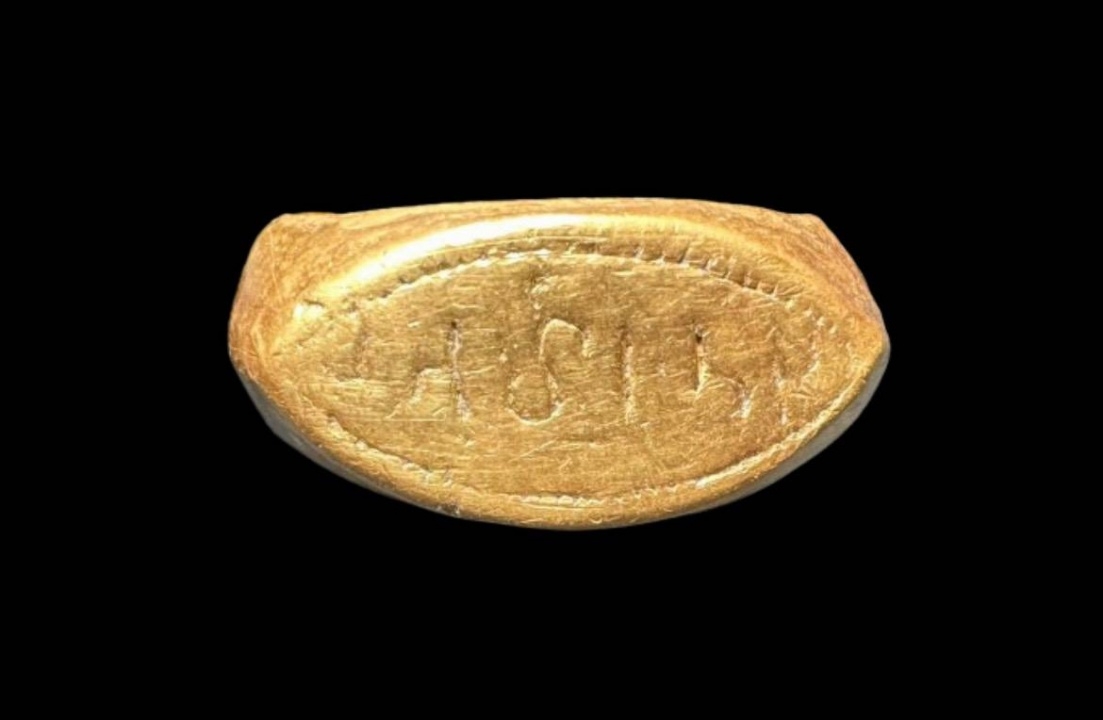
The Department of Fine Arts discovered two gold rings engraved with Indian script at the Don Yai Thong archaeological site in Phetchaburi Province. It is presumed the owner of one ring was from the Vaishya caste or a merchant. The other ring has no decorative patterns. This is an important piece of Thai archaeological history.

Mr. Phanomphut Chantrachot, Director-General of the Department of Fine Arts, revealed that on 2 July 2026, he assigned Mrs. Nipa Sangkanakin, Director of the Fine Arts Office 1 in Ratchaburi, to lead a team of archaeologists and experts in collecting archaeological evidence, including human skeletal remains and artifacts unearthed from the excavation at the Don Yai Thong archaeological site, Samo Phlu Subdistrict, Ban Lat District, Phetchaburi Province. The excavation site faced problems with groundwater, salinity, and dampness from the rainy season, which accelerated the decay of bones and corrosion of bronze artifacts. Therefore, urgent recovery was necessary to send these items for scientific conservation at the Department of Fine Arts’ Science Center for Conservation.

During the recovery of the skeleton and artifacts, archaeologists found two additional gold rings from skeleton No. 4. One ring’s bezel features an engraving in ancient script, identified by Dr. Uthen Wongsatit from Silpakorn University's Archaeology Department and an ancient language expert at the Department of Fine Arts as ancient Brahmi script dating to the 5th to 7th Buddhist centuries, approximately 1,900 to 2,100 years ago. The inscription reads “Pusarcitas,” meaning “of Pusarcita,” referring to someone protected by the auspicious time or star Pushya. It is assumed the ring’s owner belonged to the Vaishya caste (merchants). The other ring is plain without decoration. Similar Brahmi inscriptions on seals and ornaments have been previously found at southern Thailand archaeological sites such as Khlong Thom in Krabi Province and Khao Sam Kaeo in Chumphon Province. The Fine Arts Office 1 in Ratchaburi has handed both gold rings to the Phra Nakhon Khiri National Museum for preservation and further study.

The recovery operation for the human skeletal artifacts is divided into two approaches.
The first approach involves collecting skeletal parts individually, expected to take about two weeks. The second approach involves lifting the entire soil block from the excavation for the second group of skeletons. A team of scientists from the Department of Fine Arts supervises this, using methods to stabilize the skeleton to prevent deterioration, expected to take about one week. As for the skeletal remains found,

the latest presumed to be a child's skeleton, which is quite fragile and has a large bronze vessel placed over the midsection, will be lifted as an entire block to ensure safety and preserve its condition as much as possible. This final phase is expected to take about one month. Afterwards, the excavation site will be closed, and an initial archaeological operation report will be presented. An exhibition will be organized to allow the public to view artifacts from the Don Yai Thong archaeological site before they undergo conservation and further research.
