

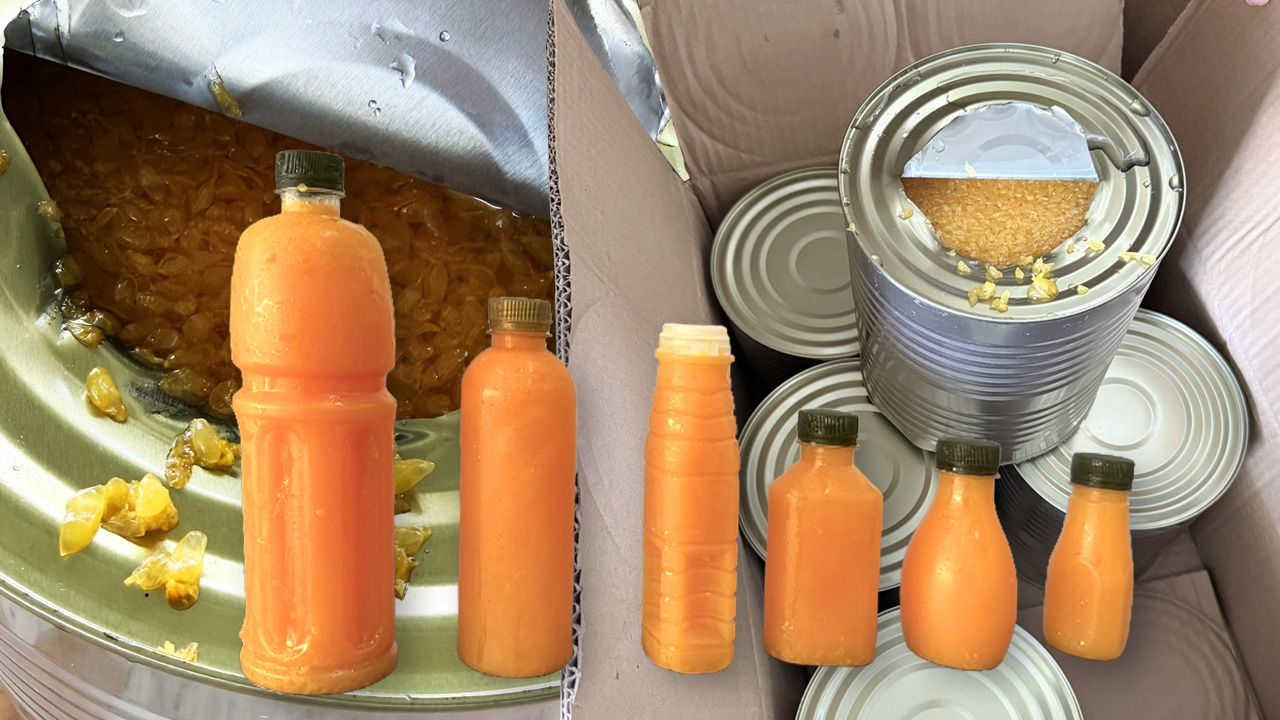
Police are preparing to expand their investigation into a network smuggling canned orange peel from China to evade taxes. They suspect a large operation involving more than just orange peel and warn that the cans may contain high levels of contaminants. It was found that orange juice producers buy these cans at 300 baht each.
On 8 Jul 2026 GMT+7, the Central Investigation Bureau (CIB) through the Economic Crime Suppression Division conducted a search and pressed charges for the offense of "concealing, selling, transporting, purchasing, pledging, or receiving goods known to be related to customs law violations." The raid took place at a company and an unnumbered warehouse in Soi On Nut, Prawet District, Bangkok.

Authorities discovered smuggled canned orange peel from China imported without permission, unpaid taxes, and lacking certification from the Food and Drug Administration (FDA). The peel was used as an ingredient to produce ready-to-drink bottled orange juice sold to the public. Two locations were searched by officers.
The raid uncovered 112 boxes containing 672 cans of orange peel originating from China, totaling 2,016 kilograms, with estimated damages exceeding 500,000 baht.

The smuggled canned orange peel from China is not only tax-evaded but also lacks food safety certification, posing a risk of toxic contamination to consumers. There are suspicions that the smuggling network is large and may be bringing in other agricultural products illegally. Thairath Online's special team interviewed Police Lieutenant Colonel Noppakun Tatsanamalai, Inspector of Economic Crime Suppression Division 2, who led the raid. He said initial reports indicated illegal import of non-taxed, uncertified orange peel. Upon verification, concealed orange peel was indeed found, prompting a court-authorized search and arrest.
The orange peel smuggled in was bought by the illicit orange juice factory from unknown suppliers, with authorities planning to extend the probe to identify them. When opening the cans, besides the orange pulp, water mixed inside resembles preservatives. Before using the pulp, the juice must be filtered to separate the water and pulp. The pulp is then washed again before mixing with orange juice for bottling.

The searched factory primarily produces orange juice, fulfilling orders placed by clients. It operates as a contract manufacturer but lacks official food safety certification. The distribution channels remain difficult to track, as production is mainly order-based.
The smuggling network is likely large-scale, as the behavior suggests importing other fruit raw materials from China as well. The quantity found in the raid was relatively small. Those inspected reported buying the cans at about 300 baht each.

Police Lieutenant Colonel Noppakun explained that it is hard to detect by eye if orange juice contains uncertified canned pulp. It requires tracing to the source, often packed in boxes without clear origin labels. Without opening the cans, detection is difficult.
Consumers seeking quality orange peel should check the bottle labels for FDA approval or local certification. The police aim to prevent harm from illegal imports.
Purchasers of smuggled goods risk customs penalties. Concealing tax-evaded products may result in fines up to four times the value or imprisonment. If consumer harm occurs, penalties may be more severe.
