

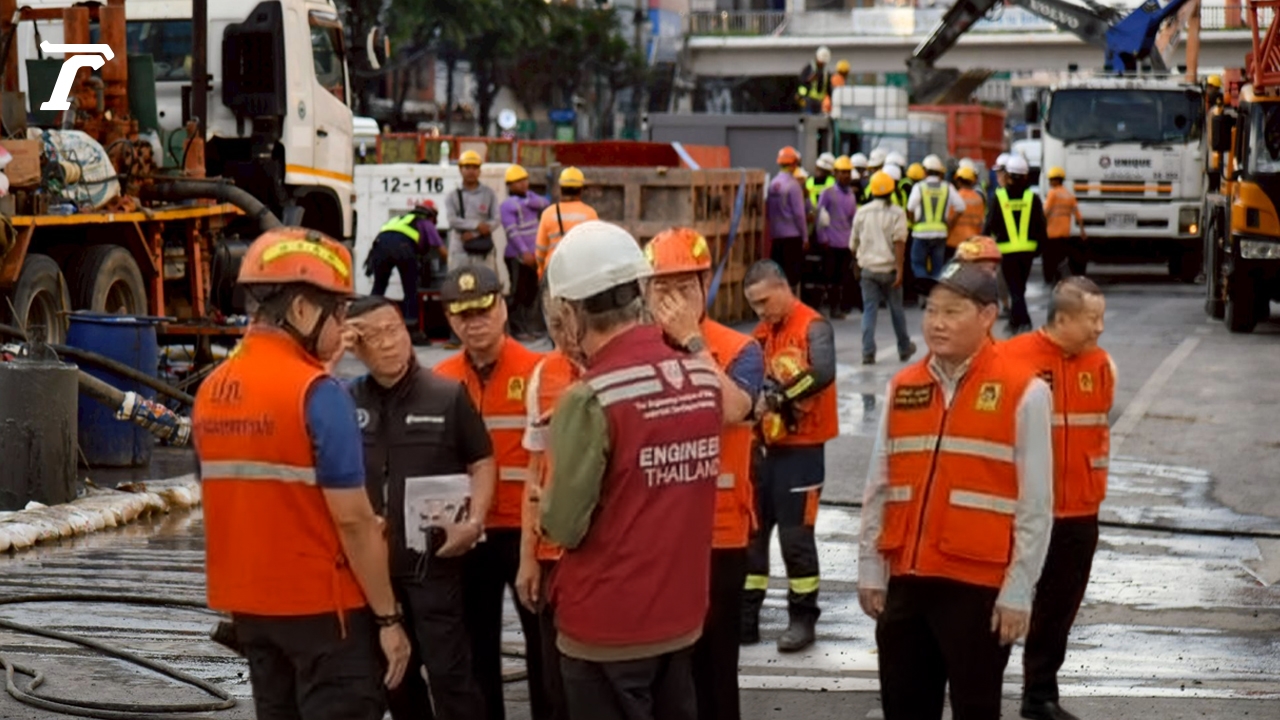
Repair methods for the underground MRT tunnel may take up to 15 days. The president of the Engineering Institute noted the difficulty in adjusting groundwater levels, which might require dismantling a pedestrian bridge to use special equipment. Surrounding buildings will also require restoration after the tunnel repairs are completed.
On 8 July 2026, a water leak occurred in an MRT tunnel within the construction zone of the Purple Line, causing concern among local residents and daily commuters. Thairath's special reporting team spoke with Associate Professor Anek Siripanich, president of the Engineering Institute of Thailand, to discuss the causes and solutions for this incident.

Normally, underground MRT tunnels are built as two parallel tracks (outbound and inbound) to allow trains to pass safely. In this incident, only one side was affected while the other remains strong and operational. Associate Professor Anek explained that the problem originated from the sump pit, usually located between stations along the rail line, which collects and pumps out groundwater regularly. However, naturally rising groundwater levels—likely due to Bangkok's ban on groundwater pumping—have caused the water table to rise from about 20-21 meters deep to approximately 10 meters. This increase in soil moisture led to excessive water pressure causing leaks into the MRT tunnel.

Associate Professor Anek stated that currently the team is sealing leaks using a chemical method called Grouting, which involves injecting chemicals under high pressure to block leaks in the tunnel. This requires permission from Bangkok authorities to temporarily remove a pedestrian bridge in the area to allow machinery access. The bridge will be rebuilt after the grouting is completed.
Another option, if the first method fails or water inflow increases, is to block the affected side of the MRT tunnel over a distance of about 700 meters. This closure process may take around 5 to 7 days. Then, coordination with the Metropolitan Waterworks Authority will prepare to fill the gap with water to balance pressure, potentially requiring up to 18,000 cubic meters—compared to a typical household's monthly water use of 20 cubic meters.

Finally, an alternative approach is to replace the water with air, known as an Air Lock. This method would take up to 14 days due to the tunnel's large size. Overall, the repair process is expected to take between 5 and 15 days. Associate Professor Anek believes that filling the tunnel with water to balance pressure should suffice, with ongoing monitoring of tunnel subsidence during repairs.
Regarding soil subsidence affecting nearby buildings, multiple agencies are assisting. The rate of subsidence has stabilized but has not yet improved. Repair and restoration of surrounding buildings will be the responsibility of the MRT contractor to support nearby residents.
He concluded by assuring the public that all relevant parties are working diligently to resolve the issue, expressing understanding and concern for those affected in the area.
