

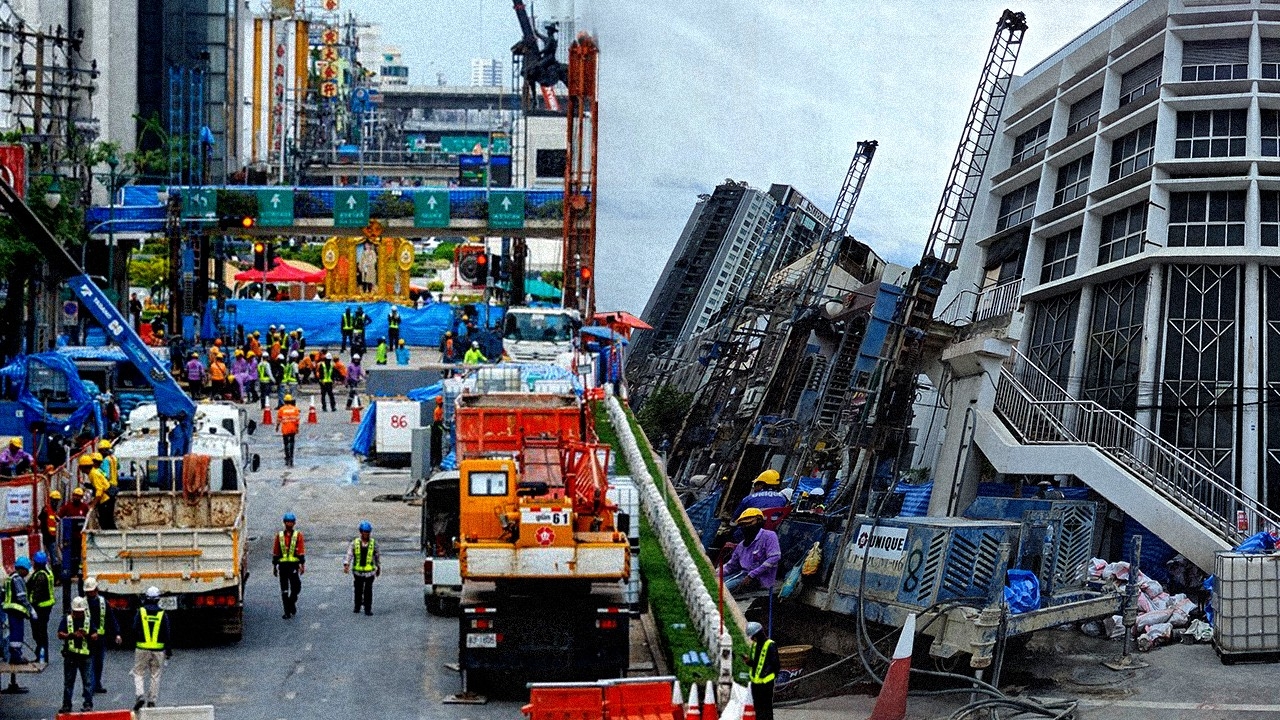
5-day update on the Wongwian Yai MRT tunnel: Residents remain worried about cracks, local vendors suffer severe losses, lack income, no compensation, and long-term home repairs are pending.
Following the prolonged crisis of water leakage and soil subsidence at the construction site of the Purple Line MRT tunnel at Wongwian Yai Station since 8 July 2026, today (13 July), Professor Dr. Amorn Pimanmas, President of the Structural Engineers Association of Thailand, visited the site to update on the engineering situation and provide solutions amid local residents' concerns.
After five days, the Thairath Online special team found that officials were repairing the road surface, while the atmosphere in residential areas was quiet as some residents had evacuated. However, locals and shop owners remain worried that if repairs are not completed soon, livelihoods could be severely impacted.

Professor Dr. Amorn stated that although the exact source of the initial leakage is still unknown, engineering assessments show such incidents in Bangkok have about a 30% chance of occurring, mainly due to two factors:
1. Geological conditions featuring a soft clay soil layer on top, with groundwater acting as a conduit allowing soil to flow easily.
2. Underground construction, especially at the junction between the tunnel structure and the construction shaft, which is a critical risk point as subterranean conditions may change over time.

The main issue is soil intrusion into the tunnel. Engineers and contractors are doing everything possible to stop it. Contractors have urgently deployed machinery to inject chemicals and cement into the soft clay layer to block soil ingress and reinforce stability, preventing surrounding buildings—mostly supported by short piles—from tilting due to the incident.
At the same time, the solution applies the principle of "water against water" by pumping water into the tunnel to counterbalance soil pressure, which has gradually improved the situation. Results show partial success in controlling the situation, with three safety indicators:
• Water inflow into the tunnel has clearly decreased from 50 cubic meters per hour to 20 cubic meters per hour, indicating the clay soil is hardening and sealing leaks better.
• Cracks on the road have stopped expanding, and ground subsidence levels have not increased.
• Building tilting has stabilized, with no new buildings showing additional tilting.
The team will continue close monitoring for at least seven more days, focusing on measuring the tunnel, buildings, and roads until they are 100% confident no further structural movement occurs.

The Thairath Online special team interviewed a local noodle shop owner near the affected area, who said that since the soil subsidence and surrounding road closures began, business has been quiet with very few customers. So far, the shop has received no assistance, only officials coming to record initial damage and stating that damage assessment and compensation will follow later.

A local gold shop owner also suffers similarly, having to temporarily close the shop due to lack of customers. The nearby bridge has been dismantled, eliminating regular customers who used to cross it to buy gold. Cracks on the road in front of the shop cause safety concerns and economic impact, leaving the shop silent. The owner has only received a complaint form from relevant authorities and is awaiting further assessment.

The impact extends beyond vendors to public transportation systems. Motorcycle taxi drivers report that prolonged road closures have caused heavy traffic congestion in many areas, forcing them to reroute and take longer detours, adding to their hardship.