

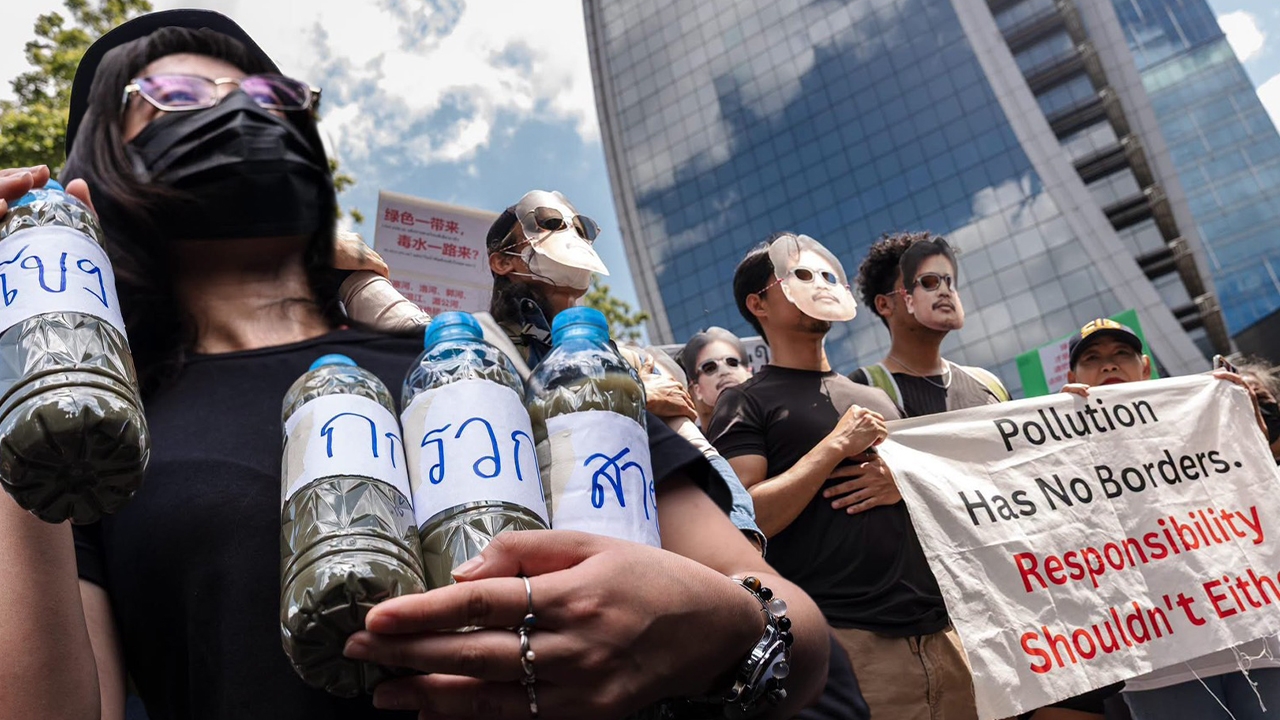
An NGO has sent a letter to the Prime Minister to discuss cross-border toxic pollution issues ahead of his visit to China, after discovering that Chinese-funded mines in Shan State, Myanmar, have discharged heavy metals into major Thai rivers such as the Kok, Ruak, and Mekong, making the water unusable for locals and increasing their living costs.

The letter from the NGO Coordination Committee (NGO-CC) states that
Open letter
To Anutin Charnvirakul, Prime Minister
Amid growing resentment toward illicit Chinese business practices in Thai society—ranging from mafia-style operations to companies registered with hidden shareholders or nominees that harm SMEs and cause severe environmental pollution—the image of China as a good friend, relative, and partner aiming to build a shared future with Thailand has been severely damaged. However, it seems both the Chinese and Thai governments are unaware or unwilling to address these issues properly, focusing instead on promoting Thailand as a hub for AI and future technologies for Chinese investors, which risks increasing Thailand’s role as a dumping ground for future industrial pollution.

In this context, China’s announcement on 13 July that Prime Minister Anutin will make an official visit from 16–20 July presents a significant opportunity and challenge for the government, led by the Bhumjaithai Party, to choose diplomatic actions that respect or neglect the people’s interests.
To date, no agenda item addresses cross-border pollution from Chinese mining investors in Shan State, Myanmar (nor from Chinese investors’ precious metal extraction plants processing e-waste and industrial waste in eastern Thailand). This raises the question: "Will the Thai government bring the people’s hardships to the negotiating table with China?"
Before going to Beijing, Prime Minister Anutin has yet to listen to residents along the Kok, Ruak, and Mekong rivers who marched 68 kilometers to present a letter. Even invitations for the Prime Minister and the Chinese ambassador to visit the area and hear concerns have gone unanswered. The main demand is to declare cross-border pollution from Chinese mining investors in Shan State a national policy and establish a national task force with real decision-making power, but the government has only formed an ineffective ministerial-level committee.

Pollution is not just an environmental issue but a daily living cost for residents. Recent tests found arsenic, lead, and manganese exceeding standards at multiple points in the Kok, Ruak, and Mekong rivers. Sediment arsenic levels in the Mekong are up to 30 times above safety limits. Around 70% of residents can no longer use Kok River water for daily life, incurring an average monthly cost of 2,600 baht per family for clean water. Additionally, 63% have lost income from river-related activities. These costs are not accounted for in Thai-Chinese trade and investment figures.
UN experts have named companies directly linked to cross-border pollution, including China Investment Mining Company, connected to Xiamen Tungsten Corporation and Chifeng Gold. The extracted minerals enter Chinese supply chains producing electric vehicles and wind turbines. Therefore, Prime Minister Anutin should exercise control at border checkpoints by banning all mineral imports from Myanmar, as Thailand is not just an end user but a transit state and part of China’s monopoly on critical and rare minerals supply chains.
Although the National Action Plan on Business and Human Rights (NAP) is not law, it is a government-declared policy, so the Thai government cannot claim it has no duty to act. The problem is not a lack of laws but a failure to fully exercise the state’s responsibility to protect citizens’ lives.
With facts showing the Myanmar military dictatorship denies all allegations and claims no mining occurs in the area, the Thai-Myanmar joint working group established since late 2025 has no concrete plans. Discussions between agencies of both countries have failed, and Thai laws on mining violations cannot be enforced in Myanmar. It is time for Prime Minister Anutin to discuss directly with Chinese leaders to hold China accountable for business practices oppressing and harming Myanmar and Thai communities. Countries such as Congo, Guinea, and Zimbabwe have already begun using state power to negotiate with Chinese mining investors, while Thailand has yet to even control mineral sources crossing its borders.
The NGO Coordination Committee (NGO-CC) strongly hopes that Prime Minister Anutin’s visit to China will be a crucial opportunity and challenge to conduct diplomacy that respects the people, rather than treating land and lives as commodities, and to clearly inform Chinese President Xi Jinping that cross-border pollution from Chinese mining in Myanmar, which contaminates the Kok, Ruak, and Mekong rivers and enters the food chain, is a severe national security threat to Thailand requiring urgent resolution and Chinese responsibility.
Respectfully,
NGO Coordination Committee (NGO-CC)
15 July 2026 GMT+7