

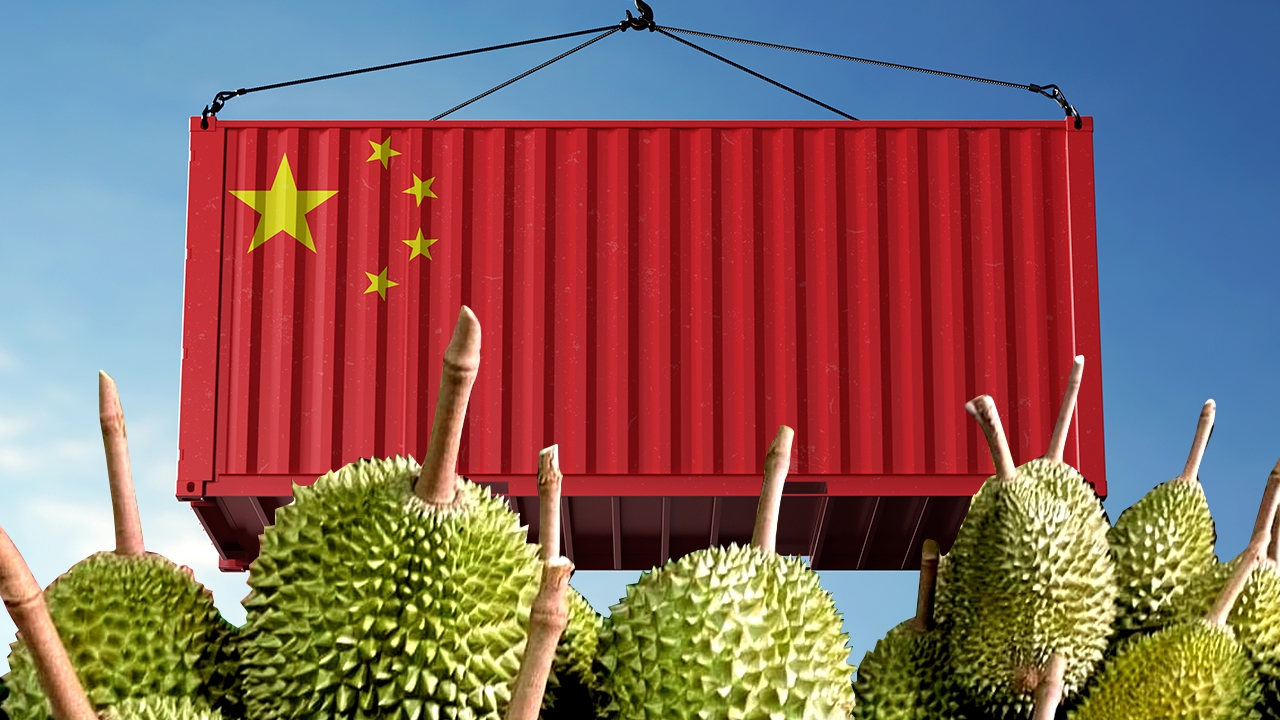
The president of the Thai Fruit Traders and Exporters Association revealed the reasons behind the drop in southern durian prices and suggested three solutions as exports to China face prolonged disruption caused by "southern borers."
Durian is a major export product of Thailand. This year, 2026, it has the potential to surpass last year's record in 2025 when export value might have reached 150 billion baht. However, the southern region's durian prices are facing a severe crisis, continuously declining even before the durian export season from July to August.
Thairath special news team spoke with Sanchai Puranachikiri, president of the Thai Fruit Traders and Exporters Association, on this issue. Currently, green-spiked durians are sold at 70-75 baht per kilogram, but prices are about 10-15 baht cheaper in the south, around 65-70 baht per kilogram. Durian flesh sold separately is priced at 60-65 baht per kilogram.

Southern durian and Uttaradit durian are facing the same problem: "durian borers." Southern durians from Yala, Pattani, and Narathiwat provinces grow on mountains with tall trunks, making pesticide spraying and care difficult.
He explained the export process of southern durians to China, which requires paying taxes before inspection. If even one borer is found in a shipment, that entire batch is immediately rejected without refunding the previously paid tax. This causes sellers to hesitate to risk exporting durians to China, leading to price drops.
When exports fail, the last resort is peeling the durian flesh and freezing it, which incurs high costs. Market mechanisms cap prices, so if raw durians are bought above 60-65 baht per kilogram, factories cannot operate profitably since they must compete with frozen durians from rival countries like Vietnam. Thus, high-quality durians maintain prices, but those affected by borers in the south suffer price declines.
Solutions for southern durian problems.
Mr. Sanchai emphasized that the borer problem in southern durians can be controlled if done properly and timely—such as when durians are about the size of chicken eggs and insects are about to lay eggs. However, past efforts by Thai government agencies often involved planning projects without serious implementation, such as pheromone traps or light traps.

Therefore, the government, including the Ministry of Agriculture and Cooperatives and local administrative bodies, must cooperate to declare this a national agenda and work together decisively to solve the problem. He recommended three approaches:
1. Using pheromone traps to attract male insects.
2. Injecting pesticides into the soil to destroy insect eggs and larvae.
3. Spraying pesticides at proper intervals during the insect egg-laying period.
If neglected, this "southern borer" problem may spread uncontrollably to other areas, similar to past outbreaks.
