

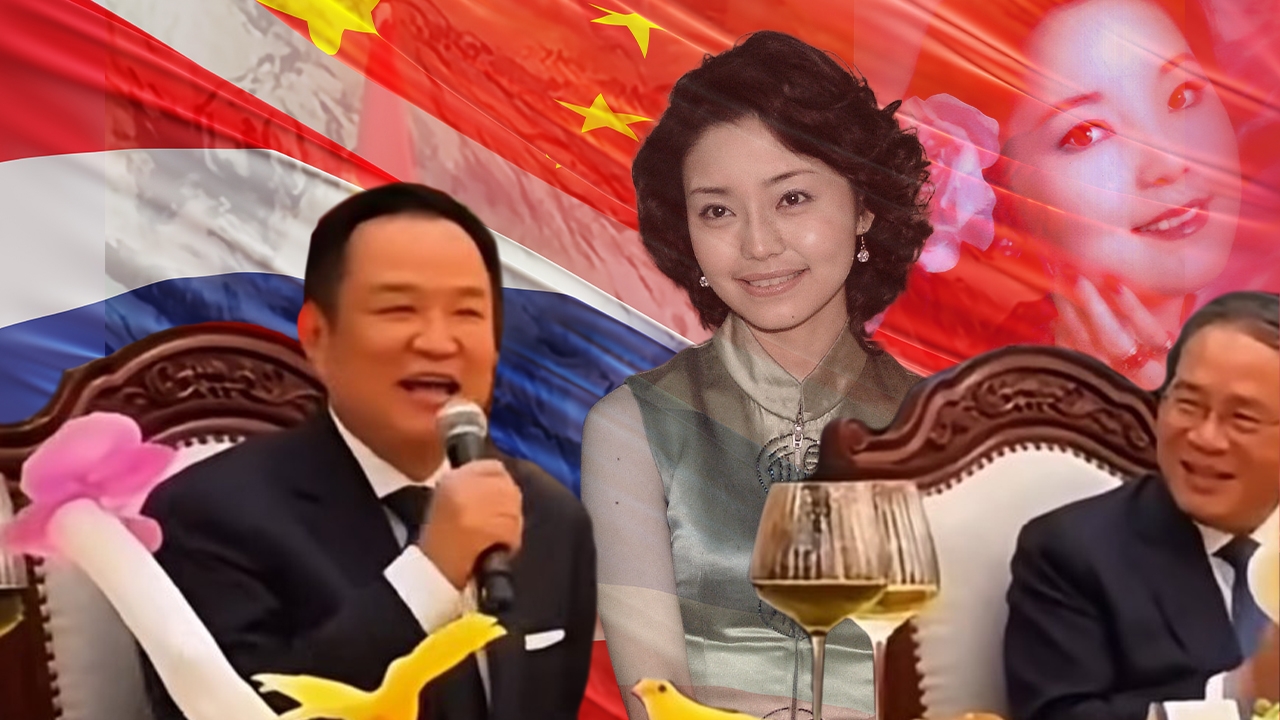
Fierce debate erupted over Prime Minister Anutin singing “Tian Mi Mi,” a legendary hit song previously banned in China. A former diplomat criticized the move as politically naive, prompting government officials to quickly try to calm the controversy.
On 20 July 2026, Prime Minister Anutin Charnvirakul sang the song “Tian Mi Mi” at a luncheon hosted by Chinese Premier Li Qiang during an official state visit to the People's Republic of China to discuss economic and security issues.
The Prime Minister's singing sparked widespread criticism about the appropriateness amid sensitive geopolitical tensions, because the song “Tian Mi Mi” is by a famous Taiwanese singer, Teresa Teng, and was once banned in China.

The song “Tian Mi Mi” performed by the legendary singer Teresa Teng, was first released on 20 September 1979. Its lyrics were written by famous Taiwanese songwriter Zhuang Nu, and it became a widely beloved hit across Asia.
However, Teresa Teng never performed concerts in China, and her songs were banned there during the 1980s due to political tensions between China and Taiwan. The Chinese Communist Party viewed her music as bourgeois, focusing on love themes that conflicted with state ideology. Additionally, Teng was the daughter of a Kuomintang military officer.
Despite the ban, her music was widely listened to and tapes were circulated clandestinely, giving rise to the saying “Big Teng (Deng Xiaoping, China's leader) rules China by day, Little Teng (Teresa Teng) rules China by night.”
Regarding this, Analayo Koskul, an expert in weapons and security and owner of the ThaiArmedForce Facebook page, explained additional reasons why Teresa Teng's music was once banned by the Chinese Communist Party. Beyond the Western values seen in her songs, there is a specific line mentioning the plum blossom (mei hua) as a symbol of the great Chinese nation. Mainland China, however, uses the peony flower as its national emblem, not the plum blossom. Also, the plum blossom is referenced in the lyrics. Moreover, Taiwan used Teresa Teng politically, such as having her perform concerts on Kinmen Island, just a few kilometers off the coast opposite Xiamen in China's Fujian province, where she spoke about freedom and democracy. Nevertheless, the Chinese government eventually lifted the ban on Teresa Teng.
“Tian Mi Mi” and political implications?
Rat Chaleejan, also known as Ambassador Rat, a former Thai ambassador and former assistant foreign minister, who runs the Facebook page “Rogue Ambassador.”He posted about the incident saying“Very outdated.” Rat pointed out that “Tian Mi Mi” was written by a famous Taiwanese songwriter. Taiwan remains a thorny issue for China, which opposes Taiwanese songs, especially those seen as supporting Taiwan's independence. The Prime Minister singing this song indicates a lack of knowledge, especially in international politics.
Rat recalled an incident 20 years ago when a Chinese vice premier visited Thailand and a famous Chinese-language song was played at a dinner. However, it included Taiwanese songs, including “Tian Mi Mi,” causing the vice premier to leave the event.
“The Chinese authorities must have felt awkward but kept face and forgave the Thai side's ignorance. They probably cursed inwardly and wondered if the entire Thai delegation had no knowledge at all.”
"Prime Minister and Government" respond to the controversy

Prime Minister Anutin responded amid the controversy by posting a famous verse from the play “The Merchant of Venice,” a poetic work by King Rama VI, saying “Those who have no music in their souls are strange people indeed. And anyone who cannot appreciate music is fit for rebellion and disgrace.”
Meanwhile,
Deputy Prime Minister and Foreign Minister Sihasak Puangketkaew addressed the controversy, saying the luncheon atmosphere was good and everyone enjoyed themselves. If there had been any problem with the song, the Chinese band would not have played it.
“Perhaps it’s because everyone knows this song and no one thought about politics. The song has existed for decades. I think sometimes we shouldn't politicize things, as it would overshadow the success of the visit and the benefits Thailand gains. It would just create drama. I was there, and the atmosphere was truly like that. These are the facts I want to share.”
On the other hand, Dr. Ratchada Thanadirek, spokesperson for the Prime Minister's Office, alsoclarifiedthe issue, explaining that the Prime Minister sang a Chinese song at the invitation during the final part of the reception following official Thailand-China talks. This was “music diplomacy” that naturally fostered friendship, as Chinese people appreciate foreigners speaking or singing in Chinese, which reflects intention, respect, and cultural closeness. That day, Premier Li Qiang smiled, participants sang along, and the media praised the atmosphere.
Regarding claims that “Tian Mi Mi” was banned, it is no longer prohibited in China and remains culturally significant and popular across generations. In 2006, a major performance was held at the Beijing Concert Hall, and in 2024, international students from Peking University adapted the song to warm reception.
“As someone present that day, I confirm the atmosphere was full of smiles, friendliness, and participation. Before lunch, both sides discussed important national issues and signed 15 cooperation agreements. One song helped warm relations between the two countries.”
Dr. Ratchada added that there is currently a Teresa Teng Arts and Culture Center in Handan, Hebei province — the hometown of Teng's father — as well as a bookstore and café bearing her name.