

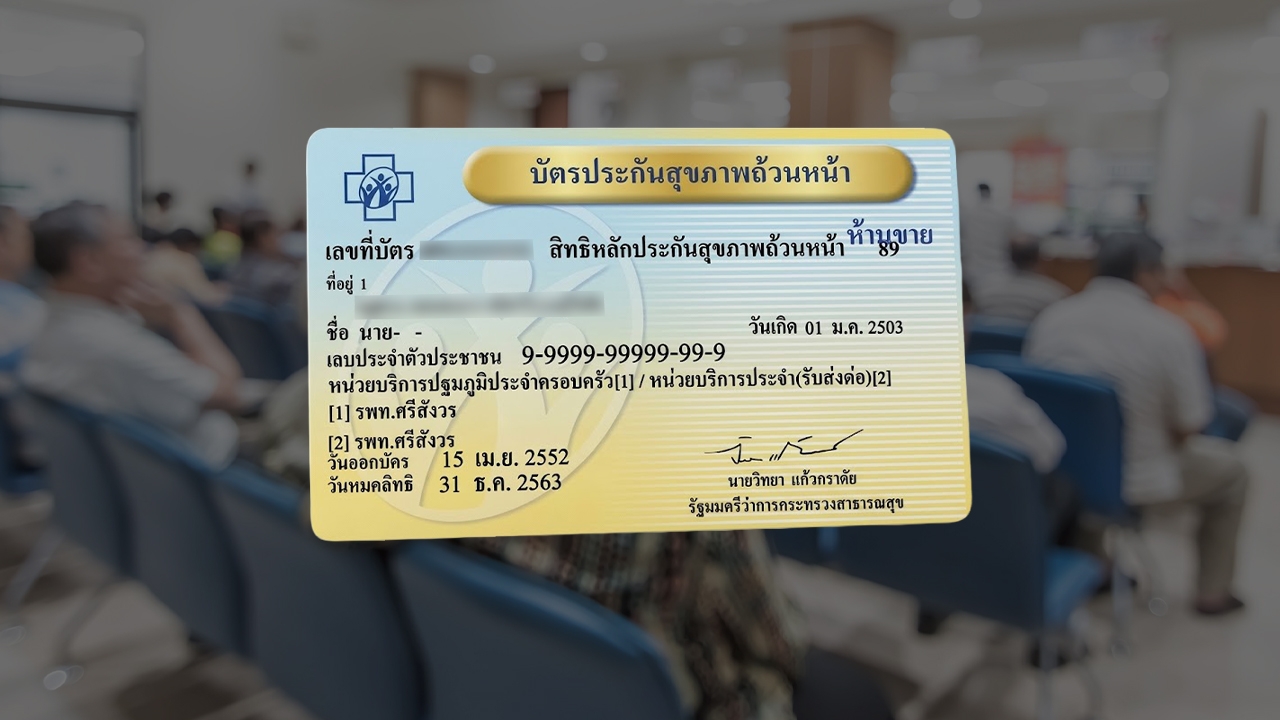
Efforts to amend the "Gold Card" law to introduce co-payments aim to reduce hospital debt but risk shifting the burden onto civil society. Critics point out it creates social inequality and argue for reforming the three health funds to ensure equal treatment rather than adding costs.
The group "People Who Love Health Security" expressed concerns about the Senate Public Health Committee's proposal to amend the National Health Security Act of 2002, which would allow users to co-pay for some services.
On 23 July 2026 GMT+7, the group "People Who Love Health Security" discussed the Senate Public Health Committee's proposal to amend the 2002 National Health Security Act to introduce co-payments. Civil society views this proposal as potentially severely impacting citizens' welfare rights.

The origin of the Gold Card system traces back to Dr. Sanguan Nitayarumpong, Chairman of the 8th Rural Doctors Club, who pioneered and studied the project's feasibility from 1990. A draft National Health Security Act was presented to Parliament but was rejected.
Dr. Sanguan continued feasibility research, summarizing universal health coverage principles, background, and implementation possibilities, estimating a budget of about 30 billion baht at that time. Before the 2001 election, he consulted political parties; only Thai Rak Thai Party deemed it feasible. The party adopted it as the '30 Baht Treats All Diseases' policy and appointed Dr. Sanguan as the first Secretary-General of the National Health Security Office (NHSO).
The policy received both praise and criticism. Supporters said it improved access to public health services with minimal cost, while critics argued it discouraged personal health care, was too accessible, and burdened hospitals and medical staff. By 2026, criticism grew that the Gold Card system was collapsing due to public hospitals' debt burdens caused by NHSO's reimbursement limits, leading some hospitals to withdraw. Proposals to reform the system, such as introducing co-payments, have been promoted by some senators.

Jintana Srinudetch, Head of the Khon Kaen Provincial Office of the Consumer Council, commented on the proposed amendments to the health security law, saying the co-payment concept effectively collapses the Gold Card system. Civil society has long advocated for state welfare funded by taxes to cover citizens' health care without patient costs or co-payments.
A major issue is that most committee members pushing for the amendment are medical professionals, who view the system as causing hospital losses, while civil society argues hospitals are not losing money since public funds cover welfare rights.
Moreover, attempts to restructure the NHSO board to increase government officials and service providers' representation while cutting civil society members open the door to centralized management. Budget approvals could occur without civil society oversight or opposition. If co-payments are implemented, Thailand would lose its health insurance or Gold Card system, reflecting the current government's intent to reduce health welfare subsidies and push forward this amendment.
Nimit Thianudom, a civil society NHSO board member, revealed that initially the law required a 30-baht payment. Later, when Dr. Mongkol Na Songkhla was Minister of Public Health, evaluation showed the 30-baht fee did not sufficiently increase hospital income to cover costs but imposed hidden burdens on patients, such as travel and lost work time, leading to its cancellation. However, subsequent governments reintroduced a 30-baht-style fee as a 'service charge' to deter unnecessary use.
Currently, movements from the Senate Public Health Committee and some medical professionals seek to push co-payments due to hospital losses. The most concerning legal proposal seeks to amend Section 5 of the law, which currently covers health services 'necessary for health and survival.' The committee proposes changing this to 'basic benefits,' stating that if citizens receive services beyond these, they must co-pay. Civil society fears the vague term 'basic benefits'.
Nimit also pointed out that reforms should focus on addressing disparities among the three health funds: civil servant welfare, social security, and Gold Card. Currently, even for the same disease with equal severity, the government pays hospitals differently.
The Comptroller General's Department (civil servants fund) pays open-endedly; hospitals claim what they incur and receive full reimbursement.
Social Security has a sizable budget, paying higher rates, such as 13,000 baht per case.
The Gold Card (NHSO) covers 48 million people and must strictly control its budget, resulting in a fixed payment rate of about 8,350 baht per case.
Therefore, if senators or politicians want reform, they should unify the payment system so that for the same disease treated at the same hospital, the payment is the same. Public health budgets—currently about 10% of the national budget or 4% of GDP—should be consolidated and managed fairly under one standard.
Kannika Kittivechakul explained that the National Health Security Board ('main board') consists of 30 members from five main groups.
The first group includes nine ex-officio members led by the Minister as chair, along with permanent secretaries from seven ministries (Defense, Finance, Commerce, Interior, Labor, Public Health, and Education), plus the Budget Bureau director. Next are local government representatives covering municipalities, provincial administrative organizations, subdistricts, and special administrative areas such as Bangkok and Pattaya.
There are seven expert members specializing in areas like medicine, traditional Thai and alternative medicine, finance, law, and social issues. Notably, only two of these are non-medical professionals. The professional council representatives are all medical personnel from various professional councils and private hospital association representatives.
The last group, currently under debate, includes five representatives from non-profit private organizations. Presently, these five are selected from nine registered civil society groups representing persons with disabilities, women, ethnic groups, farmers, youth, laborers, slum communities, and the elderly, who choose among themselves.
The Senate Public Health Committee has proposed amending this selection process by removing the civil society groups' self-selection and instead having representatives from 13 Health Regions for the People select the five members.
This proposal has raised serious concerns among civil society because most Health Region representatives are bureaucrats linked to the government. Changing the structure this way could allow the Ministry of Public Health to easily control or influence these representatives, resulting in the loss of genuine civil society representation.