

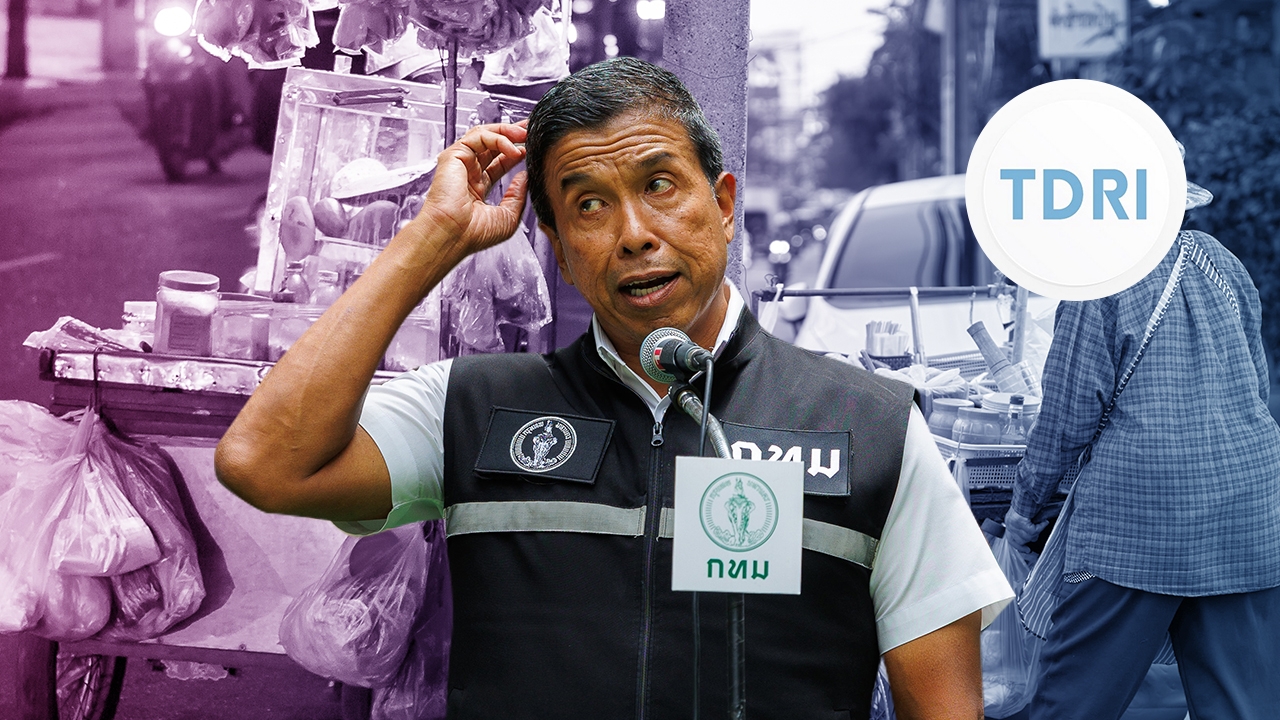
A study found that Bangkok residents have jobs but their income remains insufficient! TDRI grades 'Chadchart 1' on addressing livelihood issues and recommends for 'Chadchart 2' to upgrade skill development platforms for measurable impact and support street vendors' growth by finding suitable replacement locations.
Following the Bangkok gubernatorial election on 28 Jun 2026, Mr. Chadchart Sittipunt was entrusted by Bangkokians for a second term, winning with an overwhelming majority of over 1.5 million votes—an increase from 2022 and the highest vote count in history. This reflects Bangkok residents’ expectations that Governor Chadchart will continue addressing economic and living challenges for the city’s people.
Recently, the Thailand Development Research Institute (TDRI) conducted an assessment of Governor Chadchart Sittipunt's first four-year term performance and prepared recommendations for his second term across six areas, including the issue of “people’s livelihoods.”

TDRI points out that the livelihood problem in Bangkok is not “unemployment,” but that many workers do not have “quality jobs with good income.” Data from the National Statistical Office in May 2026 shows Bangkok has a labor force of 5.88 million people aged 15 and over, with only 0.75% unemployed—meaning almost everyone has a job, but these jobs do not necessarily provide a good living.
The 2025 informal labor survey found that employees in Bangkok earn an average salary of 21,565 baht per month, but informal sector workers earn only 11,722 baht monthly—about half of formal sector workers’ average of 21,737 baht.
Meanwhile, the 2025 Household Economic and Social Survey reports that Bangkok households spend an average of 32,695 baht monthly (with an average household size of 2.2 people, about 14,900 baht per person). In other words, informal workers’ wages are even lower than per capita household expenses in Bangkok.
Issues with job quality
1. Occupational structure is concentrated in “service and sales” jobs, which account for 24.7% of all employed people and generally offer low pay.
2. Long working hours, with 20% working more than 50 hours per week. While some choose this voluntarily, many work long hours simply to earn enough for living expenses.
3. Large skill gaps, although 35.3% of workers have higher education, over 40% only completed lower secondary school or less.
4. Nearly 1.6 million informal workers, a large vulnerable group mainly in the city, many without social security, with limited access to formal credit due to lack of collateral or income history, risking falling into informal debt cycles.

The city’s direct responsibilities for tackling livelihood issues mainly include 1. vocational skill training aligned with market needs and 2. addressing street vending issues, which often create conflicts between urban regulation and vendors’ incomes.
During his first term, Chadchart emphasized the concept of “capillaries” through over 200 policy measures, including vocational training, the lifelong learning platform (Next Learn), creative economy by neighborhood, and regulating street vendors alongside finding alternative spaces or food centers (Hawker Centers).
1. Vocational skill training
The lifelong learning platform (Next Learn) stands out with over 680 modern and diverse courses such as AI skills, foreign languages, and electric motorcycle electrical system repair.
Among these, there are more than 60 job-ready courses (Next Jobs) co-designed with businesses, including solar panel installation, massage, barista skills, and dog grooming. To date, there are over 400,000 learning hours, with course fees ranging from free to 305 baht.
The Chadchart team website states that 84% of course graduates with certificates from vocational training centers in 2025 found jobs. However, it does not disclose methodology details such as the definition of “employed,” the timeframe measured after course completion, or the sample population used for this figure, so independent verification is recommended.
This does not diminish the platform’s value but suggests improving the outcome tracking system with transparent data on how soon graduates find jobs, income changes compared to before training, informal or vulnerable group participation, and the proportion of target learners among total training hours.

Over 30 alternative selling sites or food centers have been developed to accommodate vendors relocated from sidewalks. Initiatives include loan programs with Krung Thai Bank using income data or licenses as credit substitutes, and organizing over 400 community and district markets, a Farmer Market linked to certified Bangkok G farmers, and the online stall booking system ThaiMarket.
However, data from the Chadchart team website shows more limitations than successes, noting market turnover of around 30 million baht in 2025. Divided by over 400 markets, this averages about 75,000 baht per market per year, with Farmer Markets generating 8.6 million baht since 2023. If accurate, these figures indicate minimal livelihood impact relative to the scale of activities.
Three remaining challenges First, balancing sidewalk orderliness with small vendors' livelihoods. As exemption areas decrease, how can vendors upgrade skills and increase incomes rather than remaining indefinitely in exemption zones?
Second, the quality of alternative selling areas. Some food centers are located in low-traffic areas, reducing vendors’ incomes after relocation, and the number of alternative selling spaces remains very limited compared to tens of thousands of vendors.
Third, access to finance and collateral. Very few informal workers currently access loans compared to the nearly 1.6 million informal workers, so informal debt remains a serious issue. Additionally, delivery riders and motorcycle taxi drivers lack clear protection and welfare mechanisms.

Chadchart 1 laid considerable groundwork for livelihood-related infrastructure such as learning platforms, credit databases, and selling spaces. The next step is to expand projects for real impact and shift management from “counting activities” to “measuring outcomes” seriously. TDRI offers three key proposals:
1. Establish a verifiable outcome measurement system. Define key performance indicators and publish them annually, such as median income of graduates six months after courses compared to before training, proportion of graduates employed within three months, proportion of informal and vulnerable learners, and annual increases in informal workers enrolled in Section 40 social security.
This can be done without new surveys by linking learner data (with consent) to social security and revenue department databases, allowing independent agencies to evaluate and learn lessons, providing concrete evidence for policy design.
2. Upgrade skill training to better meet market and worker needs. Quickly adjust curricula to market demands, add evening and weekend courses for full-time workers, and expand job-ready courses (Next Jobs) with employers jointly defining competencies and guaranteeing interviews for graduates.
Allocate seats and scholarships specifically for vulnerable groups and jobs at risk of technological replacement to avoid the platform serving only those already prepared.
3. Transform street vendor and small trader management from “control” to “growth pathways.” Design stepwise advancement routes with clear conditions and timelines, such as allowing vendors in exemption zones who meet sanitation and training requirements to reserve stalls first in food centers or markets via ThaiMarket, enabling vendors with stable sales to access expansion loans based on formal income records, and setting measurable targets like the annual proportion of vendors promoted from exemption zones to permanent spaces.
Simultaneously, Bangkok should address issues of low-traffic alternative sites and upgrade at least one location as a standout model for cleanliness, taste, and environmental care to attract tourists, following Singapore’s Hawker Center approach.
For delivery riders and motorcycle taxi drivers, although most platform labor protections fall under the government, Bangkok can take initial steps such as campaigns to facilitate social security enrollment under Section 40, using existing motorcycle taxi data to provide access to loans and skill training.
TDRI states the core of these three proposals is enabling the city to genuinely solve livelihood issues, know how much target groups’ incomes improve, and transparently prove those figures to the public.
Source:TDRI