

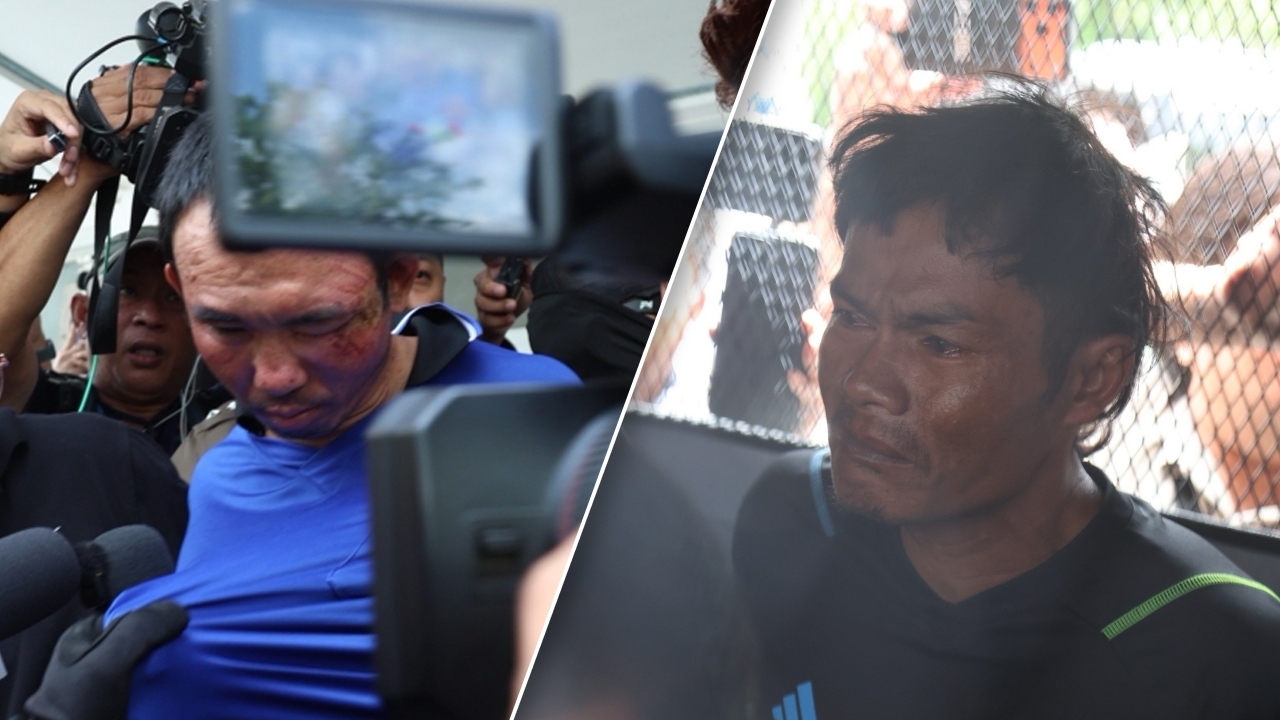
Analyzing the behavior of “Pong-Thong,” a ruthless killer who is not psychotic but fully conscious and calmly planned. Experts point out that his body language after being arrested is indifferent, revealing a new level of menace.
In a shocking case that alarmed the entire nation, heavy pressure from police operations ended with the arrest of Thongchai, or “Thong,” 39, and Tachana, or “Pong,” 43, two violent suspects who deceived two Russian siblings in Chonburi province by impersonating officials to rob and brutally murder them, then calmly burying the bodies. This case is linked to the killing and burial of five victims.
The arrest occurred near the forest along the Chanthaburi-Sa Kaeo road in Wang Mai subdistrict, Wang Sombun district, Sa Kaeo province. Authorities first captured Thongchai, while Tachana tried to flee deep into the forest but was cornered by police patrols. They seized as evidence a handgun and a grenade.

Behind the systematically planned heinous behavior—from impersonating police, coercion, to assaulting and killing to silence victims and hide the bodies—what lies within these killers’ minds? Are they mentally ill, or simply "remorseless criminals"?
Associate Professor Dr. Weerasak Charatchaisri, a forensic medicine specialist and medical professor at Srinakharinwirot University, analyzed that the offenders’ behavior shows "full intention and complete consciousness" during the acts, evidenced by their methodical preparations.
They selected victims carefully, targeting those they believed they could control, intimidate, and rob.
Their preparations and disguises included dressing like police officers and carrying firearms to intimidate and approach victims.
The execution process involved coercion, silencing, and physical assault up to causing death.
They planned and chose locations methodically to conceal and hide the bodies.
All these behaviors indicate full awareness, planning, and deliberate action—not loss of control or resulting from psychiatric illness. Whether they have mental disorders requires detailed examination, but at the time of the crimes, they were fully in control.

When asked about offenders often claiming to imitate behavior seen in movies or crime cases, the expert offered an interesting perspective that media is merely a source of technical information.
Media provides information; watching crime films or media may help copy techniques like planning or concealment. Essentially, the offenders have an inherently brutal nature. Ordinary people, even if exposed to violent films, would not commit such acts. The offenders have "a core behavior that is cruel, violent, and enjoys using force." They disdain their victims’ lives. If only motivated by robbery, there would be no need to kill. Thus, the murders clearly reflect their personal brutality.
During the crime reenactment and confession, the offenders’ body language revealed a chilling new level of coldness.
They remained very still, showing no signs of remorse or regret for their actions.
They accepted punishment reluctantly, seeing wrongdoing simply as a matter of legal penalty but lacking "moral awareness" that what they did was gravely wrong.

Besides severely undermining foreign tourists’ confidence, this case reflects two major structural problems in Thai society.
These offenders had just been released from prison two months earlier but committed serious repeat offenses twice. This shows the system for rehabilitating or reforming violent offenders in prisons may be ineffective and highlights the necessity for strict post-release monitoring for violent ex-prisoners.
Regarding impersonation of police, the expert personally noted that careful observation of the suspects’ personalities, mannerisms, and attire "did not look appropriate or resemble real police officers."