

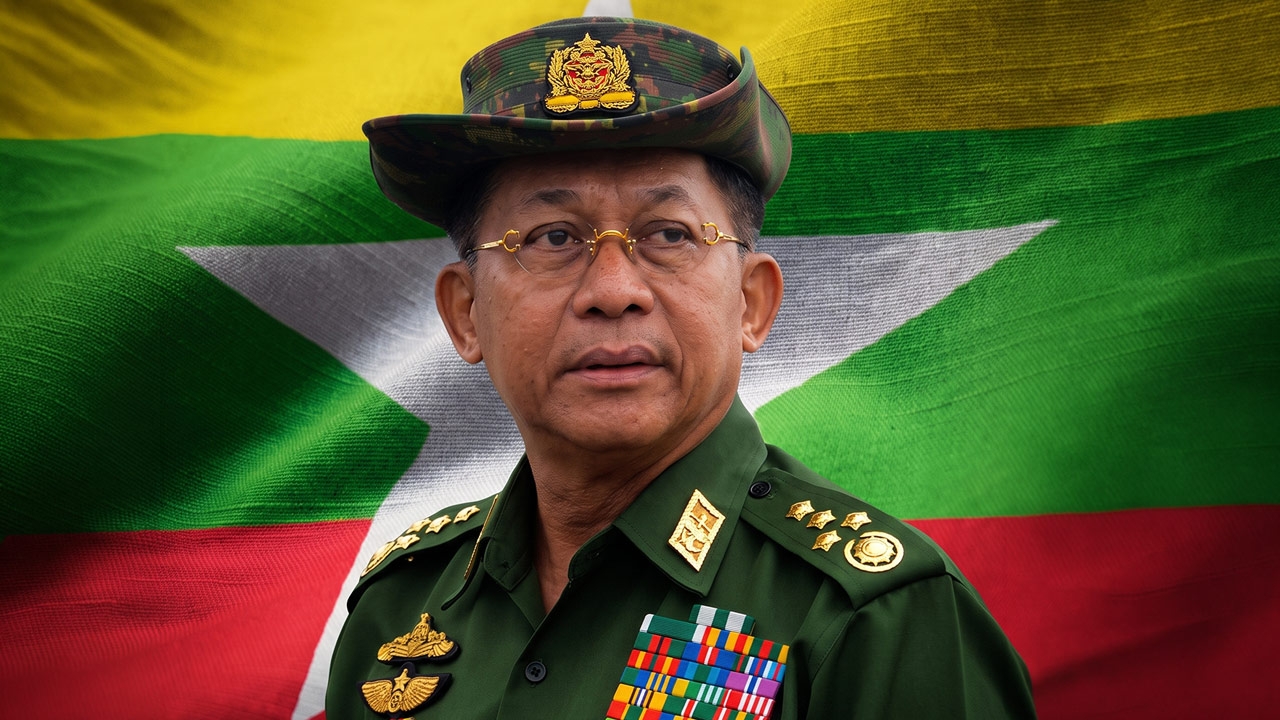
Min Aung Hlaing's visit to Thailand is closely watched due to border security and Myanmar labor issues. Experts highlight his strengthened domestic power after election victory and advise Thailand to seize the chance to coordinate with ethnic groups along the border to tackle drug trafficking and cross-border pollution, while cautioning against underestimating opposition voices.
President Min Aung Hlaing is scheduled to visit Thailand on 6-7 Aug 2026 to meet with Thai Prime Minister Anutin Charnvirakul, focusing on security and key cross-border issues. The Thai government aims to serve as a bridge to advance peace processes, though dissent exists from those opposing his power following the coup and concerns over toxic substances flowing across the border into Thailand.
Thairath Online's special team consulted Assoc. Prof. Dr. Dulyapak Preecharatch, President of the Regional Studies Association and Southeast Asia Studies lecturer at Thammasat University. He views Min Aung Hlaing's visit as a move to strengthen economic ties and discuss pollution problems in the Kok River, haze, drugs, and scammers. Thailand acts as a bridge between Myanmar and ASEAN, which hopes Myanmar improves peace and development conditions. Success in this regard would earn ASEAN's trust in Min Aung Hlaing.

Earlier, on 13 Jul 2026, a two-part meeting was held: the main foreign ministers' forum in Bangkok and a smaller discussion with ethnic groups and opposition representatives in Jomtien Beach, Pattaya. Representatives of minority groups and the ASEAN chair, the Philippines' foreign minister and special envoy, heard the border minorities' demands along the Thailand-Myanmar frontier.
In these talks, Thai authorities should prioritize Myanmar's ethnic minorities such as the Shan State Restoration Council led by Sao Yawd Serk, based along the border and representing a coalition called the 7 Ethnic Armed Organizations (7 EAO). Sao Yawd Serk opposes drugs. If the Thai Yai community or the United Wa State Army can assist in addressing Kok River pollution at its source, it would be highly beneficial due to shared language and culture with the Lanna region.
The Karen political groups are strategically important for Thailand's security. The main economic artery, the Asian Highway connecting Mae Sot and Myawaddy, links Myanmar. Regarding scammers, groups like Shwe Kokko and KK Park represent Karen political power centers.

Regarding potential opposition in Thailand during Min Aung Hlaing's visit, Assoc. Prof. Dr. Dulyapak warns of the need for vigilance. Many Myanmar workers in Thailand oppose Min Aung Hlaing's government despite its electoral legitimacy. While dissent exists, free dialogue is not rejected. Myanmar workers in Thailand and Thai citizens affected by Kok River pollution may organize and raise questions.
When asked if President Min Aung Hlaing's stated intent to reform the country differs from past efforts,
Assoc. Prof. Dr. Dulyapak notes that Min Aung Hlaing was formerly Commander-in-Chief who led a coup lasting over five years. Now elected with legal authority, his current term grants greater power, but obstacles remain from past government takeovers. Peace negotiations have yet to earn the trust of Myanmar's ethnic minorities along border areas.

On 3 Aug 2026, representatives from the International Committee of the Red Cross (ICRC) visited Daw Aung San Suu Kyi. This visit followed standard ICRC procedures for detainee monitoring, including private talks with Daw Aung San Suu Kyi. The purpose is to allow detainees to exchange news with family. Observations and recommendations from the visit are confidentially shared only with detaining authorities. The ICRC continues coordinating with all involved parties to maintain and expand access to detention sites in Myanmar. This development is closely watched as a potential indicator of President Min Aung Hlaing's efforts to improve the atmosphere for peace development.
