

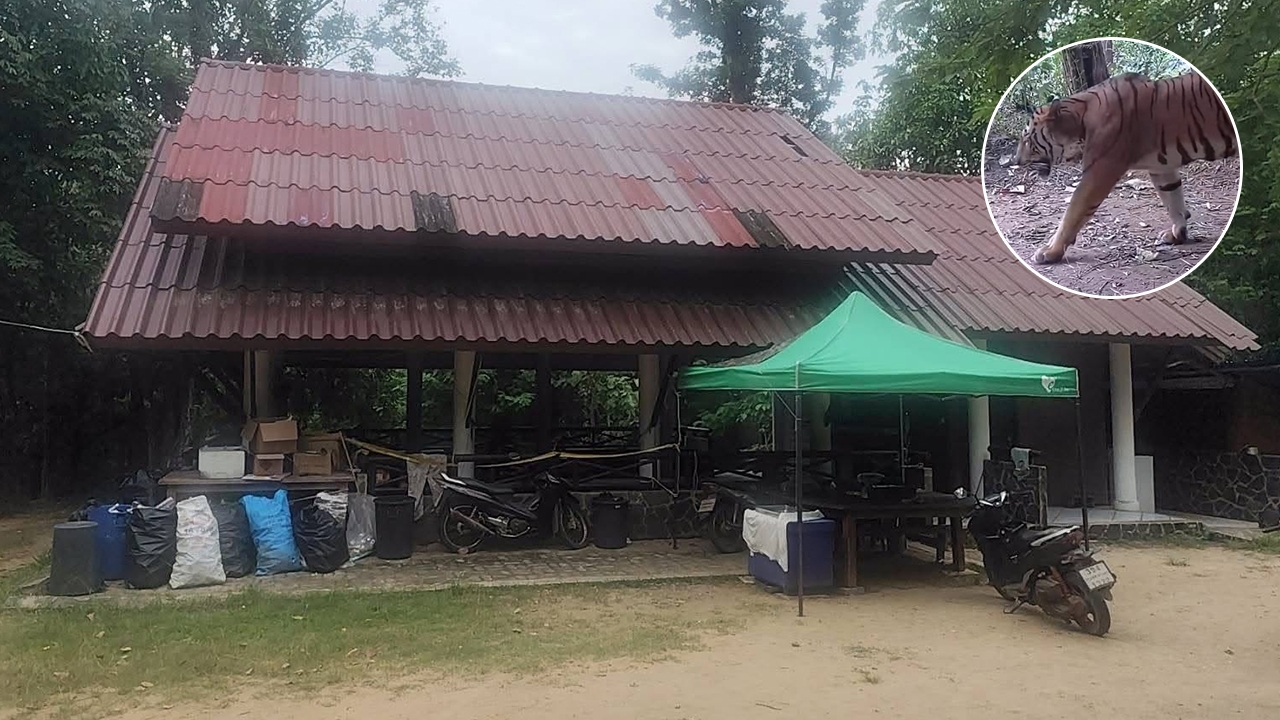
Tracking tigers in Huai Kha Khaeng forest following an attack on a staff member has identified 2 to 5 suspected tigers living near the incident site. DNA from hair found at the scene is being tested. The Director-General of the Department of National Parks emphasized the need to modify tiger behavior to prevent future human attacks. Meanwhile, the Seub Foundation has urged frontline officers to conduct thorough inspections, warning that rushing the investigation could harm conservation efforts.
Yesterday (5 Aug 2026), Mr. Atthaphon Charoenchansa, Director-General of the Department of National Parks, Wildlife and Plant Conservation, confirmed the death of Mr. Sakrin Wichajan, a government employee at Huai Kha Khaeng Wildlife Sanctuary, who was fatally attacked by a wild animal while on duty in the area during the morning.
Meanwhile, the Thailand Tiger Project DNP page, run by officials working in the area, posted that the incident site (Makham Kitchen) is an open-air building surrounded by low railings, with seating inside and gaps for access. Nearby, tiger tracks are regularly observed. In the past, staff used this area for sleeping. On this occasion, officials slept on the building floor under mosquito nets with fans.

After the incident, tiger hair was found on the seating area, and evidence suggests the tiger carried the human victim over the railing easily, rather than using the access gaps. No blood stains or drops were found on the sleeping area.
About 15 meters from the building, a blood-stained green mosquito net was found on the ground. Along the path of tiger tracks, no blood stains were found until the endpoint where the deceased was located with bite marks, though the blood was already dry.
Today (6 Aug 2026), the Department of National Parks page stated that the Director-General ordered wildlife conservation experts to capture tigers near the Huai Kha Khaeng office to collect DNA samples for comparison with hair found near the victim’s location. It is estimated that there are no more than five tigers involved.
On social media, many expressed concern about capturing tigers for DNA testing, fearing a repeat of past incidents where wild elephants died during relocation and behavioral adjustment processes.

The tiger attack in Huai Kha Khaeng Wildlife Sanctuary, which resulted in a staff fatality, has alarmed conservationists because this area is a key site for tiger conservation in Thailand. The incident could impact tiger preservation efforts. The Thairath Online special news team asked Mr. Atthaphon Charoenchansa, Director-General of the Department of National Parks, about plans to collect tiger DNA. He explained that social media reports mention five suspected tigers involved, but this has not been confirmed. Surveys previously found about 2 to 5 tigers around the office. They do not yet know which one attacked the staff, so they plan to capture as many suspects as possible to match their DNA with the hair found at the scene.
The principle behind the search is to find the tiger that attacked the staff to capture and modify its behavior for study. Various hypotheses exist, such as the tiger being old or starving, leading it to attack humans, but no definitive conclusion has been reached.

Normally, tigers do not attack staff, and their instincts do not include harming humans. Currently, field officers are working intensively; first, they must capture the tiger. Safety measures are already in place. Nearby communities are about 14 kilometers away.
Huai Kha Khaeng is an important tiger research site with increasing tiger populations, though not overcrowded. Its conservation approach is significant for Southeast Asia.
Regarding concerns about relocation or behavioral adjustment of tigers, detailed procedures have been ordered. Many experts and scientists are already on site, emphasizing careful capture and use of tranquilizers to avoid harm to the tigers.
Modifying the behavior of the attacking tiger is crucial because if released without intervention, future incidents could occur. Officials fear tigers may become habituated to attacking humans, posing a serious danger. This has happened before in Khao Yai.
Ms. Orayupa Sangkanman, Secretary-General of the Seub Nakhasathien Foundation, said conservation workers in the area are worried about the situation. Frontline staff are working quickly, but all current information is speculative, with no confirmation of the cause. The team is urgently seeking facts and requests time for thorough investigation before drawing conclusions.
The social media references to past tiger attacks occurred over 20 years ago in Khao Yai and likely involve different factors, with a large time gap between incidents.
Ultimately, establishing scientific facts will lead to stricter prevention measures to protect both officials and the public, ensuring sustainable safety. Rushing the investigation could lead to errors and negatively affect tiger conservation in Huai Kha Khaeng.