

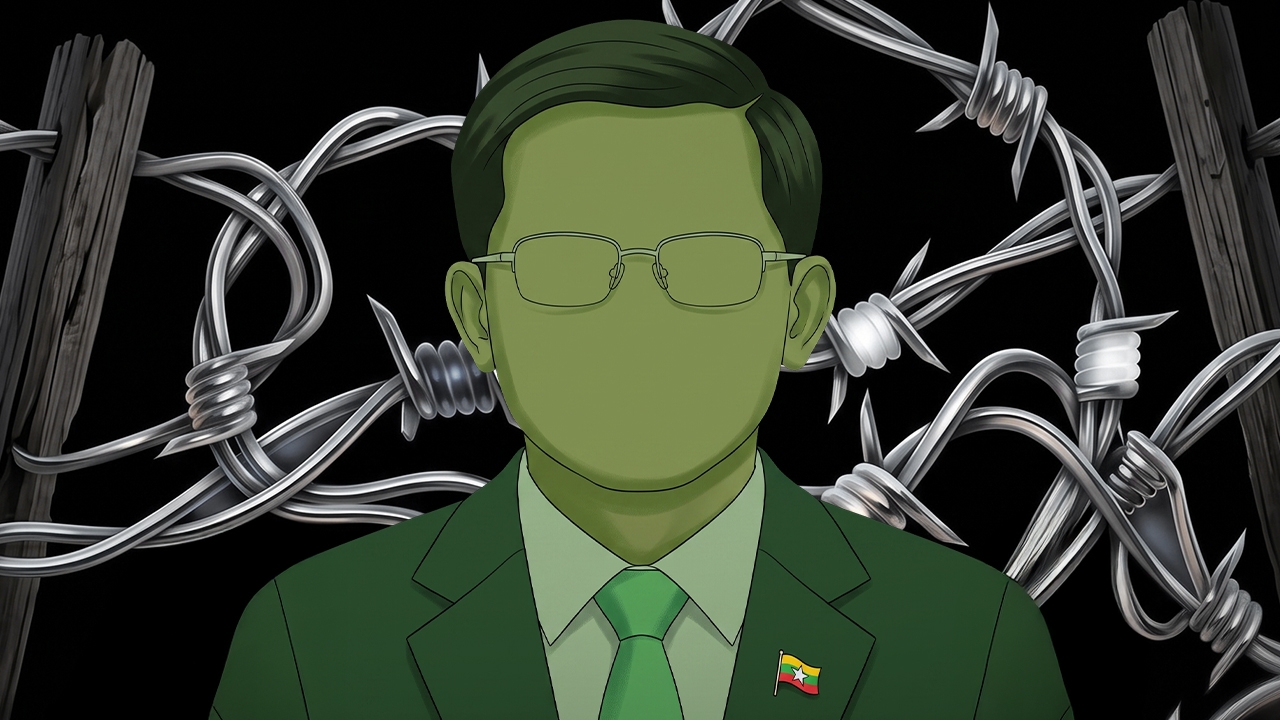
Senior General Min Aung Hlaing made an official visit to Thailand, discussing the "Seven Major Challenges." Myanmar's diplomatic success benefits it more, using Thailand to legitimize itself after elections and acting as a bridge back to ASEAN rather than yielding clear benefits for Thailand itself.
The outcomes of the official visit to Thailand by Myanmar's President Min Aung Hlaing on 6-7 August seem to meet the objectives of the newly civilian government in Naypyidaw, formed after the elections in December-January, more than achieving the goals desired by Thailand. The issues stemming from Myanmar's internal civil war are numerous and complex, making them difficult to resolve easily, as follows:
resulting from military operations that cause cross-border impacts and harm to people living near conflict zones along the border. There have been instances of artillery shells or airstrikes mistakenly landing on Thai territory, especially near Myawaddy in Kayin State, such as in Ban Huai Maha Wong, Ban Mae Kon Ken, Mahawan Subdistrict, Mae Sot District, Tak Province. Locals live in fear of fighting, and schools often close to keep children safe from stray munitions.
Visit outcomes: Security cooperation was mentioned in the joint statement between President Min Aung Hlaing and Deputy Prime Minister Anutin, specifically clause 3.1.4, where both sides pledged to strive for peace and stability along the border. However, no detailed plans or specific actions were outlined.

Instability, crisis, and civil war in Myanmar have driven about 5 million people, roughly 10% of Myanmar's population, to migrate into Thailand. Thai authorities categorize them as follows:
1) Refugees fleeing conflict from Myanmar (RFFCs) This group is officially recognized by the Thai state as refugees fleeing conflict (though not using the term "refugee" to avoid the UN Convention definition) and have been housed in temporary camps along the border for decades. Currently, there are 77,895 people in nine camps across four border provinces: Mae Hong Son, Tak, Kanchanaburi, and Ratchaburi. 2) People fleeing unrest from Myanmar (PFRUs) This group fled after the 2021 coup and is not in the camp system but may have temporary shelter permits (before possible deportation). Many live hidden or dispersed in communities, border towns, and economic zones nationwide. This group overlaps with economic migrants, both legal and illegal, numbering in the millions. NGO surveys indicate that about 40% of these refugees work in scam operations near the Thai border.
3) Foreign laborers According to the latest Ministry of Labor report in May 2026, Thailand has authorized at least 3.48 million Myanmar workers, about 79.5% of all 4.37 million foreign workers permitted to work in Thailand.
Only 179,787 are under the MOU system—the memorandum of understanding on labor cooperation signed by the Thai and Myanmar governments a decade ago. Most, about 3.4 million, are permitted through cabinet resolutions in 2024-2025 to register by proving nationality and seasonal migrant workers. However, since Myanmar's enforced conscription law in 2024 drafting men aged 18-35 into the military, many Myanmar workers avoid registration fearing conscription to fight armed ethnic and other groups amid ongoing intense conflict.
Visit outcomes: There was no mention of either category of refugees or displaced persons.
MOUs on labor cooperation and employment agreements were signed, essentially renewals of previous documents, with no expected structural changes in cooperation or employment.
Importantly, labor documents emphasized that "law enforcement, labor recruitment, and entry must comply with the laws of both countries, with workers adhering to host country laws and customs, refraining from political or internal interference, and paying contributions, taxes, fees, and expenses as required." This appears unlikely to ease workers' fears of conscription, meaning many will likely remain undocumented voluntarily. Third, cross-border crime problems
including drug trafficking, arms trading, and human trafficking, as well as the most severe current issue of scammers who proliferate in border areas between the two countries. The civil war makes law enforcement difficult in Myanmar, allowing illegal activities and criminal networks to flourish over the past 4-5 years. Despite crackdowns, these networks quickly adapt and recover.

Joint statement clause 1.3.5 states both sides will strengthen cooperation in combating transnational crime, especially drug trafficking and scammers, agreeing to enhance collaboration between relevant agencies to dismantle scam networks along the border through information exchange, financial route disruption, and anti-money laundering cooperation.
Thailand will support Myanmar's participation in the Egmont Group to facilitate intelligence sharing. Both sides will also tighten cooperation in preventing and combating drugs and related precursors. Fourth, environmental issues
due to cross-border water and air pollution. A major concern for Thai civil society is rare mineral mining by mostly Chinese investors in ethnic armed group-controlled areas, releasing heavy metals like arsenic into northern rivers such as the Kok, Ruak, and Sai, which flow into the Mekong. This has impacted health and agriculture along these river basins for some time.
Air pollution partly stems from slash-and-burn farming in Shan State near the Thai border, causing smog problems in northern provinces like Chiang Mai, Chiang Rai, and Mae Hong Son. So far, effective bilateral cooperation on this issue is lacking, though some pollution originates within Thailand itself.
Visit outcomes: A joint signing of the "Terms of Reference (TOR) for the Joint Working Group on Water Quality Management of Border and Transboundary Rivers between Thailand and Myanmar" was made.
This TOR is effective for three years, empowering the joint working group to support prevention and resolution of cross-border environmental pollution, including water and other pollution, toward more concrete outcomes. However, civil society and environmental academics have called for full disclosure of the TOR to study its details and assess whether it can truly address root problems. The water pollution issue involves multiple stakeholders beyond Thai and Myanmar governments, including Chinese authorities, armed groups—especially the United Wa State Army (UWSA) with high autonomy—and Chinese investors. Comprehensive plans and actions are required. Fifth, economic problems
Two types exist: First, insecurity disrupts trade routes, especially the Mae Sot-Myawaddy border, which can be easily cut off. Transport infrastructure suffers damage, and traders and transporters pay protection fees to various armed groups, raising costs. Sometimes Myanmar authorities close crossings to block supplies to opposition or ethnic groups, such as the recent closure of the Second Thai-Myanmar Friendship Bridge. Second, improper economic management and policies by Myanmar's government, such as official exchange rates misaligned with the market, causing multiple exchange rates with large gaps. Import rules require importers to export an equivalent amount of foreign currency, burdening traders. Myanmar's deteriorating economy, limited export goods, and sanctions by the US, Europe, and UK have shrunk markets.
Visit outcomes:

Clause 3.2.2 welcomes reopening the permanent crossing at the Second Thai-Myanmar Friendship Bridge (Myawaddy-Mae Sot).
Clause 3.2.3 confirms joint intent to enhance connectivity through infrastructure and efficient transport networks, emphasizing establishing a joint working group to coordinate multimodal connectivity master plans covering road, maritime, and port transport. Potential future cooperation includes developing maritime links between Ranong port and suitable Myanmar ports, promoting economically viable coastal shipping, developing the Phu Nam Ron–Tigi–Dawei route, supporting the India-Myanmar-Thailand trilateral road project, facilitating cross-border transport, and studying special economic zones and logistics centers near the border.
Clause 3.2.6 mentions the Thailand-Myanmar Business Forum held in Bangkok on 6 August 2026 to promote networking and cooperation between private sectors of both countries. However, the statement focuses only on trade goals and opportunities without concrete action plans to achieve them, despite ongoing conflict and unfavorable economic policies hampering business operations.
Sixth, Thailand's facilitation of ceasefire negotiations
Thailand aims to be a "facilitator" for ceasefire talks between Myanmar's government and various ethnic armed groups. After inviting the National Solidarity and Peacemaking Committee (NSPC) for talks in Thailand and informal meetings with ethnic groups such as the Karen National Union (KNU), Karenni National Progressive Party (KNPP), Kachin Independent Organization (KIO), Restoration Council of Shan State (RCSS), Chin National Front (CNF), and New Mon State Party (NMSP) on 13 July, hopes for concrete progress appear limited.
These groups, though long close to Thailand, distrust Thai intentions, fearing pressure to accept a peace plan dictated by Min Aung Hlaing. Some groups like RCSS and NMSP have prior ties with NSPC.
Moreover, groups like KNU, KNPP, KIO, and CNF, members of the Steering Council for the Emergence of a Federal Democratic Union (SCEF), prefer unified, collective approaches and view current Myanmar conditions as unsuitable for formal peace talks.

Joint statement clause 5 briefly states Thailand welcomes Myanmar's ongoing commitment to peace talks aiming for sustainable peace through a Myanmar-owned and Myanmar-led process, with Thailand providing support and close consultation, which Myanmar appreciates. However, Thailand's promise to tighten border controls preventing weapons produced in Thailand from reaching Myanmar armed groups may undermine ethnic groups' trust, fearing Thai collaboration with the military to pressure them. Seventh, Thailand's role as a bridge to ASEAN
to reintegrate Myanmar fully into ASEAN after ASEAN barred Myanmar's official political representatives from key meetings to pressure compliance with the five-point consensus.
So far, Myanmar disregards these measures; its parliament recently rejected the consensus and denied ASEAN special envoys access to Aung San Suu Kyi, leading to criticism of Thailand for legitimizing the military dictatorship that has destroyed democracy, killed civilians, and widely violated human rights, damaging ASEAN's credibility. Visit outcomes:
Joint statement clause 4.3 states Thailand reaffirms commitment to support Myanmar's full and equal participation in ASEAN mechanisms per ASEAN charter, principles, and processes. Myanmar thanks Thailand's constructive role in facilitating normalization of Myanmar-ASEAN relations. However, there is no mention affirming the sanctity of the five-point consensus as the main document for addressing Myanmar's crisis.
Min Aung Hlaing's visit can be seen as a diplomatic success for Myanmar, using Thailand as a key platform to demonstrate that the post-election government is recognized and able to resume normal relations with neighbors.
For Thailand, the outcomes are much less clear.
The seven major challenges Thailand faces do not stem from lack of contact between governments but from civil war, fragmented state control, and Myanmar government's management failures. Raising diplomatic ties alone cannot resolve these issues. Thailand's post-visit challenge is not whether to engage with Min Aung Hlaing's government, as geography, economy, labor, and border security make contact unavoidable. Rather, Thailand must shift from general diplomacy to problem-solving with cooperation that defines goals, methods, responsibilities, timelines, and measurable progress—from preventing cross-border fighting impacts, regulating labor, combating scammers, resolving river pollution, to maintaining border trade routes. Otherwise, many agreements from this visit risk remaining symbolic declarations without measurable results.

Crucially, Thailand should not assume Myanmar's Naypyidaw government is a sole interlocutor capable of addressing all Thai concerns, since the military government cannot fully govern its country. Control over many border areas rests with ethnic armed groups and others. Effective problem-solving requires multi-level diplomacy, engaging central government, local authorities, ethnic groups, civil society, and influential third countries, without interpreting contact as interference in Myanmar's internal affairs. The same principle applies to peace facilitation and ASEAN reintegration efforts. Thailand should not promise unconditional help to restore Myanmar-ASEAN relations, as full ASEAN membership is not Thailand's sole decision, nor should it occur separate from progress in resolving Myanmar's internal crisis. If Thailand wants to be a genuine bridge, that bridge must connect all parties, not just Bangkok and Naypyidaw. Ultimately, Thailand's policy success on Myanmar should not be measured by visit frequency, number of MOUs, or diplomatic pomp, but by simple questions: Has the Thai border become safer? Have crime and scammers decreased? Is labor better managed? Has cross-border pollution been addressed at its source? Is border trade more stable? Can Thailand help create a peace process trusted by all parties?
If these questions remain unclear, Min Aung Hlaing's visit may represent a significant step for Myanmar's return to the international stage rather than a meaningful advance in solving Thailand's problems.