

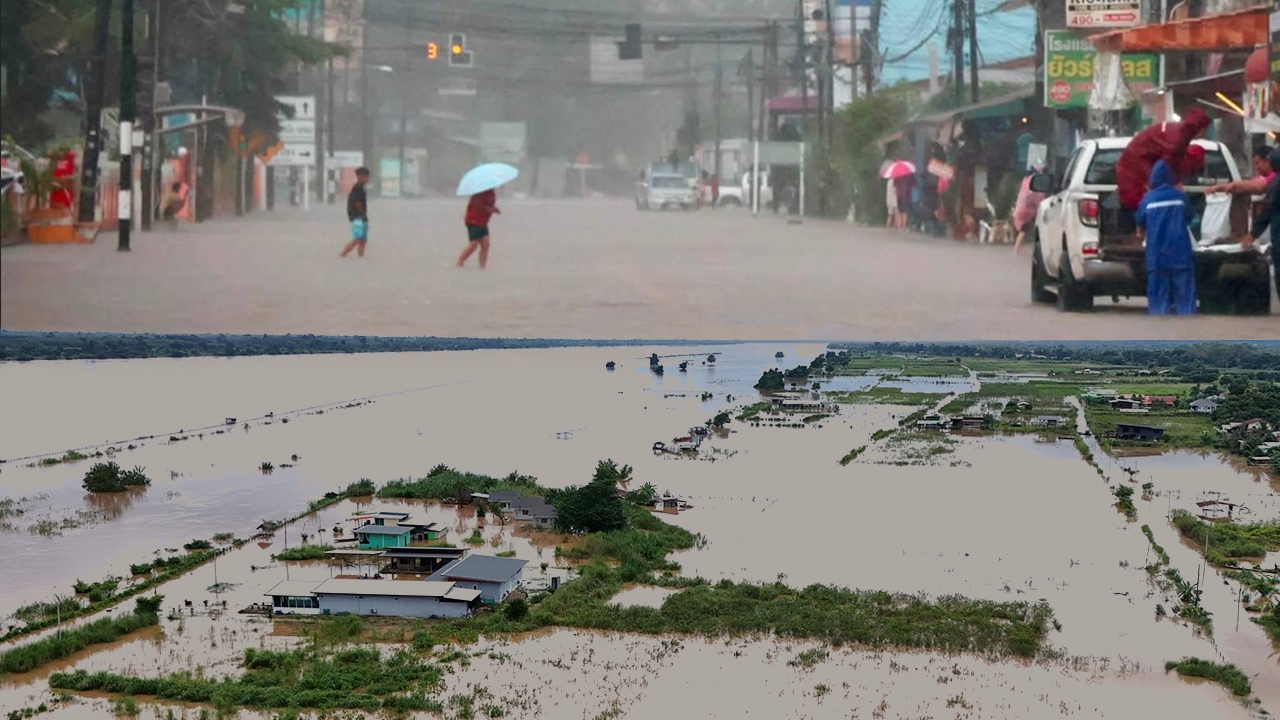
The Mekong River's water level has risen sharply, prompting warnings for low-lying areas in Nakhon Phanom and Mukdahan to prepare for flooding. Water levels are expected to rise on 13-14 Aug 2026.
On 10 Aug 2026, flood conditions along the Mekong River saw water levels rise rapidly, affecting nearby riverbank areas. The National Water Resources Office (NWRO) issued warnings for eight provinces along the Mekong. Those nearing critical water levels include Nakhon Phanom, Mukdahan, and Nong Khai, while Loei, Bueng Kan, Udon Thani, Amnat Charoen, and Ubon Ratchathani remain under surveillance.
This morning, water at Ban Phan Lam, Wisit Subdistrict, Mueang Bueng Kan District, stood at 12.38 meters—1.62 meters below the riverbank. Rising water levels have impacted residents in Bueng Kan, damaging homes and farmland. Livestock, especially cattle and buffalo, lack grazing areas. Local authorities have distributed survival kits to affected villagers.

Most recently, on 11 Aug 2026 at 14:13, the Facebook page 'Nakhon Phanom News' warned residents traveling through Ban Xayaburi, Tha Uthen District, Nakhon Phanom, that rising water has flooded roads, leading to closures of the Ban Na Phieng U-turn bridge and the Huai Hong Din Chi at Ban Xayaburi. The Songkhram River Bridge, Huai Nong Wai Bridge, and Huai Sueam remain passable but travelers are urged to exercise caution and monitor water levels closely.
Thairath Online's special reporting team interviewed Mr. Thanaroj Waratprasert, Director of the National Water Command Center and Deputy Spokesperson of the National Water Resources Office (NWRO), regarding the rapid rise in Mekong water levels. Mr. Thanaroj explained that recent rainfall has begun to decrease, reducing flood risk in central economic areas, except localized rainfalls such as in Nakhon Phanom, where 222 millimeters fell on 9 Aug 2026. This volume exceeded drainage capacity, causing water to pool in low-lying areas. Vehicles attempting to cross flooded zones stalled due to water too deep for passage, leading to engine failures.

Mr. Thanaroj stated that water discharge from China's Jinghong Dam is only about 1,000 cubic meters per second, with no additional releases downstream. The increased water levels stem primarily from rainfall in Laos, causing floodwaters to flow through the Xayaburi Dam, peaking at approximately 17,000 cubic meters per second, now reduced to about 14,000 cubic meters per second. This floodwater is moving through the Mekong, expected to impact provinces from Loei, Nong Khai, Bueng Kan, Nakhon Phanom to Mukdahan, with the greatest effects in the low-lying areas of Nakhon Phanom and Mukdahan.
Discharges from Jinghong Dam currently range between 1,500 and 2,000 cubic meters per second, reduced from about 2,000 to 1,500 cubic meters per second. This inflow raises water levels around Chiang Saen in Chiang Rai by only about 10 centimeters. The main impact comes from the Xayaburi Dam in Laos, which regulates inflows to prevent risk levels from rising too high. The dam's maximum discharge was increased from about 14,000 to 15,000 cubic meters per second on 10 Aug 2026 but has since been lowered back to 14,000 cubic meters per second.

Mr. Thanaroj anticipates water volumes to gradually decrease, with floodwaters moving from Nong Khai and Bueng Kan toward Nakhon Phanom and Mukdahan, areas likely to be affected in the next two days (13-14 Aug 2026). Water levels are expected to rise about 60 centimeters. Authorities have been notified to prepare and have informed the public to stay alert and ready for flooding.
Relevant agencies have deployed sandbags to block water from entering community areas, except for lands outside embankments used by locals for dry-season crops, which will be affected. Preparations include continuous monitoring, assessment, and regular updates. Adequate sandbags are available to manage the situation. Rainfall is expected to decrease moving forward, and if no additional storms influence Thailand from China, peak flooding should subside. August through October typically sees cold winds reduce rainfall intensity.