

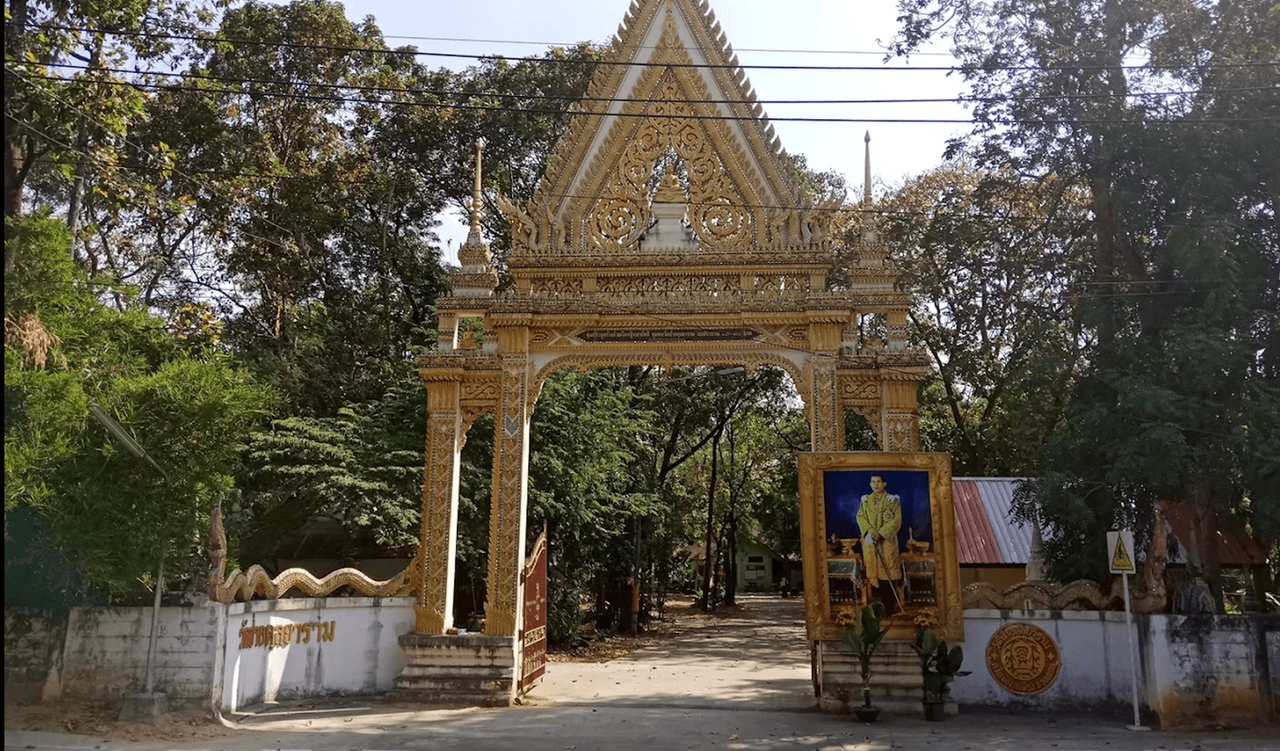
The land dispute at Wat Pa Adunyararm in Khon Kaen has become a major news topic, attracting wide interest when a group claiming to be heirs of the original landowner arrived with forces and equipment to block the temple’s entrances and exits. They posted notices demanding all property be removed within 15 days, leading to confrontations and raising critical questions about the ownership of this prime land.
Wat Pa Adunyararm is a lay Buddhist temple affiliated with the Dhammayuttika Nikaya order, located in Village 16, Nai Mueang Subdistrict, Mueang District, Khon Kaen Province.
In 1990, Mr. Hiang, a devout Buddhist local businessman, donated over 20 rai of land to Phra Kru Adulsaranithet (the abbot) to establish a temple and meditation center.
Legal establishment: The temple was initially registered as a meditation center and was later officially recognized as a temple under the law. Religious objects and structures were built over time through the faith and donations of Buddhists in Khon Kaen for more than 30 years.

The conflict arose after the original landowner, Mr. Hiang, passed away shortly after donating the land, leading later heirs to question the legitimacy of the land title transfer.
Points of contention | Wat Pa Adunyararm’s position | The donor’s heirs’ position |
Evidence of donation | There are historical photos from 1990 and temple account books documenting the donation of 21 rai of land clearly recorded during a merit-making ceremony. | They argue that the rights granted at that time were conditional and that the legal title transfer was not fully finalized before the original owner’s death. |
Ownership and legal matters | The temple insists it has possessed and used the land as a religious site for over 30 years, and that courts have previously dismissed similar lawsuits filed by plaintiffs. | The heirs claim that the original land title remains in the family’s name, and upon the owner's death, ownership should pass to them as inheritance, so they have applied for a new land title. |
Latest situation | The abbot, monastic authorities, and local officials affirm the temple’s ownership rights and have filed trespassing charges against those disturbing the temple’s rights. | They poured concrete over drainage pipes to block the temple’s entrances and exits, posted threatening notices demanding removal within 15 days, and declared intentions to bring machinery to alter the land. |
A key reason why this approximately 21–28 rai land dispute is so fiercely contested is the "economic value of the location."
The land borders Khon Kaen University, with a main road passing behind the university, connecting the government center and business district.
It is in the heart of a dormitory and community zone with a high concentration of students, medical personnel, and university staff—one of the densest in the area.
Close to provincial-level amenities: near Srinagarind Hospital, the Faculty of Medicine, high-rise condominiums, shops, cafes, and leading community malls.
Thirty years ago, land on the outskirts of Khon Kaen University, in the Kangsadan area, was priced at only a few hundred to a few thousand baht per square wah. But with the city’s expansion, prices along Kanlapaphruek Road have surged dramatically.
The assessed and market price of land on Kanlapaphruek Road in this area now reaches 50,000 to over 100,000 baht per square wah, depending on frontage and accessibility.
Currently, local authorities, the Land Office, and police in Khon Kaen have taken control of the situation, explaining that although the legal ownership is still under judicial process, the practical possession rights remain with the temple. Thus, placing barriers blocking the temple’s access is illegal. The legal outcome of this prime land dispute continues to be closely followed.