

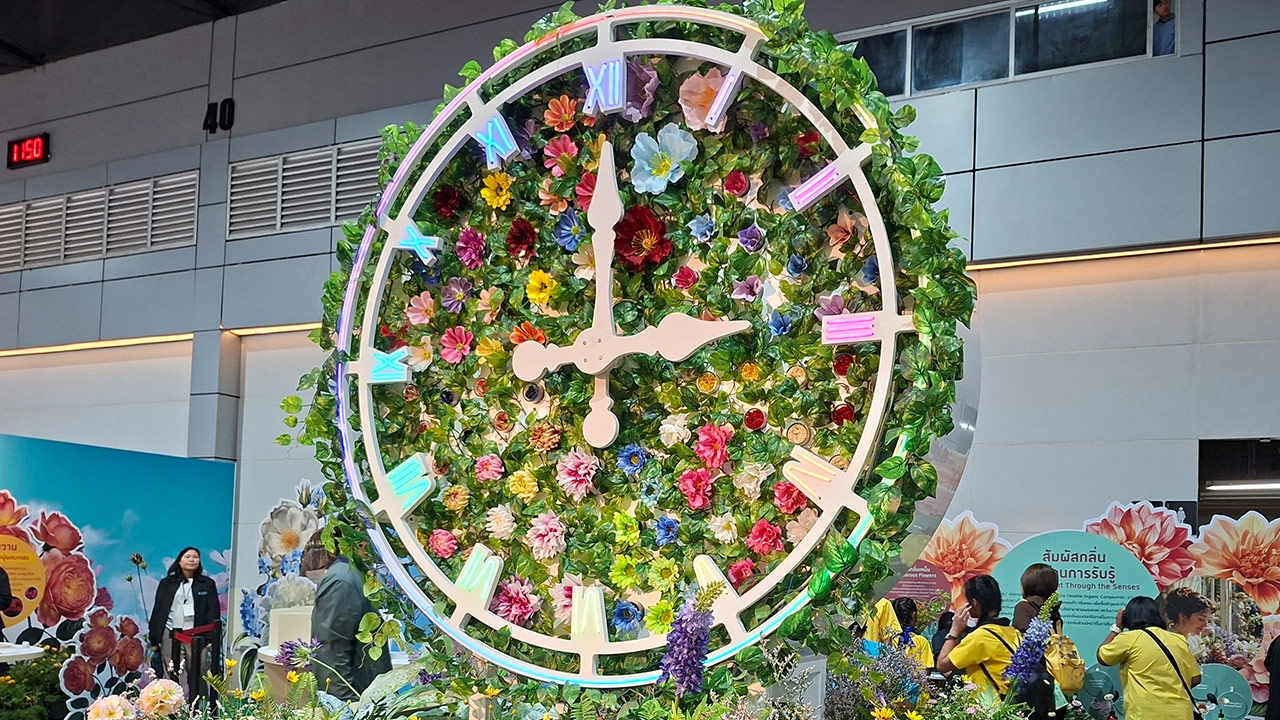
Visit the "OVER THE BLOOM – Flowers Changing the World" exhibition showcasing beauty beyond the surface, viewing flowers through a scientific lens that reveals astounding facts about their communication and time-telling bloom patterns.
When people think of flowers, they usually picture only their beauty, but in reality, flowers offer much more than that. Thairath Online special team takes you to explore the exhibition. "OVER THE BLOOM – Flowers Changing the World" Featured at the 2026 National Science and Technology Fair, offering a scientific perspective on flowers.
Dr. Putthamon Phongkai Dr. Putthamon Phongkai, a specialist at the Botanical Science Division, Natural History Museum Academic Office, explained that the "OVER THE BLOOM – Flowers Changing the World" exhibition aims to help visitors appreciate the deep value of flowers and see them as life-givers. Flowers connect plants, animals, humans, food chains, and biodiversity. For example, without rice flowers, there would be no rice to eat; without mango flowers, no mango fruit. She wants everyone to recognize their importance and value.

Dr. Putthamon added that beyond beauty, the blooming and closing of flowers can also indicate time—not precisely to the minute but roughly by the hour. However, this timing applies only to certain flower species.
The main factor controlling flower blooming is light intensity. The amount of light affects blooming because flowers have light receptors that detect when to open and close. For example, the "Eleven O'Clock Flower" blooms around 10 a.m., when light intensity is just right, then closes as light decreases. Similarly, night-blooming flowers open around 5-6 p.m. Light is essential for flower growth; less light means fewer or no blooms.
Another factor is seasonal temperature. Some flowers bloom only when temperatures are cool, such as lychee flowers, which won’t bloom if it’s not cold enough. Many cold-climate flowers cannot grow in Bangkok because the temperature is too warm.

Dr. Putthamon also shared research indicating that plants and flowers do communicate—not through sound like animals or human speech, but by releasing chemicals to signal each other. This communication occurs via leaves or through soil, helping plants avoid overlapping leaves or flowers so they can evenly share sunlight. If plants shade each other, they compete for nutrients.
This topic is particularly interesting as it is relatively new and currently under active study.
Finally, Dr. Putthamon emphasized that every flower blooming tells a story of interdependence linking nature and all life. As nature and flowers have nurtured life abundantly, it is time for us to embrace and care for nature with understanding and love to preserve biodiversity and hope for future generations.

The 2026 National Science and Technology Fair is held from 15-23 August 2026 at Halls 9-11, IMPACT Muang Thong Thani, open 9 a.m. to 7 p.m. The theme is "Intelligence in Science for a Sustainable Future."
Mr. Surawong Wongsiri, acting deputy director of the National Science Museum Organization (NSM), said the fair features exhibitions and science activities with participation from over 98 organizations, including 28 international agencies from 8 countries.
The NSM also presents five main exhibitions as follows:
1. Royal Pavilion – Tracing the wisdom and ingenuity of Thai monarchs and royal family members through science.
2. Rare Earth: The Invisible Power – Exploring rare earth minerals.
3. AI Revolution: The New Human Edge – Examining the future created by human and AI collaboration.
4. The Hidden World of Rangelands – Discovering secrets of grasslands.
5. OVER THE BLOOM – Flowers Changing the World, viewing flowers beyond beauty.
The event encourages visitors not only to read but also to engage in hands-on experiments, as science is best understood through practice.