

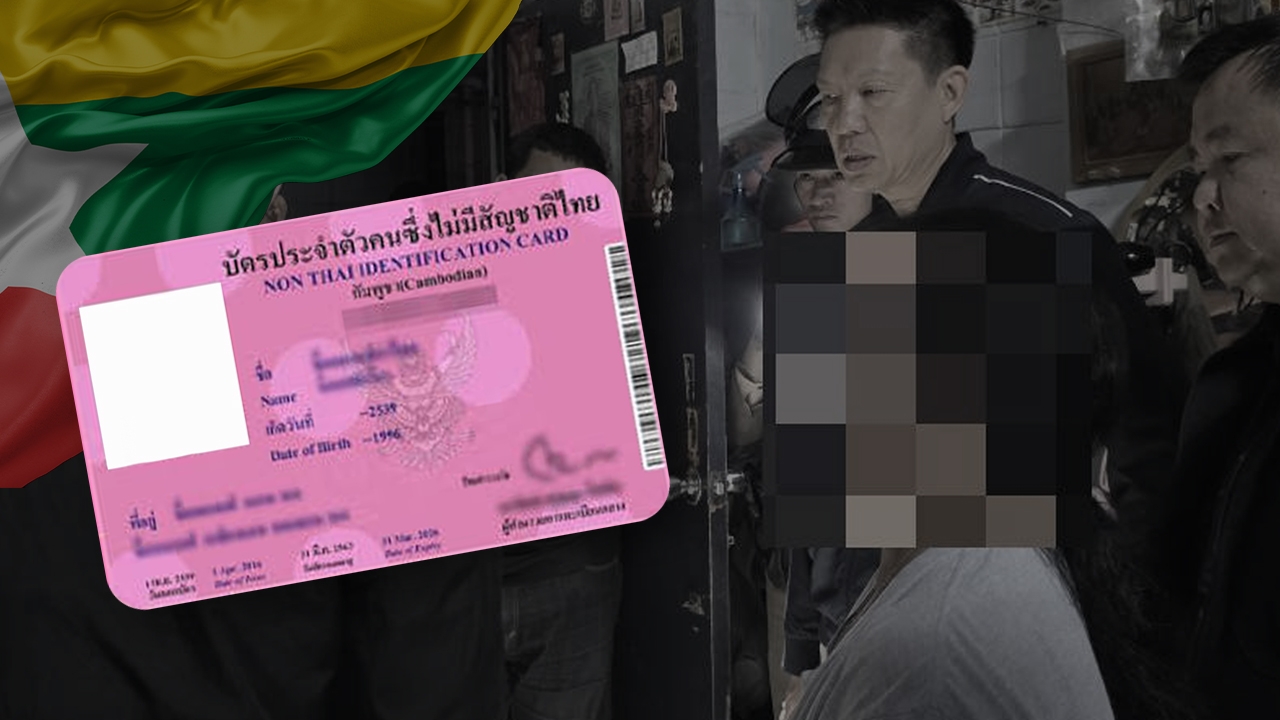
Tracing the crackdown on the "Pink Card" fraud gang reveals most are Myanmar children aged 7-15, hoping to buy a future with Thai nationality. The network is believed to be spread nationwide, with Din Daeng identified as a major strategic hub close to labor areas.
The crackdown on the fraudulent use of the Pink Card for foreign children and foreigners seeking basic rights in Thailand began in March 2026. Officials raided three abandoned houses in Phra Nakhon Si Ayutthaya Province used for illegal household registrations. Most involved were children under 15 years old, averaging about 20 per day applying to transfer their household registration (Form T.R.13) into these abandoned houses in Wang Noi district. After receiving the card within seven days, their names were promptly removed from the registration. Homeowners consenting to use their household registration received 1,000–3,000 baht per foreign individual. Investigations found over 217 cases of foreign children’s names transferred into abandoned houses in this manner.
Most recently, on 18 Aug 2026, officials raided and dismantled an illegal Pink Card and unlawful foreign household registration operation at three Din Daeng flats, with one unit registering up to 64 people, mostly children aged 5-15. It is estimated that at least 1,366 foreign children are registered in these flats.
In both cases, similar behavior was noted: using Thai-owned houses to register mostly Myanmar foreign children. Homeowners received financial compensation. Meanwhile, investigators from the Office of Public Sector Anti-Corruption Commission (PACC) confirmed government officials were involved in the corruption. It is believed such illegal acts occur in several other areas, particularly in Bangkok and nearby provinces.

The Pink Card fraud network involves the personal ID card issued to stateless persons, mainly temporary foreign workers. The Ministry of Interior issues these cards to legally identify foreigners residing temporarily in Thailand. Eligible foreign workers for the Pink Card include Burmese, Lao, and Cambodian nationals.
Regarding the Pink Card fraud crackdown, Thairath Online interviewed Mr. Natthapong Srinak, Director of the Anti-Corruption Enforcement Group at the Office of Public Sector Anti-Corruption Commission (PACC). He said that in March, Wang Noi district, Phra Nakhon Si Ayutthaya, had a crackdown on fraudulent Pink Card and foreign household registrations. The modus operandi between Ayutthaya and the recent Din Daeng flats is similar: bringing foreign child laborers into household registrations as Thai residents. The main objective is to obtain the Pink Card, which has a 13-digit ID number starting with 7.

Most registered children are Myanmar nationals. Once these foreign child workers receive the Pink Card, they gain benefits such as access to basic education, healthcare rights, and potential eligibility for Thai nationality in the future if they graduate with a bachelor's degree, according to Department of Provincial Administration criteria.
They can also open bank accounts and conduct transactions. Having the Pink Card protects them from government arrests, as it allows free movement throughout Thailand without foreign labor restrictions.
In the Din Daeng flats case, a search of room 6004/7 revealed 64 registered occupants, all Myanmar nationals, mostly children aged 7-15. It is believed younger children are chosen to obtain the Pink Card and improve chances of future Thai nationality.

Mr. Natthapong stated that going forward, the Department of Provincial Administration, PACC, Department of Special Investigation (DSI), and police will investigate whether the networks are interconnected. Initially, the Din Daeng flats fall under the Ministry of Labor's jurisdiction, which handles foreign labor issues, making it a hotspot for foreign workers. There is a possibility that networks operate here. Whether the Ayutthaya cases connect remains to be further investigated.
Additionally, two homeowners not acting as brokers and one homeowner acting as a broker, totaling three houses, were arrested. It is suspected that some middlemen brokers connected to government officials exist, which requires further investigation. There are 14 rooms in total where up to 67 people may be registered per room.
Financial investigations found that in Din Daeng room 6004/7, the homeowner, Ms. Phueng, was aware only of three foreign children residing there and received 5,000 baht compensation, averaging just over 1,000 baht per person. However, this is doubted since Ms. Phueng faces financial difficulties, and brokers may have pressured to lower prices from tens of thousands to just thousands of baht.
Police will interview brokers and homeowners to verify if the compensation was truly only 500 to just over 1,000 baht per person as claimed. If the homeowner knew 64 people were registered, the payment likely would have been higher.

Initially, PACC received tips from locals and conducted inquiries that revealed credible suspicions of corruption by officials in the Din Daeng district office responsible for recording household registration transfers. Unusually high numbers of people were registered, indicating misconduct.
According to Ministry of Public Health regulations, residential buildings, factories, or worker accommodations with more than one person per 3 square meters are overcrowded and unhealthy. Room 6004/7 in Din Daeng measures 30–35 square meters. Since registered residents must actually live there, the presence of over 70 people, both Thai and foreign, raises serious doubts about feasibility. Coordination with the Department of Provincial Administration will expand investigations to other rooms, estimating over 16 foreign children in more than 40 rooms.
Mr. Natthapong said that Deputy Secretary-General Pol. Lt. Col. Siripong Sritula of PACC indicated further inspections are needed. Currently, such illegal foreign registrations occur not only in houses but also in flats, which have more rooms and thus facilitate easier illegal registrations. Plans are underway to coordinate with Bangkok authorities to inspect other high-risk areas for similar cases.
