

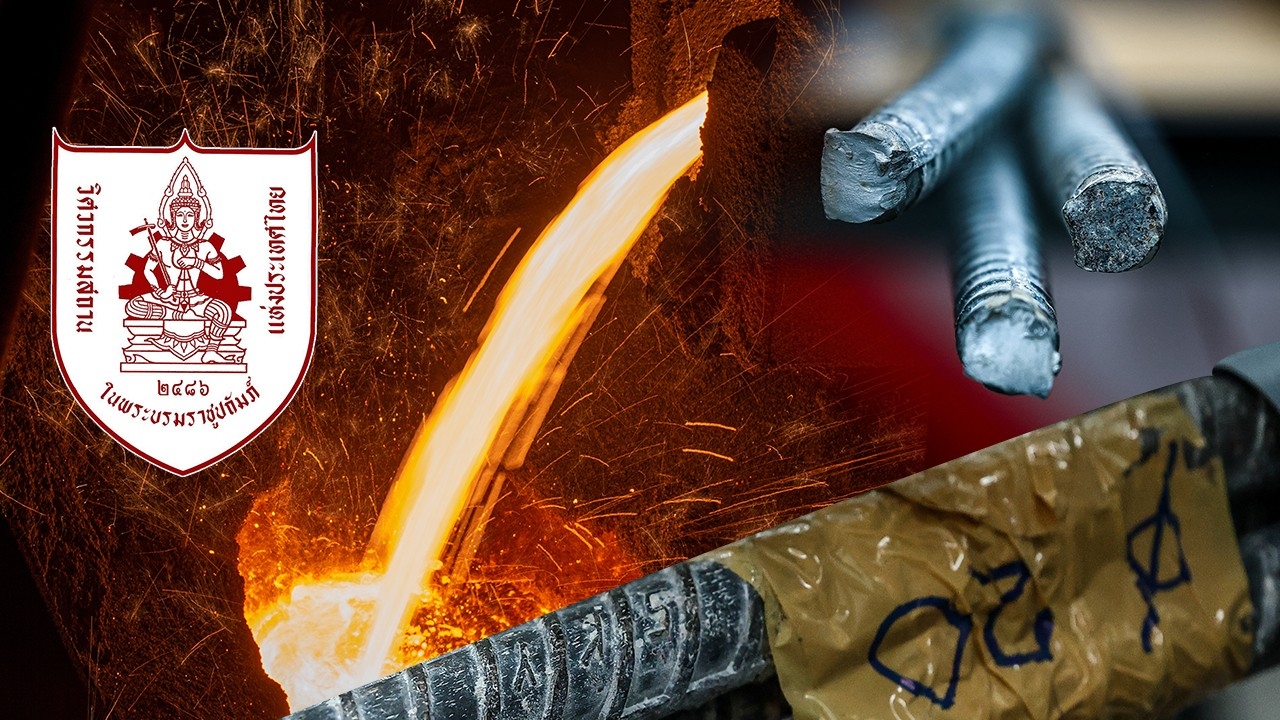
The Engineering Institute of Thailand (EIT) supports upgrading the production of rebar and deformed steel bars to ensure consistent quality appropriate to the risk level of construction projects. They do not specifically exclude the Induction Furnace (IF) production method, believing that strict standards combined with thorough inspections will eliminate non-standard furnaces from the market.
Since the tragic incident of the "Office of the Auditor General (OAG) building" which was under construction and collapsed due to an earthquake in 2025. Although investigations attributed the collapse to construction defects, inspections also found that some steel used did not meet standards. This raised questions about the steel quality used in Thai constructions, especially in high-rise buildings and infrastructure, prompting calls to upgrade standards to protect lives and property.
Recently, the Industrial Product Standards Committee (IPSC) approved revisions to the 2016 Thai Industrial Standard (TIS) for reinforced concrete steel bars. The revisions limit production methods for deformed steel bars, used for columns and beams, to only two: Basic Oxygen Furnace (BOF) and Electric Arc Furnace (EAF), thereby excluding the Induction Furnace (IF) method. This upgrade brings the standards closer to international benchmarks.
On 17 Aug 2023, the Thai Industrial Standards Institute (TISI) of the Ministry of Industry, together with industry groups like the Thai Metal Association, held a public consultation forum. They are now compiling conclusions to proceed with legal promulgation of the revised standard.

Special Report by Thairath Online Inquiries were made to Assoc. Prof. Anek Siripanichkul, President of the Engineering Institute of Thailand (EIT), who serves as chair of the committee reviewing the 2016 TIS. He revealed that the committee studied for nearly two years after IF technology, originating from China, began entering Thailand in 2014. The IF-produced steel was permitted but had to meet specified standards.
Despite pressure from various parties to expedite consideration, the committee chose a cautious approach, not allowing unrestricted use of IF technology, but imposing conditions.Appendix Battached to the specific inspection criteria for approval details technical requirements for deformed steel producers, focusing heavily on environmental control issues.
Regarding the debate, Assoc. Prof. Anek pointed out that the new standards are now enforced. The committee decided not to specify furnace types, but to require processes that purify molten steel, clearly mandating a refining furnace. However, the IF process may not purify molten steel as effectively as the EAF.
In detail, the IF furnace uses electromagnetic induction to melt scrap steel but lacks systems to separate phosphorus and sulfur. Thus, the grade of scrap fed directly determines molten steel grade, making chemical control more difficult.
Meanwhile, the BOF or EAF furnace uses high-current arcs from carbon electrodes to generate heat, with refining and slag removal systems that capture and separate harmful impurities, allowing consistent chemical purity in molten steel.
Assoc. Prof. Anek emphasized that government and industrial standards authorities strictly regulate steel use in high-strength structural applications. International standards do not mandate specific furnace types but strictly control final steel quality. In fact, Thailand enforces even higher standards by specifying increased steel strength and the maximum ratio of load-bearing capacity to yield strength (the point where permanent deformation begins), ensuring substandard steel cannot be used. He believes that with stringent standards and good inspection, non-standard furnaces will disappear in the future.

While new steel standards in Thailand may impact some producers, the EIT believes future structural projects should elevate rebar quality criteria to meet international standards, especially regarding yield strength, tensile strength, tensile-to-yield ratio, and appropriate ductility to ensure safe and consistent engineering performance.
Usage classification by application is suggested, such as requiring steel from specific processes for structures subject to vibrations, while general buildings may use standard grades. This approach aligns with practices in Japan, Indonesia, and the Philippines.
The EIT strongly supports revising the steel product standards to be stricter and more modern, as Thailand and the world face increasing natural disaster risks, including earthquakes. Promoting high-strength, ductile steel helps absorb shock energy and deform significantly before failure. Generally, harder materials tend to be brittle.

Raising the TIS standards to reflect these risks will be crucial for filtering construction materials and ensuring public safety in future projects, covering applications requiring high performance. Construction requirements depend on steel type; for example, building steel does not require fatigue testing but must meet concrete compression and tensile strength tests since buildings experience natural movement without severe shaking. In contrast, steel for earthquake-resistant structures must be tough, suitable for fatigue resistance in bridges, high-speed rail structures, and critical long-term infrastructure.
Attention should be given to molten steel refining processes, chemical composition control, and appropriate use of microalloying (small additions of alloying elements between 0.05% and 0.15%) to enhance toughness, crack resistance, and fatigue durability.
Assoc. Prof. Anek clarified he neither supports nor opposes excluding IF from the rebar and deformed steel standards. Steel quality improvements should align with reducing environmental impacts. His academic comments aim to elevate construction material standards to safeguard public safety, structural security, and sustainable development of Thailand's steel industry.