

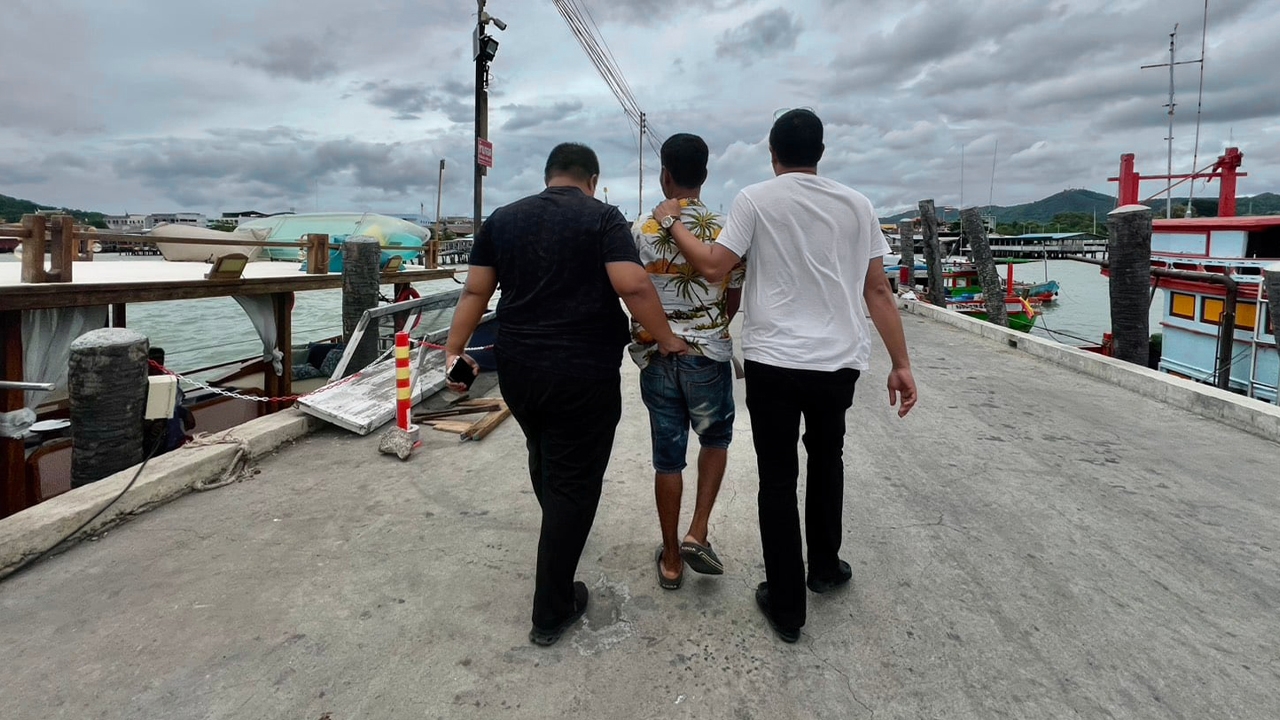
A Cambodian broker was arrested for deceiving fellow nationals into forced labor on fishing boats, involving physical abuse, threats, and passport confiscation. He fled and hid in Chonburi province and is now being prosecuted on human trafficking charges.
On 20 August, Chonburi Immigration Office officials arrested a Cambodian suspect on human trafficking charges in Sattahip district, Chonburi province, Thailand. Run, a Cambodian national, was apprehended following coordination between Thai police, Interpol, Cambodian authorities, and the International Justice Mission (IJM). The suspect had been fleeing between Cambodia and Thailand for several years after an arrest warrant was issued in Cambodia for human trafficking.
He was also listed on a recent Interpol red notice. The arrest followed information from IJM that the suspect was hiding in Sattahip district, Chonburi. Officers from the Provincial Police Division and Chonburi Immigration began surveillance and investigation, eventually locating the suspect working on a fishing boat near the Sattahip fishing port and successfully apprehending him.
According to victim testimonies and investigations, between 2018 and 2019, Run and his associates were accused of recruiting workers from several Cambodian provinces, including Kampong Thom, Kampong Speu, Siem Reap, and Prey Veng, to work in Thailand's fishing industry. They promised monthly wages around 12,000 baht, reasonable working hours, food, medical care, and travel documents. Survivors reported that after crossing the Poipet border into Thailand, they were sent to work on fishing boats and exploited in many ways.

These abuses included excessive working hours, insufficient food, physical and psychological abuse, passport confiscation, restricted freedom of movement, and wage deductions. These allegations led Cambodian authorities to issue an arrest warrant for Run on human trafficking charges. Some workers escaped when the boats docked and eventually returned to Cambodia, where their testimonies aided investigations and prosecutions. IJM assisted Thai police in tracking the suspect in Thailand, supporting cross-border coordination that resulted in the arrest.
Andrew Wasuwong, Executive Director of IJM, stated, "Human traffickers often use borders to evade justice. This arrest shows what is possible when victims come forward and Cambodian and Thai authorities collaborate to hold traffickers accountable." After the arrest, Thai officials began revoking the suspect’s visa and coordinating his extradition to Cambodia, where he is expected to face human trafficking charges.