

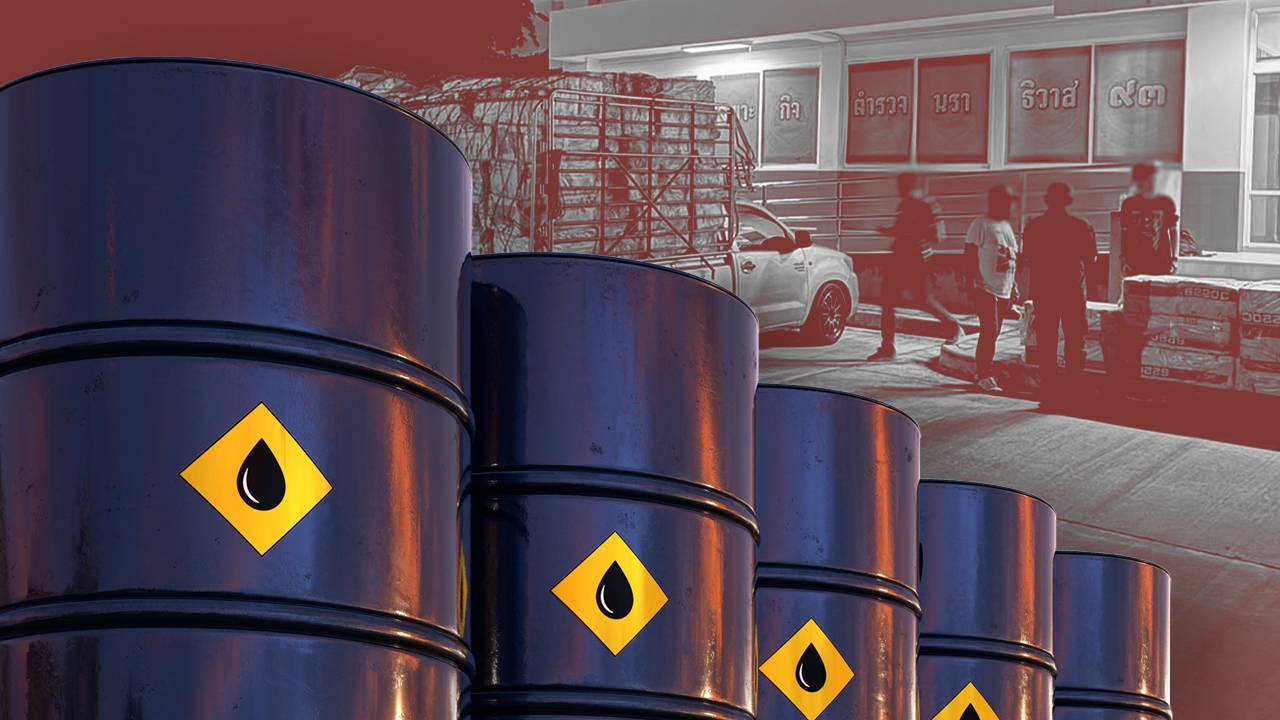
This report exposes the deep operations of illicit fuel and drug trafficking across borders, focusing on transshipment routes in the Gulf of Thailand, the 'border ant' smuggling networks, and reveals decisive measures to cut off supply lines in the southern border areas.
Following unrest on 22–23 Aug 2023 in the three southern border provinces, where insurgents attacked government and private properties causing significant damage, the Fourth Army Commander confirmed that one cause was the crackdown on smuggling of illicit goods brought in from neighboring countries, which may be linked to drug trafficking networks.
Thairath Online's special task team interviewed sources in the three southern border provinces about smuggling activities. They revealed that illicit goods and drugs are smuggled into these provinces, with the main items being fuel oil and palm oil.
The smuggling of "palm oil" occurs because Malaysia has greater palm oil production capacity than Thailand, resulting in lower prices there. This encourages importing palm oil into Thailand, which lowers domestic prices.
Additionally, smuggling includes illicit cigarettes and consumer goods such as toothpaste, soap, and diapers from Malaysia, all brought in without paying taxes.

1. The Gulf of Thailand maritime route.
Large-scale fuel transport does not use normal channels but instead employs large oil transshipment vessels operating offshore. Smaller boats or specially modified fishing boats then transfer the fuel inland. Some of these goods are transported ashore as far as Surat Thani province because the Gulf's ports near Hat Yai or Nakhon Si Thammarat lack facilities suitable for offloading.
2. The Narathiwat border route.
Narathiwat's border includes small rivers, crossed in less than five minutes by small boats. This "border ant" method is the main continuous smuggling route for illicit fuel and other goods.
These networks have operated for a long time, supported by local influential groups who manage local protection and pay benefits to residents. However, when conflicts over interests arise or new management takes over, these operations become exposed and are subject to arrests.

Drugs come from Laos through northern and northeastern regions, gathered in Nonthaburi province, then transported south for export to Malaysia. Methamphetamine is especially exported since Thailand does not produce it domestically.

On 13 Aug 2023, law enforcement acted against a drug network in Yarang district, Pattani province, arresting three suspects and seizing 2,452,680 illicit cigarettes, three firearms, and 8,759,000 baht in cash. These funds are believed to support insurgent groups financially.
Moreover, the "90-Day Drug Eradication" operation in the three southern border provinces and four districts in Songkhla province resulted in 972 cases prosecuted, 993 arrests, and seizures of over 981,638 methamphetamine tablets, 235 grams of crystal meth, and 422 grams of heroin. This represents a firm effort to sever the dark financial networks sustaining insurgent activities in the region.
