

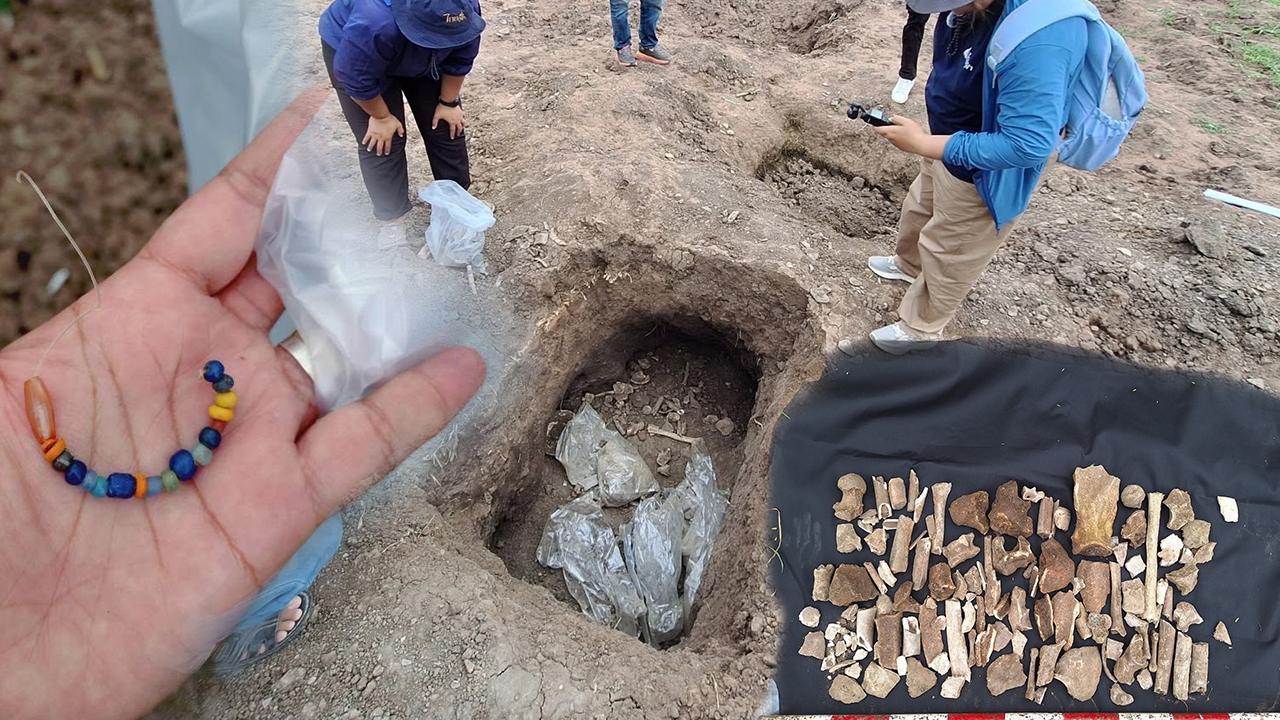
More than 200 illegal excavation holes were dug by thieves at the Ban Nong Pla Lai archaeological site in Phetchabun Province, near Sri Thep Historical Park. They were found to have set up camps to sift soil for colored stone beads and smashed human skeletons. An academic expert pointed out that budget weaknesses mean archaeological sites nationwide are not fully protected, emphasizing that destroying archaeological evidence is equivalent to destroying community stories.
On 25 Aug 2026 GMT+7, Sri Thep Historical Park under the Fine Arts Department received a report of unauthorized digging for antiquities at Ban Nong Pla Lai, Wang Yai Subdistrict, Wichian Buri District, Phetchabun Province. The site had previously been archaeologically surveyed in 2011 and identified as a large mound near a stream called Khlong Kasang, with evidence of prehistoric human burials.

According to the Fine Arts Office Region 4 in Lopburi, the Ban Nong Pla Lai archaeological site was surveyed in 2011, characterized as a large mound adjacent to Khlong Kasang stream. Evidence showed it was a prehistoric human burial site. Later, multiple individuals illegally excavated the site seeking beads for sale. Upon inspection, at least 200 holes of varying sizes were found, and the condition of human and animal skeletons was disrespectfully disturbed.
There were also signs of camps organized as a group, which is disheartening. While we may recover some items, what is lost is the archaeological context—information about whether animals were buried with the dead, the arrangement of beads, what items were buried with the deceased, diseases, age, identity, and dating of the burials—all of which we can no longer determine.

Excavated archaeological remnants left by the looters include shards of earthenware, human and animal bones—including elephant bones, which is notable since elephants have also been found in the Sri Thep area. However, the burial style remains unknown. We also found bronze and iron tools, glass beads, and interestingly, iron slag—remnants from iron smelting. Reports indicate that 20 years ago, similar furnace remains and abundant slag were found nearby. This suggests Ban Nong Pla Lai residents had ironworking technology, which could be further studied to trace iron sources, uses, and distribution.
The Thairath Online special task team interviewed Mr. Sarawut Saithong, Permanent Secretary of Wang Yai Subdistrict Administrative Organization, about the incident. After learning of the illegal excavations at Ban Nong Pla Lai, the local administration initially put up signs forbidding outsiders from treasure hunting and asked village heads to monitor the area closely, investigating any unfamiliar vehicles entering immediately.
After inspection, human skeletons, ancient earthenware pots, bronze tools, and beads were found inside burial holes.
Damage assessments are pending reports from Sri Thep Historical Park, which will coordinate with the Fine Arts Office Region 4 in Lopburi. Wang Yai Subdistrict Administrative Organization will then determine further actions to prevent future unauthorized treasure digging on the site.

Sri Thep Historical Park has filed a police report regarding trespassing and illegal artifact digging, although how the perpetrators accessed the site remains unknown.
Preliminary investigations suggest that the illegal digging was aimed at retrieving beads for sale in markets, as beads hold significant value. While exact prices remain unknown, it is believed that buyers knowledgeable about antiquities may have placed orders. Authorities are currently interviewing individuals involved in previous excavations to determine bead values by color and type.
It was also found that soil from each dug hole was bagged and taken to a nearby stream for sifting. At the stream, green tarps and piles of sifted soil were observed, indicating ongoing bead extraction efforts.
Mr. Sarawut revealed that the area was previously excavated about 20 years ago at two spots, with uniform hole sizes of about one by two meters. However, current inspections found holes of varying depths and irregular shapes, lacking systematic organization.
The land is owned by farmers who leased it to locals for growing sugarcane and cassava. Now, since no one is farming, the land has become overgrown with acacia shrubs. The landowners were unaware of the antiquities beneath but had been approached by investors seeking permission to excavate.

Thairath Online's special task team further consulted Dr. Thanongsak Hanwong, an independent archaeology scholar, about the reasons behind bead digging.
Digging for beads has long been practiced by antiquities traders, originating from U Thong District in Suphanburi Province. Prehistoric and Dvaravati archaeological sites often yield ornamental items buried with the dead 2,000–3,000 years ago. These valuables are in demand and fetch good prices. After depleting sites in central Thailand, treasure hunters have spread to other archaeological sites nationwide, setting up camps where government authorities have limited access or oversight, sometimes staying for months until burial sites are found.
The market value depends on bead type. Common glass beads are small, in blue, yellow, or orange, while upgraded stones like serpentine or black-and-white patterned stones are popular as personal ornaments. Prices range from one to two thousand baht per piece but vary by bead size.

This behavior peaked 30–40 years ago when treasure hunting groups from U Thong became large and disseminated excavation knowledge to villagers across northeastern, northern, upper central, and lower northern Thailand—from Nakhon Sawan to Lopburi—resulting in archaeological sites being dug extensively, connecting holes like underground tunnels.
Thailand has many archaeological sites on mounds near waterways, often overgrown and abandoned. Although the Fine Arts Department records all sites, limited budgets and staff prevent comprehensive protection.
Moreover, many historic sites are privately owned. In the past, there was no agreement between the Department of Lands and the Fine Arts Department to delineate historic zones. Consequently, when villagers applied for land titles, the Department of Lands issued rights on these overgrown mounds, which are less visibly obvious than large temples or pagodas. These mounds are difficult to register officially and lack 24-hour surveillance, making them vulnerable to frequent illicit artifact excavations.

Regarding site access, Dr. Thanongsak recounted that in 1987, the former Fine Arts Department Director-General, Mr. Thawisak Senanarong, proposed publishing a comprehensive book listing archaeological sites nationwide. However, the proposal was rejected in meetings, as it was seen as providing treasure maps to illegal diggers.
Currently, metal detectors and stone-finding devices have become affordable, costing only a few thousand baht and widely available, unlike the past when only military units used such equipment for bomb detection. This has facilitated easier illegal digging, as seen in the case of the ancient drum discovered at Don Yai Thong, which was initially looted and sold but later returned to the Fine Arts Department upon recognition of its importance. Similar patterns appear at Ban Nong Pla Lai.

Dr. Thanongsak shared from past experience that arrests are difficult because illegal diggers often use radios to eavesdrop on police and escape. Continuous monitoring is challenging due to the Fine Arts Department's heavy workload overseeing World Heritage sites. On private land, these groups often negotiate with landowners, who may be unaware of the archaeological value beneath.
As an advocate for national antiquities recovery, Dr. Thanongsak emphasized that the most crucial step is educating communities. Illegal excavation destroys historical evidence and community narratives, which are essential for future local development and economic growth.

Communities must become aware and cooperate in protecting their heritage, no longer viewing it as a remote issue.
Meanwhile, authorities should engage communities by providing knowledge and involving locals as key protectors. At Ban Nong Pla Lai, the whistleblower was not the landowner but water well diggers who noticed suspicious activity. This gap highlights the community’s lack of awareness. If government and communities collaborate effectively, alerts from outsiders won’t be necessary, and locals will become the best guardians of their historical heritage.

Photos from the Facebook page of Sri Thep Historical Park, Fine Arts Department.