

Final phase of the 2026 military reshuffle: the seat of the 4th Army Commander — a turning point or merely a delay tactic? Following a surge in southern unrest, we examine two factors changing the key players in the midst of battle.
The position of Commander of the 4th Army Area has never been just a military role. It serves as a measure of trust, skill, and power for those controlling the military in each era. In the current era, the 26th Class of the Armed Forces Academy holds consolidated power — with Army Commander General Pana Kluayplodtuk, Defence Minister Lieutenant General Adul Boonthamcharoen, as well as the Army Chief of Staff and Air Force Commander all from the same class. Yet this particular commander's seat is the only one rumored to change hands mid-conflict, while other army regions have clear signals from the Army Commander-in-Chief that no changes will be made during ongoing operations to ensure continuity.

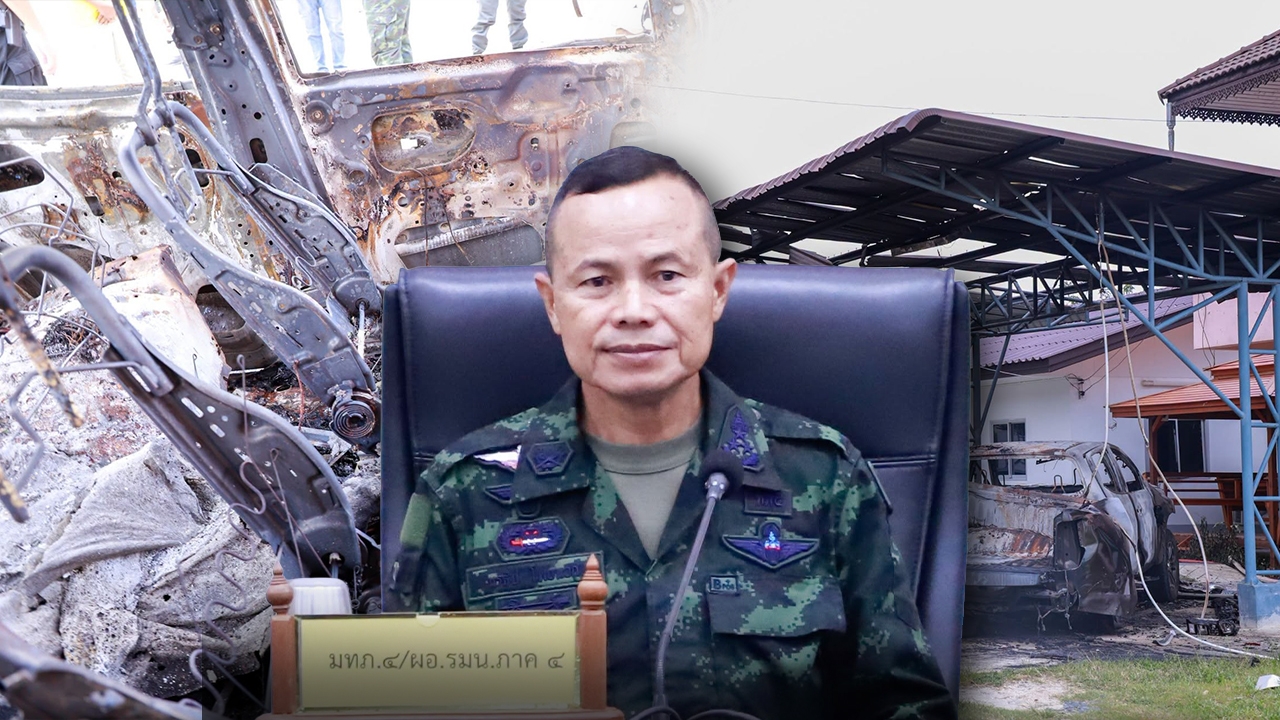
The story began on 1 October 2025, when Lieutenant General Narathip Phoinok, known as Big Yura, was appointed from his prior roles as Deputy Commander of the 2nd Army Area in the northeast, Commander of the 3rd Infantry Division, and commander of the Surasak Montri Task Force overseeing the Thai-Lao border, to become Commander of the 4th Army Area.
From the Army's perspective, this decision was a reorganization of power. Previously, the 4th Army Commander's position had been monopolized by an old faction for four consecutive commanders: Generals Pornsak Poolsawad, Kriangkrai Srirak, Santi Sakuntanak, and Lieutenant General Paisan Nusang. Lieutenant General Woradet Decharat, then Deputy Commander of the 4th Army and initially slated to be the next commander, was reassigned as Director of Coordination Center 3 of the Internal Security Operations Command (ISOC). However, locals viewed this as sending an outsider to control a battlefield that requires insiders. History has shown this formula rarely lasts long — from the "Thaksin" era sending General Songkit Chakkabat down for only six months, to the "Big Tu" era with General Walit Rojanaphakdee appointed as 4th Army Commander to fill in for the 1st Army Commander, only to be recalled within half a year.
When the commander from the northeast arrived in the south, fortune did not favor him. Major violent incidents occurred consecutively, perceived as a trial for the new commander. This was followed by the controversy over the shooting of MP Kamonsak Leewamoh, where the commander's remarks ended with an apology but left activists closely monitoring the case unsatisfied. Then came the sensitive issue involving Islamic boarding schools (pondok), forcing Lieutenant General Narathip to publicly apologize and admit that the communication may have upset many parties. The situation culminated in an unprecedented test: severe flooding in Hat Yai, Songkhla Province. Although public attention focused on local authorities and the government, as the commander overseeing 14 southern provinces, the 4th Army was questioned for a delayed response, leading the government to appoint the Supreme Commander, General Ugris Boontanont, to lead the frontline operations center personally.

Interestingly, Lieutenant General Narathip was not isolated. His entire support circle comprises the 26th Class, including Lieutenant General Adul Boonthamcharoen, Defence Minister, who declared a shared mission within the same class, and General Pana, who has visited the southern border several times to encourage his classmates.
Also supporting him are Army Deputy Chief of Staff General Natthapong Praekaew, appointed as Secretary to the government's special representative for southern border problem-solving, and Army Chief of Staff General Chaipruk Duangprapat, designated as the new Secretary-General of the National Security Council to directly address southern unrest. This represents consolidated control. However, local outcomes have been contrary: security reports note an increase in insurgents, especially among younger generations, while elderly collaborators have distanced themselves out of fear and skepticism about sustainable solutions. Violence continues daily despite reinforcements from the 1st and 3rd Army Areas sent per the Army Commander's orders.
This raises the question: why are there no change rumors in other army areas, yet the 4th Army faces daily speculation? The answer lies in the tradition of this position. Usually, the 4th Army Commander remains until retirement or at least six months prior, as this is preferable to holding a ceremonial four-star general title as a special advisor. Lieutenant General Narathip is set to retire in October 2027. He was expected to be promoted to General in the October 2026 reshuffle, but rumors suggest he wishes to continue, citing the need for continuity in the 4th Army Front's ISOC operations.

His desire to stay blocks opportunities for two groups. The first is Lieutenant General Nithi Tinsulanonda, commander of the 4th Army Corps and fellow 26th Class alumnus, a true local who has served in the south since his early military career and is the grandson of General Prem Tinsulanonda. His appointment as 4th Army Commander would mark a historic moment for his family.
The second group is Major General Chakrit Ucharattan, or "Deputy Kiew," Deputy Commander of the 4th Army and a leader of the 28th Class. He rose through special operations units, formerly commanding the 1st Special Operations Division, and has long been considered for southern command. Currently, he heads the Peace Operations Center and serves as spokesperson for the 4th Army Front's ISOC. Multiple media outlets have reported that the Defense Council plans to promote Chakrit to Commander of the 4th Army to quell southern unrest. This excludes Major General Yod-arw Phoengpat, Deputy Commander of the 1st Army Area, who leads the Narathiwat Task Force and has a multi-million baht bounty on his head due to his tough stance against the BRN group; his one-year term ends this October.
Thus, the news about changing the 4th Army Commander is more than just a reshuffle; it reflects a larger internal conflict. It is a power struggle among the 26th, 27th, and 28th Classes, and even within the 26th Class itself, deciding whether to keep Commander Yura to save face for the Army Chief, promote him once in his career, or skip a generation to appoint Deputy Kiew, a more combative figure.

Ultimately, whether Lieutenant General Narathip continues or is replaced, the question of whether this is a turning point or just a delay tactic remains valid. If it is merely to buy time, a change will inevitably occur in April 2027. But if there is a real intention to change, this is the only chance for the Army Chief — one of the most powerful leaders in years — to decide whether to stick with the principle of not changing commanders mid-conflict, even though the current commander has been off track from the start, or to change commanders to signal to the 14 southern provinces that the military understands the southern border is not just a defensive task but requires a commander with genuine local insight to lead.
Currently, the list of candidates is under review and expected to be submitted for royal approval by mid-September 2026.