

A deep dive into why "Thailand" has become a haven for transnational criminals, pointing to its position on a gray border, supportive transport and financial systems, and revealing daily losses soaring to 51 million baht. Urgent actions to dismantle money mule networks and five key online protection principles are recommended.
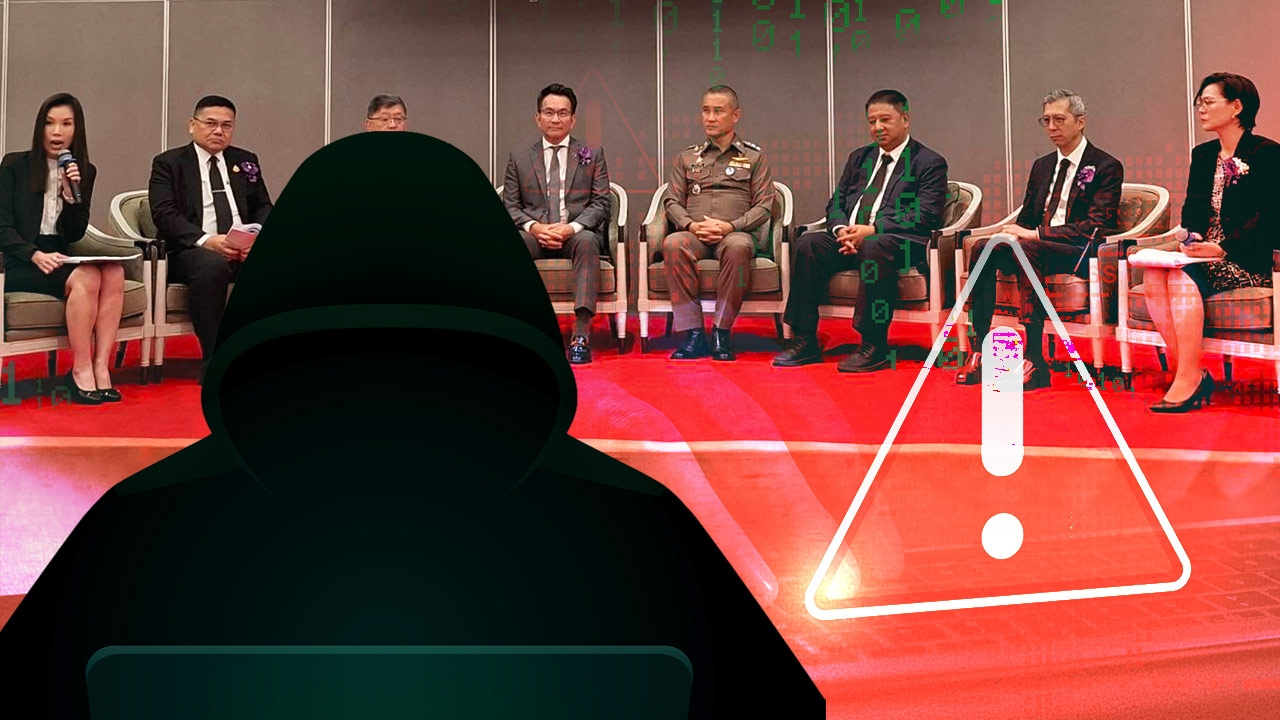
On 2 Sep 2026, the Criminal Court held an academic seminar titled "The Justice Process and the Protection of Citizens from Online Threats." From 9:30 a.m. to 12:00 p.m. at The Emerald Hotel, Bangkok, under a project promoting cooperation in justice to connect the work of the courts with relevant agencies. The key goal was to equip the public with awareness to avoid becoming victims, offer ways to stop losses during critical moments, and provide in-depth guidance on online reporting procedures, legal prosecution, and coordination to improve chances of recovering funds.
The seminar featured six distinguished experts and speakers: Mr. Patchara Anantasillapakul, Permanent Secretary of the Ministry of Digital Economy and Society; Mr. Thepsu Bowornchotidara, Secretary-General of the Anti-Money Laundering Office (AMLO); Police Lieutenant General Jiraphop Puridej, Assistant Commissioner of the Royal Thai Police; Mr. Chawrong Limpapatpanee, Chairman of the National Press Council; Dr. Piti Tandakesem, Board Member of the Thai Bankers' Association; and Mr. Ratthawit Ariyaphatphon, Presiding Judge of the Technology Crime Division at the Criminal Court.

According to the latest 2026 report from the United Nations Office on Drugs and Crime (UNODC), losses from online fraud across East Asia, Southeast Asia, and Oceania in 2025 are estimated between 88.3 and 114.1 billion dollars. Fraud networks span at least 80 countries with communication channels linking Southeast Asian nations. Currently, efforts are underway to expand operations into Europe and North America.
Dr. Piti Tandakesem, Board Member of the Thai Bankers' Association, revealed that Thailand might be the only country globally where transnational criminals thrive best. Surrounded by politically unstable neighbors, Thailand serves as a base for these criminals. Positioned centrally on a gray border, it is open to tourism and entry, with policies like 30-day visas that facilitate easy travel. It acts as a logistics hub with an open visa system.
Additionally, Thailand's financial system is open and benefits from digital finance. Its laws allow the purchase and free cross-border movement of gold without import-export taxes. Gold shops can legally accept cash payments. Foreign currency notes can be exchanged without limits at exchange booths for foreigners. The Bank of Thailand's governor is aware of these issues and is working on reforms. Furthermore, cryptocurrency is liberalized, allowing unlimited money transfers.
Therefore, if criminals choose any country or region to establish operations for defrauding people, Thailand is a paradise. Money laundering is easy, laws are either unenforced or limited, digital financial systems are advantageous, and geographically it is open. Law enforcement and regulations often fail to reach these operations, creating an ideal environment for criminals.

Dr. Piti Tandakesem added that in the past, banks could not refuse account openings, suspend accounts, or control transfer frequencies and amounts due to lack of legal frameworks. This made Thailand's financial system a free gun zone. Now, banks have tightened controls on new accounts and set transfer limits via apps tailored to each customer's profile (Customer Profiling).
Regarding money mule accounts, without them criminals cannot operate because they have no channels to transfer money. After banks tightened new account openings, criminals shifted to buying old mule accounts. When buying accounts became illegal, they evolved into renting accounts at high daily rates, sometimes tens of thousands of baht. They also selectively buy accounts that allow large transfers to avoid Customer Profiling.
Out of 154 million bank accounts nationwide, only 0.2% are money mule accounts. However, if this 0.2% uses social media to pressure the government to drop strict measures, we risk losing ground to transnational criminals skilled at leveraging social pressure to hinder justice processes.
Furthermore, Thailand's penalties for opening mule accounts and colluding in criminal networks currently include temporary account freezes or imprisonment of up to 3 years (with fines up to 300,000 baht) for account owners. Those supplying or advertising mule accounts face 2-5 years imprisonment (fines 200,000-500,000 baht), and accomplices can face 1-10 years imprisonment (fines 20,000-200,000 baht). Compared internationally, these penalties remain too lenient.

. Police Lieutenant General Jiraphop Puridej, Assistant Commissioner of the Royal Thai Police, sees online threats as a top and major problem in Thailand. The Anti Cyber Scam Center (ACSC) was established to manage this issue. Since its inception, from October 2025 to August 2026, there have been 318,886 reported cases totaling 17.342 billion baht in damages. The average daily reports reached 952 cases, with average daily losses of 51.8 million baht.
The types of cases reported in August 2026 were as follows:
1. Fraudulent goods and services: 20,756 cases (74.6%)
2. Fraud by impersonation: 2,017 cases (7.3%)
3. Fraudulent offers of benefits: 1,713 cases (6.2%)
4. Employment fraud: 1,567 cases (5.6%)
5. Financial and investment fraud: 734 cases (2.6%)
6. Proactive technical attacks: 146 cases (0.5%)
Simple guidelines the public should remember to avoid falling victim to online criminals are:
1. Do not rush—stay calm and think carefully before deciding when pressured or rushed.
2. Do not trust—never trust people you have never met or do not know; they may be criminals.
3. Do not transfer money—criminals want your money most; never transfer funds even if told it is for verification.
4. Do not click links—beware of fake links and pop-up warnings; they may be malware controlling your phone or stealing data.
5. Do not share passwords—never disclose personal passwords, OTP codes, or personal information to unknown persons via phone, social media, or any channel.
If you realize you have been scammed, you can report through the following channels: