

Faith encroaches on over 1,000 rai of Sor Por Kor forest land in Saraburi at the Pa Chana Jai meditation center. Local village heads express hope to restore the forest for communal benefit.
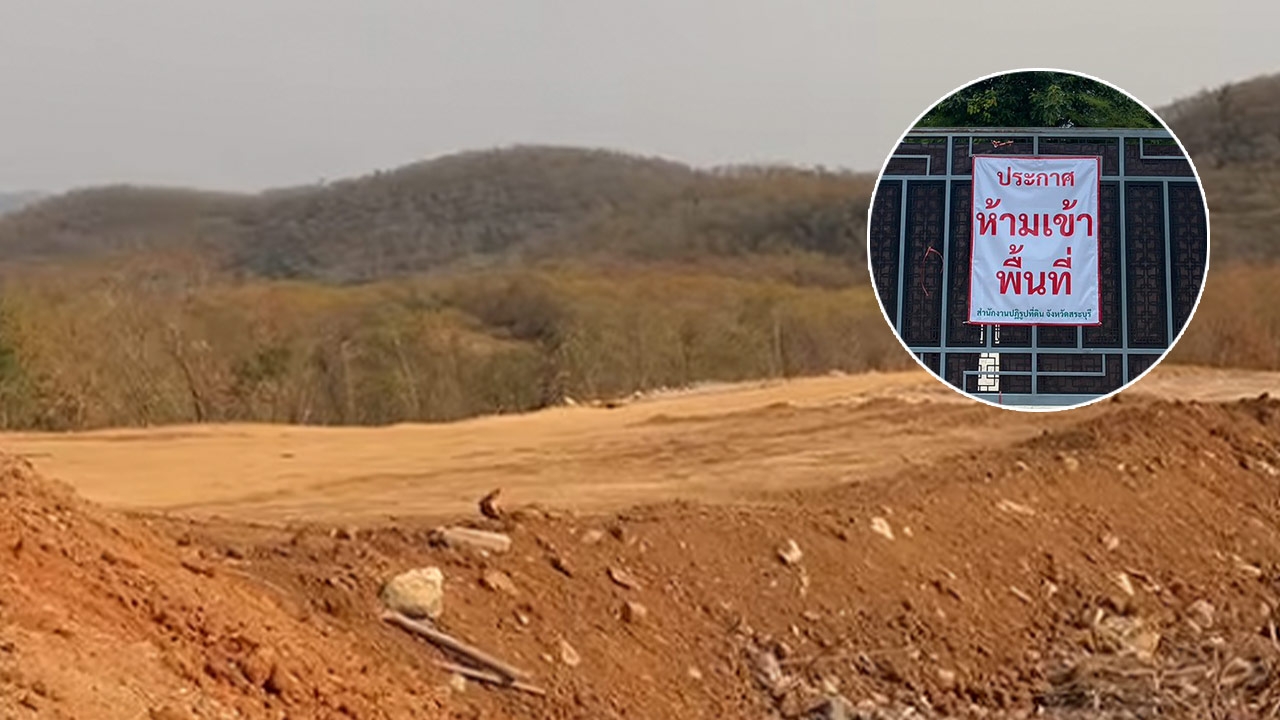
Six months after officials investigated the Pa Chana Jai meditation center in Nong Yang Suea subdistrict, Muak Lek district, Saraburi, they found encroachment on more than 1,000 rai of Sor Por Kor land. The area behind the meditation center on a mountain is planned for construction of a large Buddha statue at the summit. Below, a high cliff offers panoramic views, with potential to become a major tourist attraction. Following the investigation, Sor Por Kor took control of the land to prevent further use.
At the road leading up to "Pha Chana Jai" where the large Buddha statue was to be built, a fence was installed and the area declared under Sor Por Kor control, preventing the meditation center from accessing or using the land.

After six months, the news team’s four-wheel-drive cautiously drove along the dirt road, now increasingly overgrown with grass and trees along both sides. Upon reaching the hilltop, where the area had been cleared as a wide open space for building the large Buddha statue, grass has since grown thickly, obscuring any sign of the original clearing.
On 7 Aug 2026 GMT+7, the National Anti-Corruption Commission (NACC) and related agencies inspected the site to enforce laws regarding Pa Chana Jai's encroachment on agricultural reform land in Saraburi. Originally, this land was part of the Thap Kwang Reserved Forest, Muak Lek Forest, and Lam Phaya Klang Forest. A 1982 ministerial regulation revoked its reserved status, reclassifying it under the 1977 Agricultural Land Reform Act, with a 1990 Ministry of Interior announcement defining Muak Lek and Wang Muang districts as part of Sor Por Kor land totaling approximately 150,000 rai.
During meetings and site inspections, it was found that illegal forest encroachment and unauthorized soil excavation occurred in the Tha Rit, Lam Thong Lang, and Lam Phaya Klang forest areas. Sor Por Kor conducted surveys and preliminary land classification, totaling about 1,200 rai. The meditation center had built structures and altered the terrain in three locations: Pa Chana Jai Temple, Ariya Village, and the forest area atop Pha Chana Jai. Some of this land had been allocated to qualified individuals, but they donated it to the temple or foundation; the qualifications of these donors are currently under review.

The Thairath Online special team interviewed Adul Wangkusan, village head of Moo 10, Wang Muang subdistrict, Saraburi. He explained and showed the encroached forest area. Originally, the land belonged to an uncle who later returned to his hometown, passing it to villagers, who then sold it verbally without formal legal documents to the temple. Villagers sold about 100 rai of land to the temple. The temple wanted to buy land for an entrance road, but prices were high, so it built an entrance from the opposite side of Pha Chana Jai instead. Beyond the forest is the route to Wang Muang, Tha Luang, and Lam Narai districts. The land there isn't one large plot but consists of small valleys totaling about 100 rai, ranging from 8 to 80 rai each. After buying these flat areas, the temple reportedly claimed about 1,000 rai of surrounding valleys as its own and used excavators to block villagers’ original access roads to prevent outside interference or inspection.

The village head took the news team into the nearby forest and showed a deep pond that had dried up. He said the temple dug a pond over 3 meters deep without permission from the subdistrict administrative organization, violating local laws. The subdistrict measured the pond and initiated legal action, as it encroached on villagers’ farmland, which they had cultivated for years and paid local taxes on, though without formal Sor Por Kor titles. Most villagers’ land is deep in the forest and difficult to access; traditionally used for farming, charcoal burning, and natural reforestation. However, the temple brought machinery to dig, uproot, and destroy the area. Villagers and land tenants filed complaints with the provincial Damrongtham Center and the Office of Buddhism. Officials inspected and, two days after filing a police report, the Central Investigation Bureau personally led a crackdown.
By law, Sor Por Kor land use is limited to 15 rai per person. Because monks face many legal restrictions, the temple used a nun’s name to apply for land to circumvent these laws. They planned to build a large Buddha statue on Pha Chana Jai, surrounding it with monk residences to livestream the scenic mountain views, creating sympathy stories to attract massive donations. Their fundraising involved dividing monk residences into plots and selling them to nuns or outsiders seeking meditation spaces, resembling a real estate business. The scandal became public due to internal conflicts over profit sharing within the temple.

The village head admitted signing over only 9 rai of villagers’ land under a nun’s name. Villagers claimed their Sor Por Kor documents were lost and applied for new ones. The temple’s claim of owning 13 rai or over a thousand rai lacks legal documentation. Although the temple alleged it held community meetings to establish the temple, the village head confirmed no such meetings occurred locally. The temple tried to recruit outsiders to claim participation in a royal forest restoration project, proposing monks oversee it to disguise construction of buildings or huts on the mountain. The village head refused to approve and reported the temple distributing gifts to villagers while deceptively collecting their ID cards to forge fake community meeting documents.
He stressed no personal bias against monks or temples who live simply and do not cut trees or encroach on forests. His objection is to using religion as a pretext to destroy nature, cut down trees, damage forests, and break laws. Forest restoration requires no government budget as nature can heal itself.
Currently, acacia trees are growing rapidly. He believes in one to two years the forest will be dense enough to prevent unauthorized access. The village head is collaborating with the district chief to promote turning the area into community forest, involving villagers in decision-making through community meetings. He urged the government to allocate farmland to genuinely poor villagers rather than letting it fall into the hands of the wealthy or powerful.

Kiattisak Puttaphan, Deputy Secretary-General of the NACC, explained there was a planned step-by-step scheme using Sor Por Kor land and protected watershed forest near the mountain summit (nearly 2,000 rai) for improper use by constructing a meditation center/temple on about 13 rai. They built roads, cut mountains, cut off electricity and water, and installed knock-down buildings systematically, resembling phased development rather than gradual temple construction. The Crime Suppression Division leads legal proceedings and is expediting damage assessments to prosecute in court.
NACC officials are investigating whether any government officers neglected duty or were complicit, conducting monthly follow-ups to expedite the case. They intend to propose government measures to resolve overlapping land issues, suggesting that if Sor Por Kor land cannot be used, it should be returned to the Forestry Department for watershed forest restoration. Opening a forest monastery requires community consent and a proper Environmental Impact Assessment (EIA) under law; unauthorized development is prohibited.
Land reform law expert Nakprat Jeekratok revealed that out of about 1,000 rai, approximately 100 rai have been altered with roads and excavations. A 13-rai fenced area and about 60 rai behind it are planned for the Ariya Village. Sor Por Kor previously allocated four small plots (totaling 4 rai) to farmers, who intended to donate rights to the temple, but formal approval is pending. The temple has not been formally surveyed for the over 1,000 rai on the mountaintop. The original request was for a small temple, which could have qualified, but later construction exceeded permitted scope without permission.
Currently, no monks remain, only nuns. The submitted land use documents are incomplete and lack community meeting reports showing local approval. Without community consent, Sor Por Kor will not approve. Officials, together with related agencies such as Forestry, have investigated and filed complaints. The police are gathering evidence, and since July have coordinated with the electricity authority to cut power. Sor Por Kor asserts transparent procedures with no shortcuts or favoritism, emphasizing that legally it cannot immediately seize or demolish structures but must follow due legal process, including denial of approval, eviction notices, or court orders for demolition.