

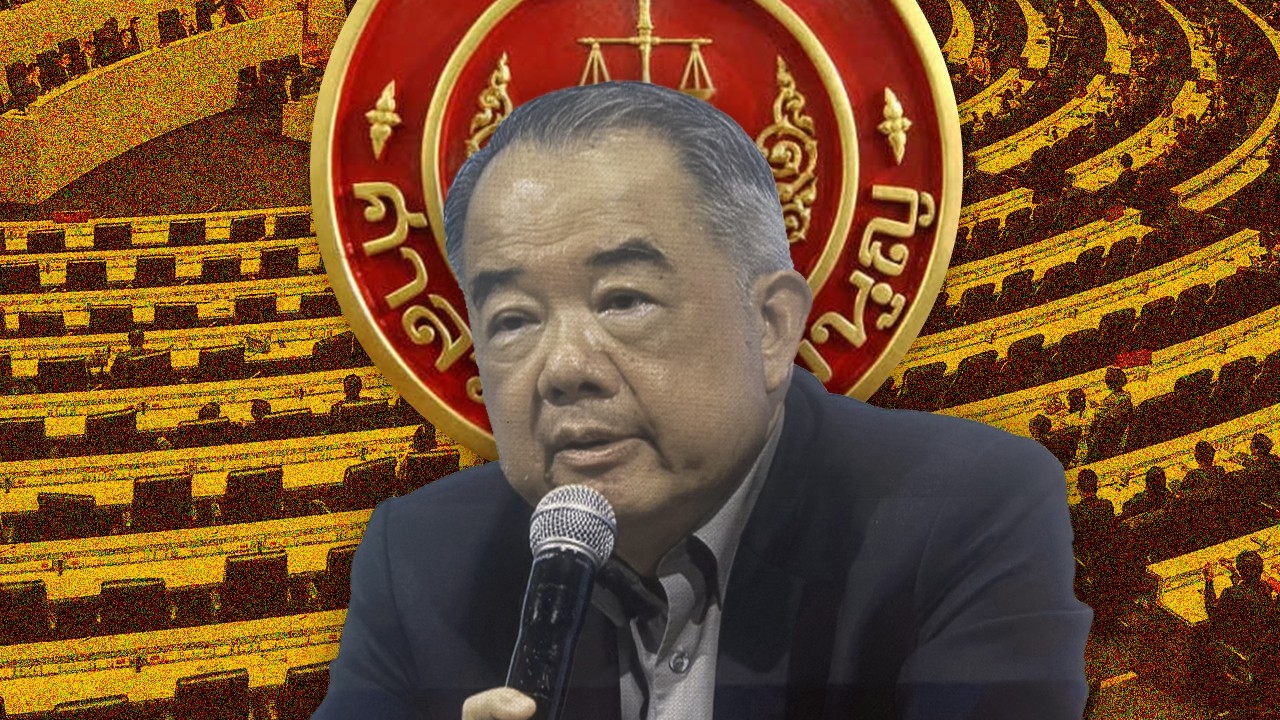
The former president of the Constitutional Court highlighted Thailand's political future as "unclear," comparing the 2017 Constitution to a house that is endlessly renovated and repeatedly torn down to be rebuilt. He noted that foreigners are confused by Thailand's political system and pointed out weaknesses in the parliamentary and Senate systems, which suffer from low legitimacy concerns.Tags: [Constitutional Court, Thai politics, political future, 2017 Constitution, political system, legitimacy, parliamentary system, Senate]
Professor Nakharin Mektrairat, former president of the Constitutional Court. He recently stepped down from the position in July and delivered a keynote speech at the 68th National Defence College (NDC) graduation ceremony, invited by Ajarn Ja Thanaporn Sriyangkul, one of the students in that class, on the topic. "Thai Politics and Society for the Future." Drawing on over 30 years of experience as a university professor and more than a decade working at the Constitutional Court, he offered insightful perspectives on the development, problems, and future of Thai politics.
Professor Nakharin traced Thai political history from 1932 to the present, emphasizing that Thailand has continuously redesigned its political system, especially since 1997. The country has had multiple constitutions, reflecting ongoing problems with the governance framework.
"We build a house but never settle on the structural design. The house is constantly renovated; if dissatisfied, we change the bathroom or the living room," Professor Nakharin analogized.
Additionally, the rise and fall of Thai governments have caused significant confusion among foreigners, particularly regarding the dissolution of political parties under Thai law, which is difficult to explain to foreign constitutional court presidents.
Regarding current structural problems, Professor Nakharin noted that the process of selecting officials for independent organizations changes frequently, causing confusion. Meanwhile, the exercise of power by the current parliament "has a low level of political legitimacy." Especially the selection of Senators, who are chosen internally through a system devised and used only domestically, with no prior precedent.
Regarding public administration, overlapping powers exist because each department is a legal entity with its own authority, leading to ambiguity between central and regional levels. Local administrative organizations are small and overly numerous, reducing their efficiency in handling large-scale public services.

The former Constitutional Court president reflected that Thailand’s past development has been driven mainly by the private sector, but society remains rife with conflict, income inequality, wealth concentration, and very high household debt, which will hamper long-term development. Social mobility is difficult and sometimes relies on "dark power."
Regarding the current direction and future of Thai politics, Professor Nakharin stated, "There is no clarity; it is as if driving on a road with no clear view ahead." Thai society continues to be driven and connected by "power" in various forms (raw power, money power, legal power, etc.), and society can only be stable if that power is legitimate in both origin and process.
Toward the end, Professor Nakharin addressed the political direction and stance on the constitution, stating that current Thai politics remains characterized by "maneuvering and contesting timing." Even if one side succeeds, it does not mean society will always accept it if the benefits do not reach the majority.
Regarding concerns about the new constitution becoming "deep blue," Professor Nakharin was clear: "The constitution must belong to everyone, not just one color. It does not matter how many colors the country is divided into, but the constitution must belong to all."
He concluded with an important lesson about drafting national rules: "Entrusting experts to write can sometimes lead the constitution off a cliff. The mistake of the 2017 drafting committee was the Senate system. If we do it this way, we must accept this fate."
He also advised the private sector on navigating this era: sometimes setbacks are inevitable, and growth sometimes depends on political power. The key is knowing how to choose. "Fight for what is worth fighting for, and accept what must be accepted." Because if one chooses to fight every battle, the business will not survive.