

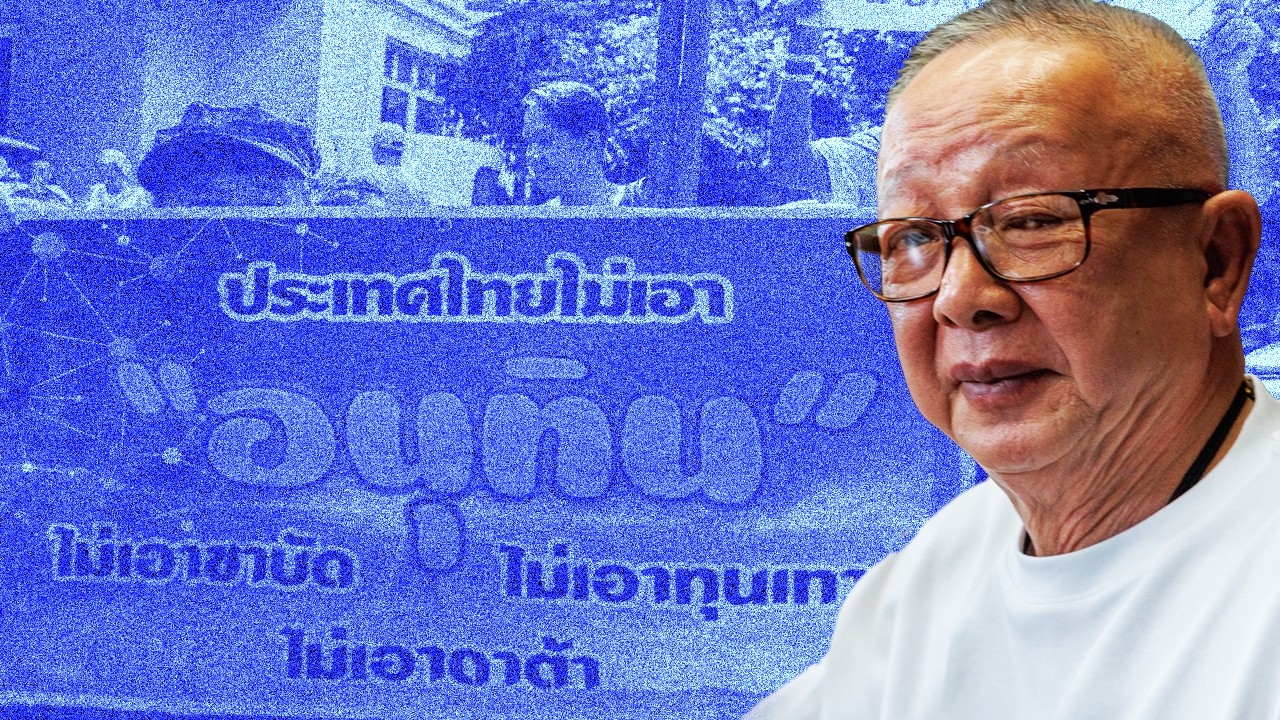
Sonthi's protest movement declares a mission to reclaim Thailand, pressing the Blue government to eliminate gray capital and protect the people's interests. Experts view the movement as unlikely to gain traction soon, as the issues are not yet ripe and the participant groups differ.
Today (7 Sep 2026 GMT+7) Mr. Sonthi Limthongkul former leader of the People's Alliance for Democracy, Mr. Nitithorn Lamlue also known as Lawyer Nok Kao, and Mr. Phichit Chaimongkol leader of the People's Student Network for Thailand Reform (PSTR) jointly held a press conference to launch a new movement under the concept "Take Back Our Thailand" at Ban Phra Athit, demanding a crackdown on foreign gray capital groups and protection of Thai interests.
Sonthi pointed out that this movement was sparked by public dissatisfaction with foreign nationals and various gray capital groups of Chinese, Burmese, Jewish, Indian, and Russian origins who engage in illegal businesses and use Thais as "nominees." He also highlighted issues with the administration of Anutin's government, accusing it of supporting big capital groups and corruption, including cheating in local government official exams, vote-rigging cases for senators, the TH-AI Passport project, among others.
On 10 Sep, they plan to submit a protest letter to the Israeli Embassy in Thailand to express their stance and rally supporters from all sectors to acknowledge their demands. Sonthi stated he is unfazed by dismissive remarks calling the protest a 'saliva mob' and is ready to continue fighting even if he is alone. He confirmed they do not seek to overthrow the government but will exert pressure until it becomes uncomfortable.
"I'm willing to die to restore Thailand to its former state. Many belittle my protest as a 'saliva mob.' That's fine. Ask yourself if you have faith and belief. If you do, there is nothing to fear."

Thairath Online's special reporting team discussed this issue with Dr. Satithorn Thananitichot from the Faculty of Political Science, Chulalongkorn University. He believes that the issue of foreign gray capital may not yet attract large crowds compared to the rally of the "United Land Sovereignty Protection Group" on 28 June 2025 at Victory Monument, which had the same leaders—Lawyer Nok Kao and the PSTR group—and a large turnout. Although both share nationalist sentiments, the previous rally was clearer as a national conflict, especially regarding the Thai-Cambodia MOU, which the public viewed as a conflict of interest colluded by both governments. This time, the issue of
"Gray China" may not be as powerful in nationalist terms compared to Cambodia, since there remains a brotherly sense between the countries. The "Gray Jewish" issue might stir stronger feelings due to negative perceptions of Jewish people in Thailand, but this group is still small and has limited impact. When asked which issues could mobilize mass support, Dr. Satithorn said that all of Sonthi's raised points could ignite protests if they ripen, or if the government clearly prioritizes personal gain, neglects problem-solving, and faces no accountability mechanisms, forcing citizens onto the streets to oust it.

Currently, although the government is powerful, many believe there are still channels to handle issues. Legal cases like vote-rigging and exam cheating are ongoing. While not reaching top politicians, they could implicate lower-ranking politicians or senior civil servants such as directors general.
Furthermore, since the protest is to
"pressure the government" to perform better rather than to "oust it," many think street protests may not be necessary, as there are other ways to apply pressure. "The issues are not ripe for pressure on foreign gray capital. The government still has tools and can enact laws to manage this. For example, it could enforce stricter measures like those used against scammers, which might ease public anger because the government is responding."
Different Groups of Supporters

"different supporter groups." Those joining Sonthi might be the old People's Alliance group, which is now aged and may find participation difficult. Meanwhile, the People's Democratic Reform Committee (PDRC) leaders are now in the current government, and many protesters are voters of the Bhumjaithai Party in the latest election. "It's also acknowledged that Sonthi had influence during the 2006 PAD protests, but the more powerful protests that led to government overthrow were the 2014 PDRC protests, which did not have Sonthi as a leader but were led by the 'Uncle Kamnan' group. Today, many PDRC leaders are in government, and their supporters may still feel the government is theirs, so there is no rush to protest."
Meanwhile, voters for the Pheu Thai Party
would likely not join, nor would those of the People's Party, who want to oust the government but are unlikely to join Sonthi. Voters of the Kla Party mostly live in provinces, and even among Democrat Party voters in Bangkok, it is uncertain whether they would join. The planned rally on 10 Sep to submit a letter to the Israeli Embassy might not directly affect the government but will require appropriate handling due to international political sensitivities. Regarding a larger protest after 14 Sep, if the Election Commission decides not to cut or dismiss the vote-rigging case, Dr. Satithorn views that the dissatisfaction mainly lies within groups opposed to Sonthi.
Compared to Mr. Yingchip Atchanont, manager of iLaw, who plans a rally at the Art Gallery on 13 Sep to pressure the vote-rigging case, which might have more public resonance. "There is already public dissatisfaction over the vote-rigging issue, mostly expressed on social media. We will see how many join Mr. Yingchip’s rally on 13 Sep and whether it influences the Election Commission’s 14 Sep decision. If no one is prosecuted after that, the aftermath could resemble the post-2019 election protests."
