

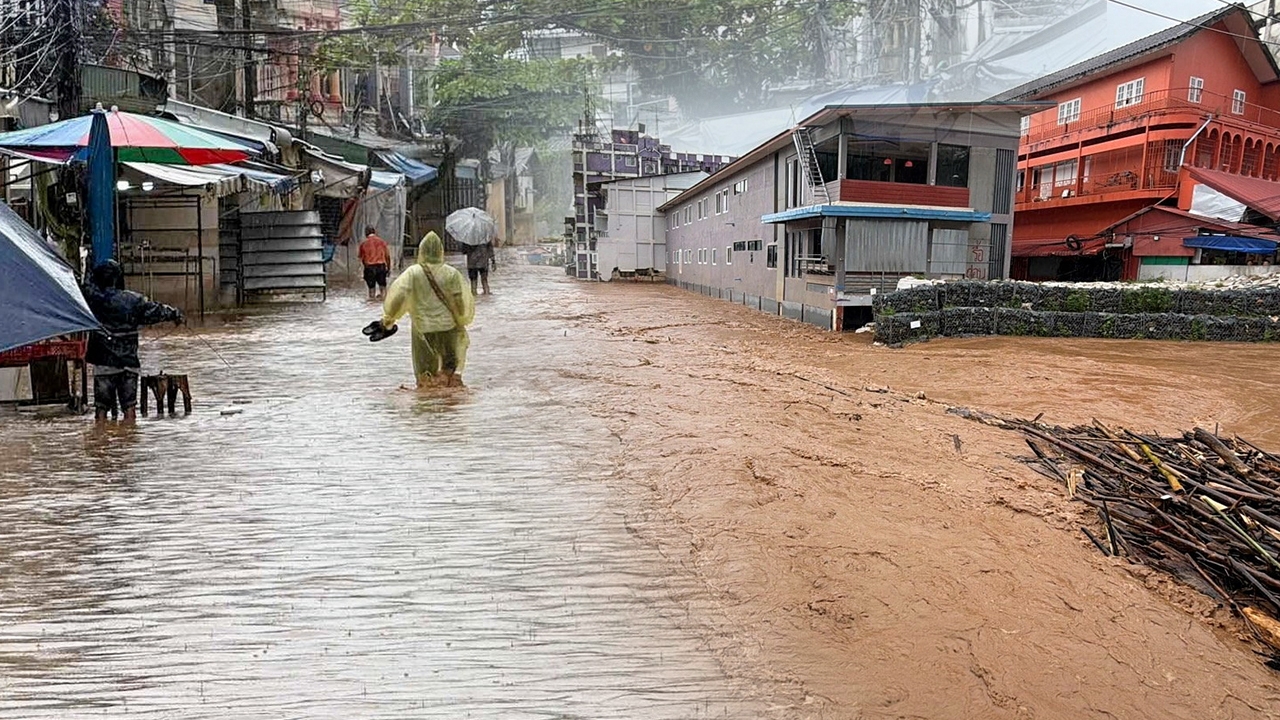
The monsoon is expected to return to northern Thailand from 17-20 September 2026, prompting flood watch along the Mae Sai River in Chiang Rai and in Nan Province, with possible landslides in some locations.
On the morning of 7 September 2026, water surged through a breached flood wall into the area around the Mae Sai Complex building in Mae Sai District, Chiang Rai. The Mae Sai Municipality deployed big bags to block water channels and strengthen defenses to slow the water flow and closely monitor water levels. Residents in the communities of Sailomjoy, Koh Sai, Mai Lung Kon, and Muang Daeng were alerted to move belongings to higher ground. By evening, water levels in Mae Sai began to decline steadily, while areas in northern Thailand remained under watch for possible landslides.

Thairath Online’s special news team discussed the situation with Mr. Thanaroj Warratprasert, Director of the National Water Command Center. He explained that heavy rain in the north resulted from a low-pressure trough passing over northern Thailand, Laos, and Myanmar, causing over 100 mm of rain near Jotada Village in Myanmar. This led to 60-80 mm of runoff between 8:00-9:00 a.m. at the Thai-Myanmar bridge, causing the flood wall on the Myanmar side to collapse and flood economic areas near Tha Lek in Myanmar.
On the Thai side, temporary sandbag reinforcements were used to contain the water, with inspections to ensure the sandbags remained sturdy and prevented flooding of nearby homes. The big bag barrier on the Thai side stands about 3 meters high. Parking vehicles behind the flood barrier remains risky, so residents were advised to move valuables to higher ground.
Regarding flood prevention, Mr. Thanaroj stated that protection is currently not feasible due to the absence of gates or water channels to divert flow elsewhere. Therefore, authorities rely on warnings and evacuation readiness. Besides Chiang Rai and Nan, Phayao Province has also been affected by recent heavy rains.
"At this time, we can only monitor because water from upstream Myanmar is flowing down and we lack a water management system. Monitoring and timely warnings are crucial," he said.

Mr. Thanaroj noted that from 9-15 September 2026, rain will shift south toward central Thailand and lessen before intensifying again in the north between 17-20 September. Areas of concern include Nan Province and the Mae Sai River basin, which frequently experience flash floods and possible landslides.
Information is being transmitted through the disaster warning system to provincial and district levels for drills and preparations at vulnerable spots in case rainfall exceeds 100 mm. The Meteorological Department forecasts over 200 mm of rain, which may affect areas along the Mae Sai River, requiring vigilance and evacuation readiness.
The Department of Public Works and Town & Country Planning has future plans to designate zones and relocate riverside communities away from flood-prone areas, as well as modify landscapes and land plots along the riverbank for usability after floods. Currently, land acquisition from local residents is underway to prepare for construction projects.
