

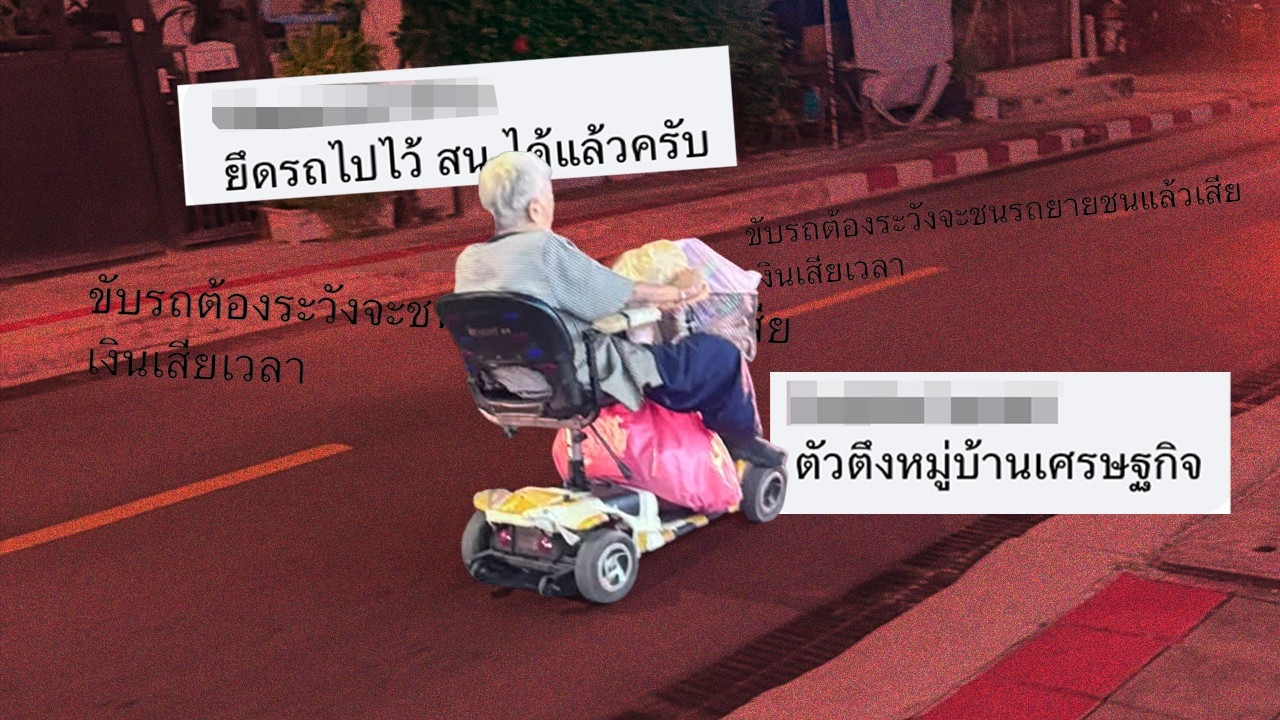
"Accelerating Inheritance" reveals the deeper story of a grandmother speedster living alone in the Bang Khae economic village neighborhood of Bangkok, facing the challenges of old age on public roads.
"Why let her out?/The family should keep her in/Police should arrest her/She even has a raincoat, so she must have intended to go out," commented some viewers on a clip showing an elderly woman driving an electric tricycle along public roads in the Bang Khae economic village in Bangkok. A week later, another clip appeared showing the grandmother wearing a raincoat, driving the electric tricycle in the rain among passing cars.
Electric tricycles for elderly people have become a promotional phrase for products sold online and in stores, even though the Department of Land Transport has yet to regulate them. These vehicles often cause accidents and leave drivers without legal protection.

Turning to the scene… the grandmother on the electric tricycle in the Bang Khae economic village. The "Thairath Online" special news team went on location to find her. The village roads wind through dense residential alleys; the community includes at least four schools, making the streets narrow and congested during dismissal times.
But this is no obstacle for the "speedster grandmother." The team asked residents in Economic Village Soi 3 and located her home in the middle of an alley — a two-story house surrounded by trees and a weathered yellow fence. Neighbors directed the team to a woman who cares for the grandmother near a nearby shop.
"Speedster Grandmother" is the nickname for Grandmother Daeng, 85, as told by "the woman caretaker" (name withheld) who looks after her. Although not related, she shared the grandmother’s story with the team. While many see her as a nuisance driving the electric tricycle on roads, the caretaker views her simply as "an elderly person."
Like many elderly people, the grandmother often drives her electric tricycle against traffic lanes, causing issues with other road users. Her body is frail; she cannot stand straight but leans forward. At home, she supports herself by holding onto stair rails.
Currently, she drives the electric tricycle about one to two times a week to buy fruit at the market because she enjoys eating fruit. For other groceries, she asks her caretaker to shop for her Monday through Friday.

Living alone as an elderly woman with no children at home, she rarely accepts visits from grandchildren. When they do come, she often scolds them, though it has eased recently. The grandchildren live far away and visit infrequently. Having lived a single life, she prefers to do things independently rather than rely on others.
Her solitary life and declining health shifted when electric tricycles arrived in Thailand. She decided to buy one with her own money, marking a turning point that led to meeting "the woman caretaker" who now helps her.

The caretaker said she first helped the grandmother when her previous electric tricycle broke down. The grandmother would push her wheelchair to the caretaker’s shop near the village roundabout to hail taxis to buy groceries or run errands in Bang Khae. But taxi drivers often refused to pick her up because she was in a wheelchair, making life difficult. Eventually, she bought a new electric tricycle to replace the old one.
Sometimes she drove the tricycle far from her home in the village to Khlong Khwang, where vegetarian restaurants are located, as she follows a vegetarian diet. Recently, since she asks her caretaker to buy groceries daily, she drives out less frequently.
Lately, she drives the electric tricycle out in the evenings to a market at the village entrance, several kilometers away.

Despite traffic laws on public roads, electric tricycles popular with seniors are often seen as nuisances. The grandmother is lucky to have medical benefits, but many other elderly people lack such support and face greater risks.
The caretaker recounted that earlier this year, while crossing a canal bridge on her electric tricycle, a car behind her likely didn’t see her and collided, flipping her vehicle. She fell onto the road but was fortunate not to fall into the canal.
She suffered serious injuries, including a broken rib on one side. Doctors advised natural healing. She also has a chronic lung condition and dislikes medical visits. As a retired railway employee, her medical costs are covered, and the driver who hit her paid partial damages. After months of recovery, she resumed driving the tricycle, showing no fear of accidents but using it daily to shop and socialize in the evenings.
Often she drives in the afternoon when students are leaving school. The caretaker advises her not to go out then, as traffic is heavy due to multiple schools nearby, and her presence only worsens congestion.
She is an elderly woman who doesn’t want others to do things for her, preferring to be independent. She offers small gifts when asking others to shop. Deep down, she is a kind person, though age causes occasional outbursts or complaints when outside. When told, she calms down. Some suspect mental health issues, but conversations show she understands everything.
She bought her electric tricycle herself when they first appeared in Thailand, costing about 40,000 baht. After a while, the battery wouldn’t charge, so she asked the caretaker to call a technician. After replacing the battery, she resumed normal use. Two to three years ago, she used to drive late at night, around 11 p.m. to midnight, to convenience stores for food, since she didn’t have someone to buy groceries for her then.
Due to age, communication with outsiders can be difficult. Once, she drove the tricycle into a group of men in the village after an argument. The caretaker had to intervene, telling her to stay inside to avoid serious injury.

The Ministry of Social Development once visited her home, but she insisted she has her own house and can care for herself. Although officials promised to provide support after another report, no government agency has offered substantial help.
Many believe electric tricycles should be regulated. The caretaker agrees, saying if a vehicle protection law existed, accident victims would have rights to free medical care. The grandmother is fortunate to have railway employee benefits, but many elderly in rural areas lack such protections and suffer more severely after accidents.
The Thairath Online team asked the caretaker to arrange an interview with the grandmother, but the reply was silence. The grandmother wishes to rest and live quietly alone.
In the Bang Khae economic village, as evening approaches, the two-lane roads fill with traffic and people move about. The elderly’s place on these public roads awaits those who will bring hope to their solitary final years—though the grandmother’s electric tricycle may be seen as a burden by some.